




Black Obsidian has a visual presence that is hard to mistake. Deep, dark, and often lustrous when polished, it seems to embody in its very appearance the intensity of the volcanic processes that gave rise to it. Used since prehistoric times to make cutting tools and ornamental objects, it has been adopted by various cultures and has found its way into the contemporary market for home décor, collecting, jewelry, and energy practices.
Although it is often referred to as a stone or crystal, there is a fundamental distinction: obsidian is not a mineral in the strict mineralogical sense. It is a natural volcanic glass, formed when silica-rich lava cools rapidly, preventing its components from having enough time to develop an organized crystalline structure.
This characteristic distinguishes Black Obsidian from crystalline minerals such as Quartz, Tourmaline, or Fluorite. Its structure is predominantly amorphous, but this does not diminish its geological importance. On the contrary: Obsidian serves as a direct record of specific volcanic conditions, magma composition, and extremely rapid cooling.
In the symbolic and crystal healing fields, its significance is also profound. Traditionally associated with protection, grounding, introspection, and the perception of hidden patterns, Black Obsidian holds a unique position among stones used in energy practices: its symbolism is linked not only to external protection but also to the conscious confrontation of what needs to be acknowledged and transformed.
What Is Black Obsidian?
From a geological standpoint, obsidian is a volcanic igneous rock with a glassy texture. It forms from magma with a high silica content and sufficient viscosity to prevent its components from organizing into crystals during cooling.
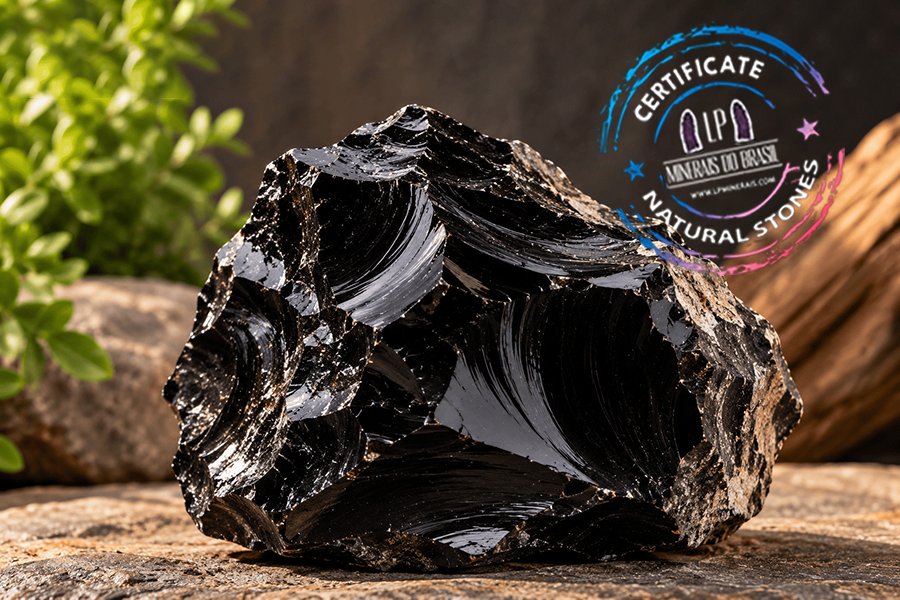
When this material reaches the surface and cools rapidly, it can solidify before significant crystallization occurs. The result is a mass similar to industrially produced glass, but entirely formed by natural processes.
This amorphous nature explains some of its most characteristic properties. Obsidian exhibits a conchoidal fracture, producing curved surfaces and extremely sharp edges when broken. This characteristic was decisive for its use by ancient populations in the manufacture of tools, arrowheads, and cutting instruments.
Among its main properties are:
- nature: natural volcanic glass;
- composition: predominantly rich in silica;
- structure: amorphous, with no true crystalline system;
- approximate hardness: 5 to 5.5 on the Mohs scale;
- luster: vitreous;
- fracture: strongly conchoidal;
- color: black to very dark brown, depending on composition and lighting;
- transparency: typically opaque in thick specimens, though it may exhibit translucency at thin edges.
The absence of a crystalline structure is particularly important. Classifying obsidian simply as “black crystal” may work in commercial or holistic terminology, but it does not accurately describe its mineralogical nature.
How is Black Obsidian formed?
The story of obsidian begins with magma. In certain volcanic environments, silica-rich magmas exhibit high viscosity. When this material is extruded and cooled rapidly enough, the atoms are unable to organize themselves into well-developed crystalline lattices.
It is this rapid solidification that produces the vitreous texture. Therefore, the formation of obsidian depends not only on its chemical composition but also on the cooling rate and the physical conditions of the volcanic environment.
Over geological time, volcanic glass is not necessarily stable forever. Obsidian can undergo devitrification processes, in which the glassy structure gradually develops microscopic mineral phases. This transformation helps explain why very old specimens may exhibit internal alterations and different textures.
Its origin is primarily associated with silica-rich volcanic contexts, including lava flows and domes. Thus, each occurrence is directly linked to the volcanic history of the region where it was formed.
Why is obsidian black?
Obsidian’s black appearance results from the interaction between its composition, glassy structure, and small amounts of different components present in the material. In thick masses, light absorption produces the characteristic deep black appearance.
However, obsidian that appears completely opaque may reveal brown, grayish, or slightly translucent tones when viewed along a thin edge under intense lighting. This is particularly helpful in understanding that “black” does not necessarily mean the absolute absence of light transmission.
There are also other commercial and geological varieties of obsidian, such as Snowflake Obsidian, Mahogany Obsidian, Golden Obsidian, and other varieties with specific optical effects or inclusions. Black Obsidian is distinguished precisely by the predominance of a relatively uniform dark appearance.
This visual simplicity is one of the reasons for its impact in design. When polished, it creates mirror-like black surfaces that contrast intensely with wood, metals, light-colored stones, and contemporary settings.
Genuine Black Obsidian: How to Identify It?
Obsidian’s popularity also calls for attention to authenticity. Because its appearance is vitreous by nature, artificial glass materials may be marketed as varieties of Obsidian, especially when they feature unusual colors or intense transparency.
Genuine Black Obsidian exhibits characteristics consistent with natural volcanic glass, including a glassy luster and conchoidal fracture. In rough pieces, fracture surfaces may reveal characteristic curves and sharply defined edges. In polished pieces, however, some of these features are less evident.
Bubbles, inclusions, and internal patterns must also be interpreted with caution. No single visual test is sufficient to authenticate all specimens, especially when dealing with higher-value pieces or materials marketed under unusual names.
A few points deserve attention:
- origin and provenance as stated by the supplier;
- consistency between appearance and the advertised commercial variety;
- how the material behaves under lighting;
- presence of characteristics typical of volcanic glass;
- absence of artificial colors incompatible with known natural varieties;
- gemological evaluation when there is significant doubt.
Responsible sourcing is especially important because correct identification adds value not only to the product but also to the relationship of trust between supplier, retailer, designer, collector, and consumer.
Black Obsidian in History: A Raw Material of Enormous Importance
Long before it was marketed as an ornamental or energy stone, obsidian held technological value. Its ability to produce extremely sharp edges allowed various peoples to use the material in the manufacture of tools, blades, points, and specialized objects.
In addition to its practical utility, it also circulated through ancient networks of exchange and trade. Since obsidian deposits are geographically linked to specific volcanic environments, materials from particular sources could travel great distances.
This characteristic has made obsidian particularly relevant to archaeology. The chemical composition of certain artifacts can help researchers link them to specific geological sources, making it possible to reconstruct trade routes and contacts between ancient communities.
In various cultures, its black, reflective surface has also taken on symbolic meanings. Mirrors and polished objects made from obsidian demonstrate that its use extended beyond that of a simple tool, taking on ceremonial, ornamental, and cultural dimensions.
Current applications: jewelry, home decor, and collecting
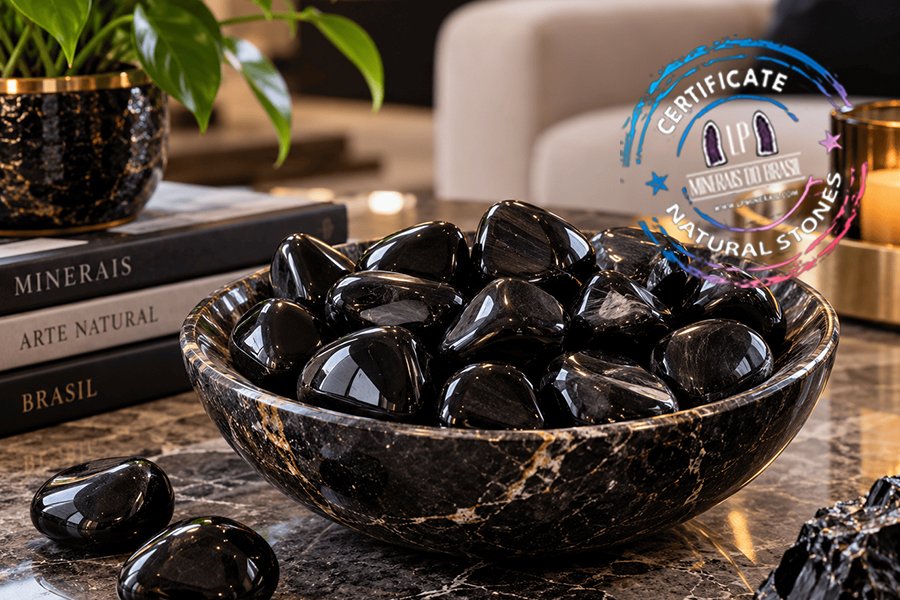
Today, Black Obsidian occupies various segments of the natural stone market. In jewelry and costume jewelry, it can be found in cabochons, beads, pendants, earrings, bracelets, and carved pieces. Polishing intensifies its vitreous luster and produces an elegant black that complements both light-colored and gold metals.
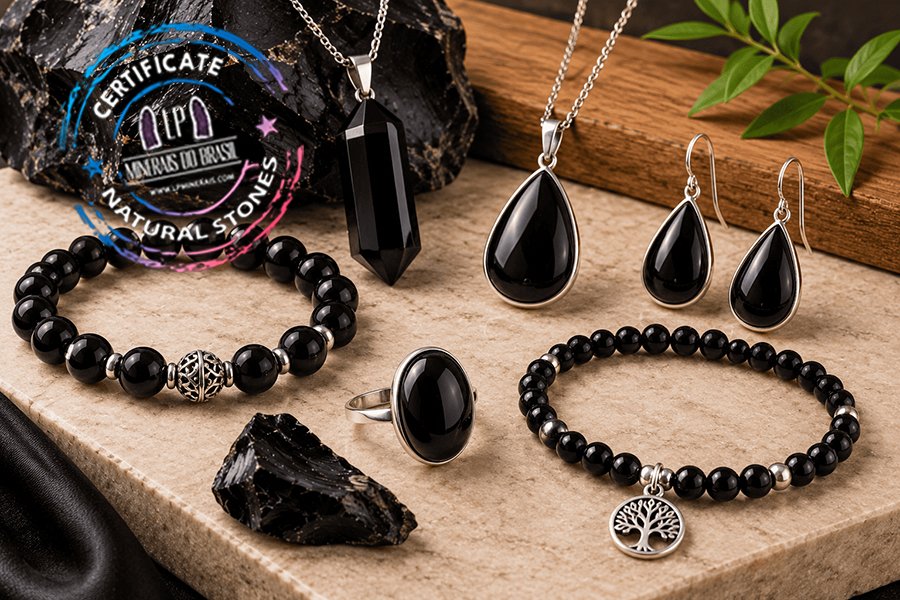
Despite its robust appearance, it is important to remember that obsidian does not possess the same mechanical strength as harder gemstones. Its conchoidal fracture means that impacts can cause chips and sharp edges. In rings or pieces subject to frequent impacts, the design must provide adequate protection.
In interior design, its visual impact is even greater. Obelisks, spheres, free-form pieces, sculptures, rough-hewn pieces, and polished objects serve as points of contrast in light or sophisticated settings. The deep black color complements minimalist and contemporary designs, as well as compositions that incorporate wood, marble, and metals.
In the world of collecting, pieces may be valued for their geological origin, texture, visual quality, size, and unique characteristics. Unpolished pieces better preserve the material’s volcanic character, while polished objects showcase their ability to achieve a mirror-like finish.
Market Value and Buyer Profile
Black Obsidian, in general, is not among the rarest gemological materials. This does not mean, however, that every piece has the same value. The price depends on size, quality, origin, finish, shape, craftsmanship, and commercial purpose.
A small tumbled stone has a completely different market dynamic than a large, perfectly polished decorative piece. Similarly, sculptures, spheres, and obelisks require careful selection of raw material, cutting, material loss, hours of processing, and specialized finishing.
In the professional trade, valuation may consider:
- quality and visual uniformity;
- size and weight;
- integrity of the piece;
- finish and quality of polish;
- complexity of the cut or carving;
- origin and traceability;
- correct variety classification;
- consistency of wholesale and export lots.
Its target audience includes collectors, interior decorators, designers, jewelers, artisans, retailers, and consumers connected to the holistic world. This breadth makes Black Obsidian commercially versatile even without relying on extreme rarity.
The Energetic Significance of Black Obsidian
In the tradition of crystal therapy, few stones have such a strong association with protection and grounding as Black Obsidian. However, reducing its meaning solely to the idea of “blocking negative energy” considerably diminishes its symbolism.
Obsidian is often interpreted as a stone of truth and self-awareness. Its dark surface—which, when polished, becomes reflective—has given rise to a powerful symbolic language related to the ability to see what normally remains hidden. In this sense, its protective power is not merely a symbolic barrier against external influences, but also a process of recognizing limits, patterns, and situations that call for change.
Traditionally, it is associated with:
- energetic protection;
- grounding and presence;
- strengthening boundaries;
- introspection;
- perception of repetitive patterns;
- symbolic release of what has lost its function;
- stability during processes of transformation.
This aspect explains why Black Obsidian is often considered an energetically intense stone. In holistic practices, its symbolism is less related to gentleness and more to the clarity needed to recognize, define, and transform.
Black Obsidian, Protection, and the Mirror Archetype
There is a particularly interesting aspect to its symbolic language: the mirror. When well-polished, Obsidian can develop a highly reflective black surface. Historically, this characteristic has contributed to symbolic and ritual uses, while today it offers a powerful metaphor for introspection.
The mirror does not create what it shows; it reveals. This idea helps us understand the energetic archetype attributed to Obsidian. Rather than promising to automatically eliminate difficulties, it is traditionally used as a symbol of perception, conscious protection, and recognition of what needs to be faced.
In environments, this interpretation can be directed toward a sense of boundary and stability. In professional settings, it can represent focus, discernment, and symbolic protection in the face of intense situations. In personal practices, it can accompany moments of reflection and reorganization.
Black Obsidian thus brings together a rare combination of geological language and symbolism: it is born of volcanic fire, solidifies rapidly as natural glass, and is ultimately associated with the Earth element in energy practices due to its connection to grounding and stability.
This apparent opposition—fire in its origin and earth in its symbolism—is precisely one of the characteristics that make its history so fascinating. Geologically, it embodies extreme transformation; symbolically, it has become a stone associated with the ability to remain steadfast during times of change.
Care and Maintenance of Black Obsidian
Black Obsidian is a natural volcanic glass, and although it visually conveys a sense of solidity, it requires some specific care. Its hardness ranges from approximately 5 to 5.5 on the Mohs Scale, but hardness should not be confused with impact resistance. The most important characteristic for its care is its conchoidal fracture: when dropped or struck, obsidian can chip and form very sharp edges.
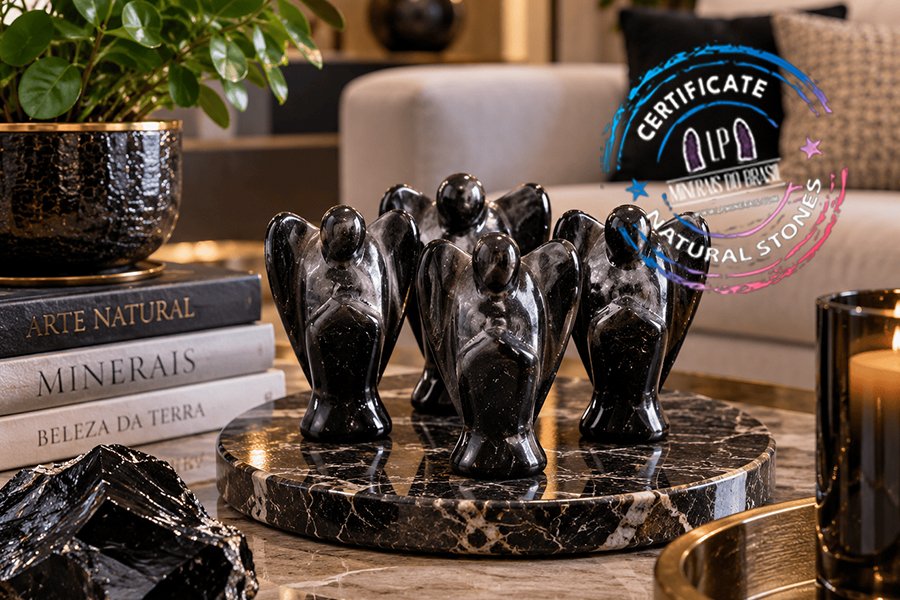
Polished pieces, such as beads, obelisks, pyramids, and free-form shapes, can also lose part of their finish when they repeatedly come into contact with harder materials. For larger decorative objects, it is recommended to place them on a stable surface and avoid locations where the piece could easily be knocked over. When it comes to jewelry, care should extend not only to the stone but also to metals, wires, adhesives, and other components of the setting.
To preserve obsidian:
- use a soft cloth to remove dust;
- when necessary, gently clean with water;
- dry it completely after cleaning;
- avoid abrasives and harsh chemicals;
- protect it from impacts and drops;
- Avoid sudden temperature changes;
- store jewelry separately from harder gemstones.
These simple precautions help preserve, above all, the vitreous luster—one of the most important aesthetic characteristics of Black Obsidian.
Energetic Cleansing and Care in Holistic Use
Within crystal therapy practices, Black Obsidian is traditionally used for protection, grounding, and energetic realignment. For this reason, some people prefer to perform periodic symbolic cleansing, especially when the stone is kept in busy environments or is frequently used in meditation and personal practices.
This energetic cleansing does not need to involve aggressive methods. Sound, intention, meditation, and moderate exposure to moonlight are among the traditionally used alternatives. The goal, from this perspective, is to symbolically mark the end of a cycle and reaffirm the intention related to the stone’s use.
It is important to distinguish between the two concepts: physical cleaning preserves the material; energetic cleansing belongs to the realm of holistic practices. The latter does not correspond to a mineralogical process nor does it represent a scientifically proven property of obsidian.
Chakra, Element, Planet, and Zodiac
Black Obsidian is traditionally associated with the base or root chakra, an association consistent with its symbolism of grounding, stability, security, and presence. In energy practices, this chakra represents our symbolic connection to the material dimension of existence and our ability to remain centered in the face of the demands of daily life.
Its relationship with the Earth element follows a similar logic. There is an interesting contrast here: geologically, obsidian is formed by volcanic processes linked to extreme heat, but in energy symbolism, it is often associated with the Earth due to its connection to stability and grounding. It is as if a material born of intense transformation came to represent the ability to find firmness in the wake of that transformation.
In planetary correspondences, Pluto is associated with Obsidian in some traditions due to themes such as transformation, depth, and the revelation of what remains hidden. In the zodiac, Scorpio and Sagittarius are among the signs frequently associated with the stone, although these correspondences may vary depending on different esoteric schools.
These relationships should not be seen as limitations. A person does not need to belong to a specific sign to use Black Obsidian; within holistic practices, intention and affinity are usually more relevant than rigid astrological correspondences.
Spiritual meaning: protection, truth, and transformation
To refer to Black Obsidian merely as a “protective stone” is to oversimplify a much deeper symbolism. Traditionally, it is also associated with truth, introspection, and the recognition of patterns that need to be transformed. Its energy is often described as direct, precisely because its archetype is not about hiding difficulties, but about observing them with greater awareness.
Its appearance has contributed to this symbolic interpretation. When polished, its black surface can take on a mirror-like quality. The reflection creates a particularly powerful metaphor: looking at Obsidian can symbolically represent a willingness to look within oneself as well.
In this sense, the protection attributed to the stone can be interpreted more broadly. It is not merely a matter of imagining a barrier against external influences, but of strengthening discernment, personal boundaries, and awareness of what we allow to remain around us.
Traditionally, its symbolism involves:
- protection and the strengthening of boundaries;
- grounding and stability;
- introspection and self-awareness;
- recognition of repetitive patterns;
- conscious transformation;
- symbolic letting go of what has lost its purpose;
- greater presence in the face of intense situations.
This aspect makes Obsidian a particularly interesting stone for reflective practices. Its archetype does not promise to eliminate obstacles: it is linked to the ability to clearly see what needs to be faced or reorganized.
The Black Mirror Archetype
The association between Obsidian and the mirror has roots that extend beyond contemporary crystal therapy. Carefully polished Obsidian surfaces have historically been used to produce reflective and ceremonial objects, reinforcing a cultural connection between this material, observation, symbolism, and perception.
Energetically, the black mirror has become an archetype of depth. Unlike a stone whose symbolism primarily seeks expansion or enthusiasm, Obsidian directs attention inward. It represents the willingness to acknowledge emotions, behaviors, and limits before deciding what to do with them.
This interpretation also explains why the stone is often described as intense in holistic practices. People seeking a symbolically gentler energy may prefer to combine it with stones associated with serenity and balance, while others use its striking presence precisely as support during times of change and personal reorganization.
Black Obsidian at Home and in Spaces
In interior design, Black Obsidian has a clear advantage: its aesthetic appeal works independently of any energetic interpretation. The glossy black creates an elegant contrast with wood, marble, gold-toned metals, light colors, and greenery, allowing the stone to be used in contemporary, minimalist, or more sophisticated settings.
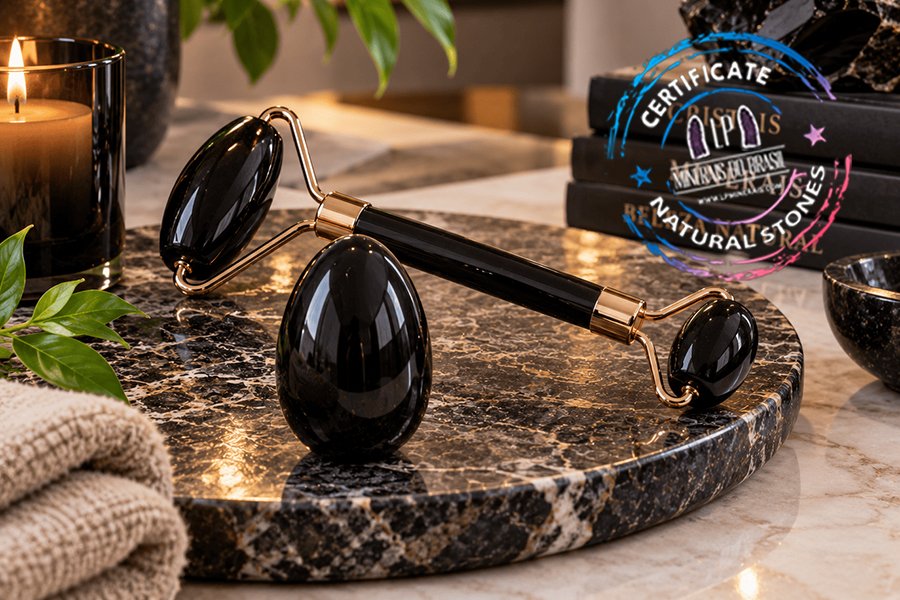
Within the energetic tradition, entryways and hallways are frequently chosen locations when the intention relates to the symbolic protection of the space. Offices and professional spaces can use the stone to represent focus, steadfastness, and boundaries. Spaces dedicated to meditation, on the other hand, highlight its introspective dimension.
A large, rough-hewn piece conveys the material’s geological power differently than a polished form. Obelisks, spheres, and sculptures highlight the stone’s luster and reflections, while natural specimens preserve its volcanic texture and bring the decor closer to the stone’s very origin.
Thus, some common uses include:
- the home’s entryway, intended to provide protection;
- the office to promote focus and establish boundaries;
- the living room as a decorative mineral piece;
- a meditation space for introspection;
- an altar as a symbol of transformation and grounding;
- personal use as an object of intention and presence.
Your choice should take into account both the symbolic purpose and the physical safety of the piece, especially when dealing with large or rough specimens.
Black Obsidian at Work and in Daily Life
In professional settings, its symbolism can be directed primarily toward steadfastness, discernment, and the ability to set boundaries. A small piece on the desk can serve as a visual reminder of focus and presence, without attributing responsibility for events in the environment to the mineral.
For people who work in very busy places or with a large flow of people, the tradition of crystal therapy often associates Obsidian with energetic protection. In a practical sense, it can represent the intention not to emotionally absorb all external tensions and to maintain greater awareness of one’s own limits.
It can also accompany periods of career change or important decisions. In this context, its association with transformation takes on an interesting meaning: letting go of patterns that no longer work to make room for more conscious choices.
Meditation with Black Obsidian
Meditation with Obsidian is usually focused on processes of inner observation. Instead of using it solely for general requests for protection, it is possible to work with a more specific intention related to boundaries, recurring behaviors, or situations that need to be understood.
The stone can be kept nearby during a few minutes of mindful breathing, serving as a visual or tactile focal point. The practice doesn’t have to be complex. Simple questions can offer symbolic guidance: What do I need to observe more clearly? Where do I need to set a boundary? What has already served its purpose and can be left behind?
In this way, Obsidian ceases to be treated as an object that supposedly brings about change on its own and instead functions as a conscious symbol of reflection and transformation.
Combinations with Other Stones
Energetic combinations become more coherent when there is a defined intention. Since Black Obsidian carries powerful symbolism of grounding, protection, and introspection, other stones can reinforce certain characteristics or bring complementary energy.
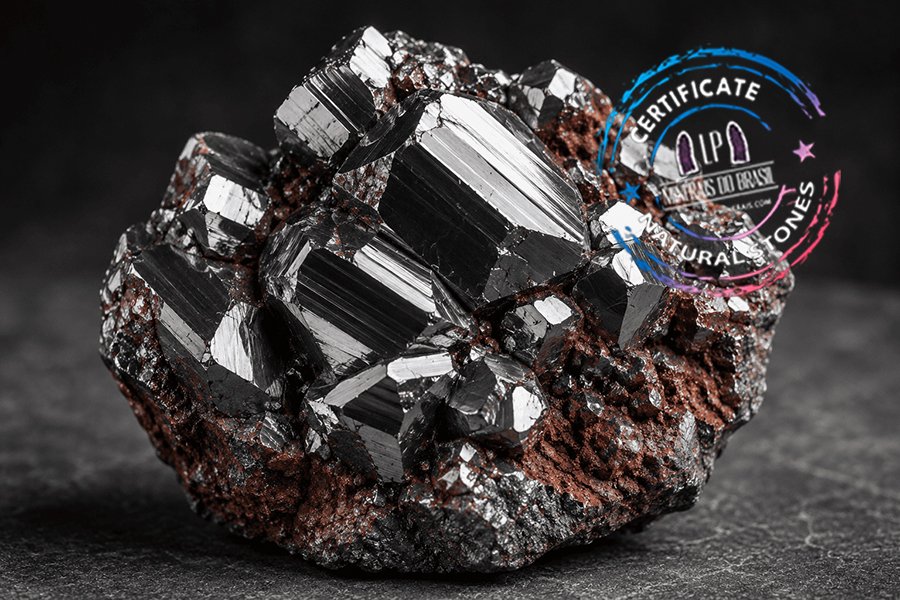
Black Tourmaline is one of the best-known combinations when the primary intention is protection and grounding. Hematite symbolically reinforces presence and stability. Clear Quartz can be used to foster clarity and direction, while Amethyst introduces a more contemplative dimension.
Some traditional combinations are:
- Black Obsidian Black Tourmaline: protection and grounding;
- Black Obsidian Hematite: stability and presence;
- Black Obsidian Clear Quartz: awareness and clarity;
- Black Obsidian Amethyst: introspection and serenity;
- Black Obsidian Tiger’s Eye: focus, steadfastness, and conscious action;
- Black Obsidian Selenite: grounding symbolically combined with purification.
More stones do not necessarily mean a better practice. One or two well-chosen combinations usually produce a much clearer symbolic intention.
Technical-Energetic Section
🗺 » ORIGIN — Formed in volcanic environments and found in different regions of the world associated with silica-rich volcanism.
⚛️ » CHEMICAL COMPOSITION — Silica-rich volcanic glass with variable composition; it does not have a single mineral formula.
🔩 » MOHS SCALE — Approximately 5 to 5.5.
🔢 » NUMEROLOGY — Correspondences vary by tradition; there is no universal mineralogical number.
🔅 » MEANING — Protection, grounding, truth, introspection, and transformation.
🅰️ » SUMMARY — Natural black volcanic glass with a vitreous luster and a strong historical, ornamental, and symbolic tradition.
✅ » SPECIFICATION — A volcanic igneous rock with a vitreous texture and a predominantly amorphous structure.
🧩 » CONDITION — Rough, tumbled, polished, cut, carved, or used in decorative objects and jewelry.
⚒ » FORMATION — Rapid cooling of silica-rich lava, preventing significant crystallization.
⚠️ » CARE — Avoid impacts, drops, abrasives, and thermal shock; when broken, it can produce sharp edges.
🛁 » CLEANSING — Physically, gentle cleaning; energetically, sound, intention, meditation, or moonlight are traditional practices.
🎨 » COLOR — Black, may exhibit brown tones or subtle translucency along thin edges.
☯️ » ZODIAC — Often associated with Scorpio and Sagittarius, with variations depending on tradition.
🪐 » SOLAR SYSTEM — Pluto appears in some symbolic correspondences.
➰ » CHAKRAS — Primarily the base or root chakra.
♻ » ELEMENT — Earth in the energetic tradition.
💎 » RARITY — The common black variety is not considered rare; specific specimens may stand out due to their origin, size, or natural characteristics.
🗳 » CHARACTERISTICS — Glassy structure, intense luster, conchoidal fracture, and strong volcanic origin.
FAQ — Frequently Asked Questions About Black Obsidian
How can you tell if Black Obsidian is genuine?
Identification should consider its vitreous luster, structure, fracture, appearance, and, most importantly, its origin. Since artificial glass can bear a resemblance, significant or questionable specimens should be professionally appraised.
Is Black Obsidian a stone or a crystal?
It is commonly referred to as a stone or crystal, especially in the holistic market. Technically, however, it is a natural volcanic glass, not a crystalline mineral species.
Can Black Obsidian get wet?
Brief contact with clean water usually poses no problem for an intact piece. Harsh chemicals, abrasives, impacts, and sudden temperature changes should be avoided.
What is the energetic purpose of Black Obsidian?
Traditionally, it is used for protection, grounding, strengthening boundaries, introspection, and symbolic processes of transformation.
Does Black Obsidian provide protection?
This is one of its most traditional associations in crystal therapy. Protection should be understood as a symbolic practice related to boundaries, stability, and intention, rather than as a guarantee against external events.
Where should you place Black Obsidian in your home?
Entrances, living rooms, offices, and meditation spaces are frequently chosen locations. The ideal placement depends on your intention, as well as the room’s decor and the safety of the stone.
Can you use Black Obsidian at work?
Yes. Within holistic practices, it is used as a symbol of focus, steadfastness, protection, and boundaries in professional settings.
Are Black Obsidian and Black Tourmaline the same stone?
No. Obsidian is natural volcanic glass, while Black Tourmaline is a crystalline mineral. Although they share some energetic associations, they have completely different compositions, structures, and formations.
Which chakra is associated with Black Obsidian?
Primarily the base or root chakra, which is symbolically related to grounding, security, stability, and connection to material reality.
Which stones pair well with Black Obsidian?
Black Tourmaline, Hematite, Clear Quartz, Amethyst, Tiger’s Eye, and Selenite are among the combinations used, depending on the intention of the practice.
Conclusion
Black Obsidian is a material in which geology and symbolism seem to interact in a particularly intense way. Formed by the rapid cooling of silica-rich lava, it preserves the glassy appearance of an extreme volcanic process and, at the same time, has become culturally associated with protection, depth, and transformation.
Its importance does not depend on whether it is classified as a crystal. On the contrary: understanding that we are dealing with a natural volcanic glass makes its history even more interesting. Its amorphous structure, characteristic luster, and conchoidal fracture explain both its ancient practical uses and its current presence in jewelry, decor, and collecting.
On an energetic level, Black Obsidian is traditionally associated with protection, grounding, truth, boundaries, and introspection. Its mirror archetype offers a particularly rich interpretation: before transforming something, one must first be able to see it. It is precisely this combination of firmness and perception that underpins its presence in contemporary holistic practices.
Whether in its raw form, preserving its volcanic origin, or as a perfectly polished surface that becomes a black mirror, obsidian retains the same essential identity: a material shaped by transformation and symbolically transformed into a representation of consciousness, stability, and protection.
By: Doris S. Rosa
Howlite: what lies behind the Stone of Calm and Inner Silence?
Moonstone: the Stone of Intuition, Feminine Energy, and the Mysteries of the Moon.
Jade: The Stone of Wisdom, Prosperity, and Harmony That Spans Millennia
Angelite: The Stone of Serenity, Intuition, and Spiritual Connection
Green Aventurine: the Stone of Prosperity, Opportunity, and New Paths
Orange Calcite: The Solar Energy That Awakens Creativity and Movement
Carnelian: origin, formation, mineralogy, and the vibrant energy of a stone linked to action.
Fluorite: Mineralogy, Formation, Colors, and Meaning of a Mineral that Organizes Light and Color
Red Jasper: Mineralogy, Vitality, and the Ancestral Strength of an Earth-Connected Stone
Hematite: The Strength of Iron, Grounding, and the Presence That Comes from the Earth