







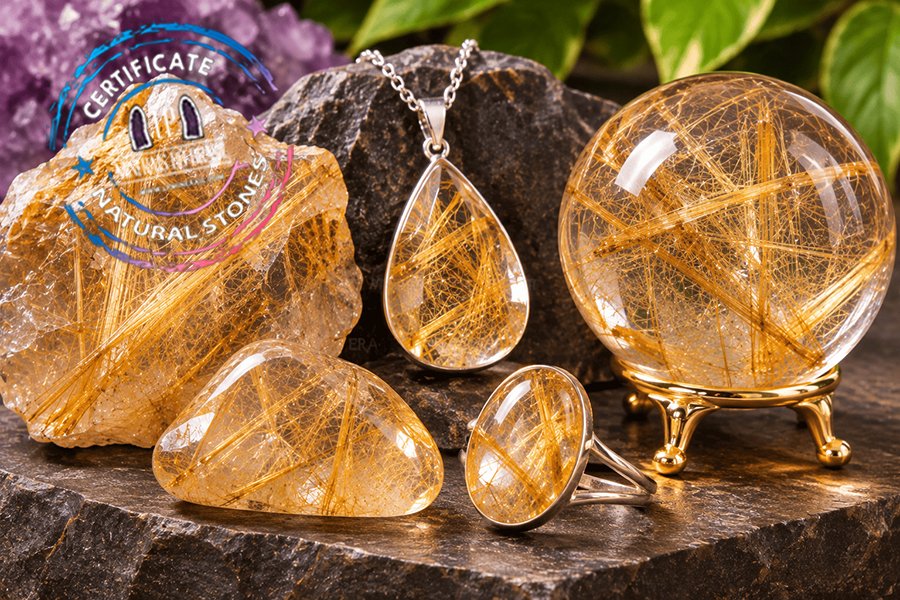
Rutilated Quartz is among the most admired ornamental varieties of quartz due to the presence of mineral inclusions that resemble delicate metallic threads trapped inside transparent or translucent crystals. These structures, often golden, coppery, reddish, or dark, create unique patterns that transform each specimen into a true expression of Earth’s geological history.
Its beauty depends not only on the transparency of the quartz but also on the relationship between two distinct minerals: quartz, composed of silicon dioxide, and rutile, formed of titanium dioxide. When rutile crystals are included in quartz, they can form isolated needles, parallel bundles, interlaced networks, and compositions of great gemological interest.
In Brazil 🇧🇷, Rutilated Quartz holds a prominent position in the natural stone trade, especially due to the diversity of specimens found in regions with a long mineralogical tradition, such as Minas Gerais. Its presence in the market includes rough crystals, cut gemstones, jewelry, decorative objects, and pieces intended for collectors.
In addition to its aesthetic value, the mineral holds significant meaning in crystal therapy traditions. Often associated with prosperity, mental clarity, willpower, and the manifestation of goals, Rutilated Quartz is popularly known as “Hairy Quartz” and, in certain commercial presentations, as “Venus’s Hair.”
To understand its true value, however, one must look beyond symbolic interpretations. Mineralogical identification, the origin of the inclusions, authenticity criteria, gemological quality, and commercial provenance are fundamental elements for recognizing the uniqueness of this material.
Geological Origin of Rutilated Quartz: How the Mineral Filaments Become Trapped in the Crystal
The formation of Rutilated Quartz is related to geological environments in which quartz and rutile can occur together. Quartz crystallizes from silica-rich fluids, while rutile develops under conditions favorable to the concentration and crystallization of titanium.
During mineralogical evolution, rutile crystals may be present before or during the growth of quartz. As the quartz develops, these structures can become incorporated into its interior, remaining preserved as solid inclusions.
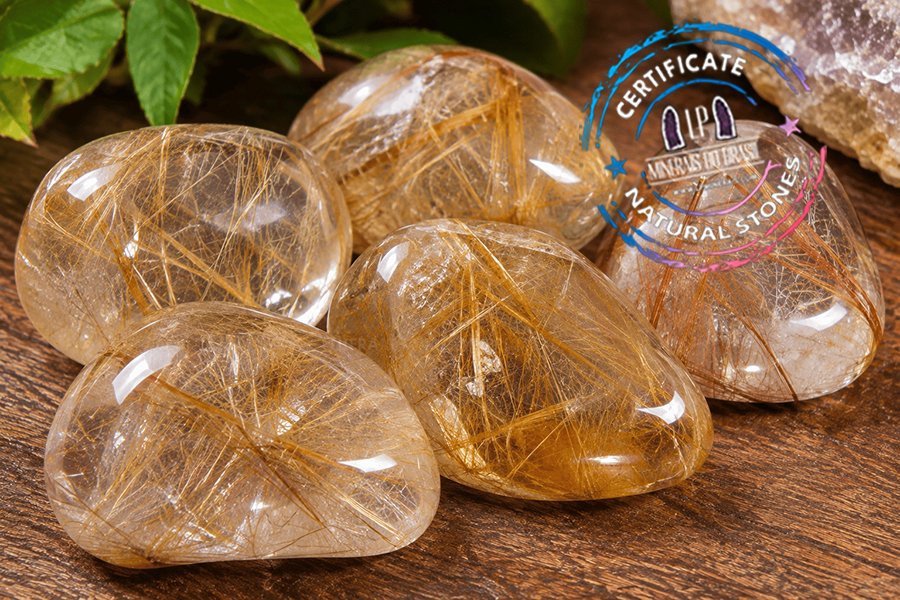
The result is a mineralogical association in which two distinct species coexist within the same specimen. Quartz serves as the host mineral, while the rutile needles represent inclusions that record specific crystallization conditions.
The orientation, thickness, and distribution of these inclusions vary significantly. Some specimens feature extremely fine and delicate filaments; others reveal thicker crystals, dense clusters, or structures that traverse different regions of the quartz.
Where is Rutilated Quartz Found?
Brazil has significant deposits of quartz with rutile inclusions, particularly in regions of Minas Gerais. Brazil’s geological diversity favors the formation of materials with distinctive visual characteristics.
Other deposits are known in Madagascar, Pakistan, and various quartz-producing regions. The quality of a specimen, however, should not be determined solely by its country of origin.
Transparency, the distribution of inclusions, crystalline integrity, and documented provenance also influence its commercial value.
Chemical Composition, Mohs Hardness, and Crystal System
Rutilated quartz is not an independent mineral species. It is quartz containing rutile inclusions, and each of these minerals has its own chemical composition and crystallographic properties.
Quartz has the formula SiO₂, belongs to the trigonal crystal system, and has a hardness of 7 on the Mohs scale. It has a vitreous luster, its fracture is predominantly conchoidal, and it lacks well-developed true cleavage.
Rutile has the formula TiO₂, crystallizes in the tetragonal system, and generally has a hardness between 6 and 6.5 on the Mohs scale. Its frequently acicular habit explains the filamentous appearance observed within the quartz.
This association produces a striking visual combination: the transparency of the host mineral allows one to observe internal structures that would normally remain hidden in opaque materials.
Notable characteristics include:
- Transparent, translucent, or partially milky host quartz.
- Needle-like rutile inclusions with varying orientations.
- Golden, coppery, reddish, or dark hues.
- Possibility of fluid inclusions and additional natural fractures.
- A wide variety of internal patterns.
The presence of these inclusions does not alter the fundamental classification of quartz, but it does influence its appearance, gemological evaluation, and commercial value.
Golden, red, and dark rutilated quartz: why do the colors vary?
One of the most interesting characteristics of Rutilated Quartz is the diversity of hues displayed by its inclusions. Although golden threads are the best known, rutile can appear reddish, brown, coppery, or very dark.
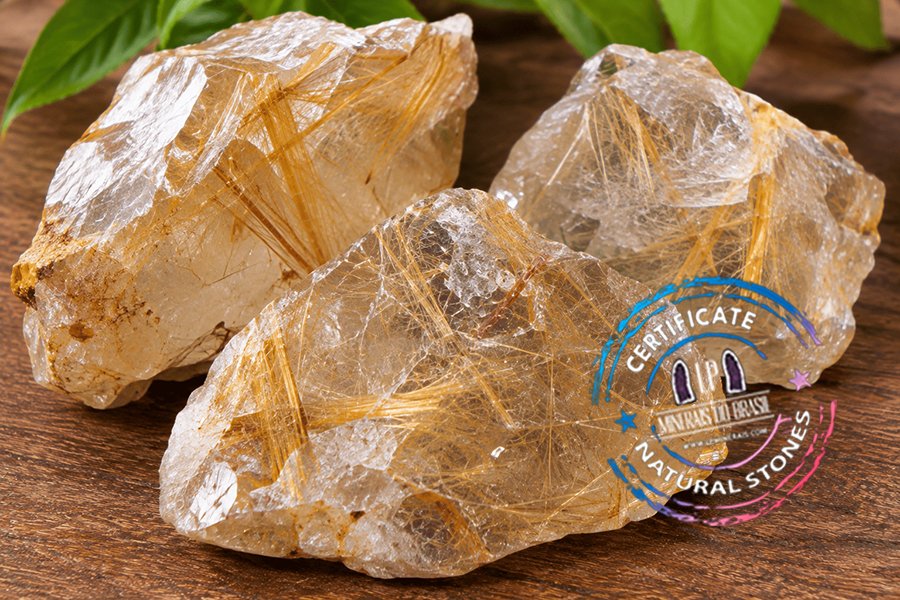
These differences depend on factors such as composition, optical characteristics, crystal thickness, orientation, and interaction with light. The lighting used in photography can also significantly alter the perception of colors.
In the marketplace, specimens with golden needles are often associated with the image of so-called “Venus’s Hair.” However, this name is commercial and poetic in nature; it is not a formal mineralogical classification.
Are Hairy Quartz and Rutilated Quartz the same thing?
The terms are often used interchangeably, but there is an important distinction.
The name “Hair Quartz” may be used commercially for different types of quartz with elongated inclusions. Not all of these inclusions are necessarily rutile.
Some specimens may contain other minerals, such as tourmaline, actinolite, or goethite. Therefore, the correct identification of the inclusions is essential to determine whether the piece is indeed Rutilated Quartz.
This distinction protects consumers and contributes to transparency in the mineral market.
Genuine Rutilated Quartz: Authenticity, Treatments, and Identification
The authenticity of Rutilated Quartz requires the identification of the host quartz and the mineral inclusions present within it. The appearance of metallic threads is an important characteristic, but it does not constitute definitive proof that these structures are rutile.
Artificial materials, glass, and composite pieces can replicate certain visual characteristics of natural stones. Furthermore, genuine quartz specimens may contain inclusions of different mineral species and be marketed under inappropriate names.
For higher-value specimens, gemological techniques and laboratory analyses can aid in identification. Microscopic observation allows for the study of the habit of the inclusions, while instrumental methods can confirm their composition.
It is also necessary to consider any treatments, settings, or fillings. Transparency regarding these interventions is an important commercial responsibility.
For an informed purchase, it is recommended to:
- Verify the declared origin.
- Check the integrity of the quartz.
- Request information about known treatments.
- Distinguish rutile inclusions from other needle-like minerals.
- Seek expert appraisal for high-value pieces.
Mineralogical knowledge builds trust among suppliers, dealers, and consumers.
Rutilated Quartz in Jewelry: Inclusions That Enhance the Gem’s Value
In jewelry, Rutilated Quartz stands out for an unusual characteristic: what would be considered an undesirable inclusion in many gemstones is, in this material, its main aesthetic appeal.
Faceted cuts can enhance transparency and internal reflections. Cabochons, on the other hand, offer rounded surfaces that allow the needles to be viewed from different angles.
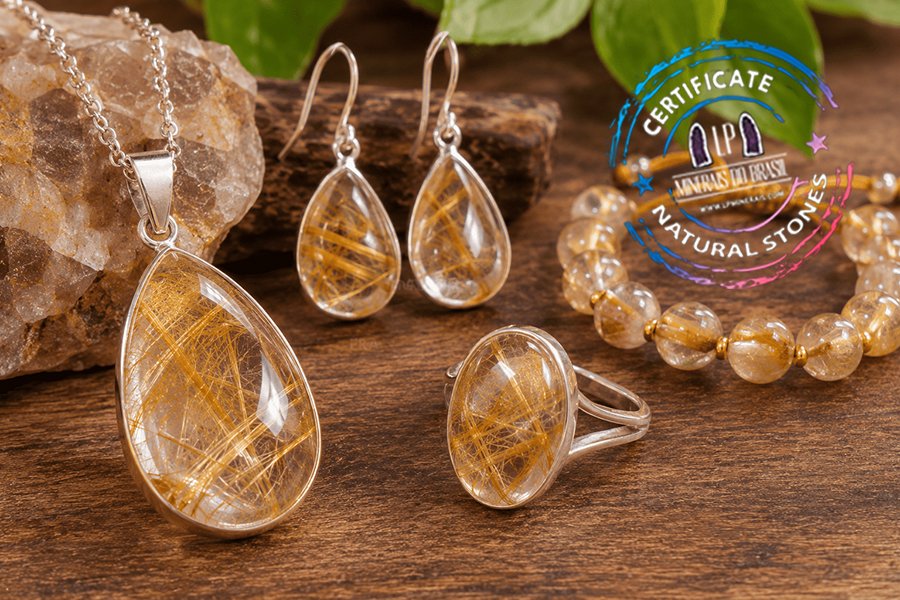
Pendants, rings, earrings, and designer pieces incorporate Rutilated Quartz into both contemporary and classic designs. The contrast between gold-plated wires and metals such as gold or silver can produce particularly elegant results.
Its hardness of 7 makes it suitable for jewelry, but the presence of fractures and inclusions requires care during cutting and setting.
Rutilated Quartz Buyer Profile
The target audience is diverse. Jewelry consumers seek exclusive pieces, while collectors value unusual inclusion patterns and well-preserved crystallographic features.
Designers and interior decorators find in this material an opportunity to explore the natural beauty of its internal structures. Meanwhile, consumers connected to holistic traditions often choose the stone for its symbolic meaning of prosperity and fulfillment.
The uniqueness of each specimen is a key distinguishing feature: it is rare for two pieces to have exactly the same distribution of inclusions.
Rutilated Quartz in Decor and Mineral Collecting
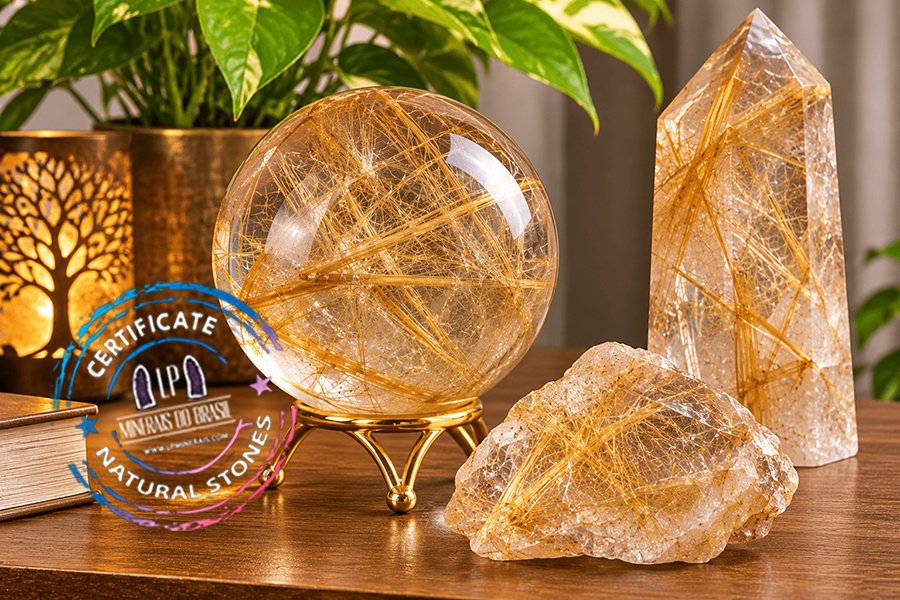
Rutilated Quartz has great decorative potential due to the interplay between transparency, light, and internal inclusions. Spheres, free-form pieces, polished tips, and natural crystals can be incorporated into display cases, shelves, and contemporary settings.
Lighting directly influences its presentation. A well-positioned light source can highlight the needles and reveal visual depth, while excessively intense lighting can produce glare that hinders observation.
In the world of collecting, specimens with well-formed crystals, striking inclusions, and documented provenance attract particular interest. The combination of the quartz’s quality and the arrangement of its needles contributes to its value.
Raw specimens preserve natural growth characteristics and may be of great scientific interest. Cut specimens, on the other hand, emphasize the aesthetic composition of the inclusions.
This diversity broadens their presence in the ornamental mineral market.
Rarity, Market Value, and Commercial Importance
Rutilated Quartz should not be considered universally rare. However, specimens that combine high transparency, visually appealing inclusions, good integrity, and impressive dimensions can be relatively difficult to find.
Commercial valuation depends on multiple factors. A gem with well-distributed golden threads and few detrimental fractures may be of greater interest than an opaque specimen with barely visible inclusions.
In the world of collecting, unusual growth characteristics and recognized provenance also influence value. There is, therefore, no single price applicable to all specimens.
In Brazil 🇧🇷, the appreciation of this material represents an opportunity to strengthen the identity of Brazilian minerals and expand their presence in specialized markets.
LP MINERAIS ⛏💎📦🗺 recognizes the importance of ethical sourcing, commercial transparency, and Fair Trade principles in building responsible relationships within the mineral sector.
Spiritual Meaning of Rutilated Quartz: Prosperity, Clarity, and Fulfillment
In crystal therapy traditions, Rutilated Quartz is often associated with prosperity, symbolic vitality, clarity of purpose, and the strengthening of personal intention.
Reference works on the world of crystals, such as those by Judy Hall, Robert Simmons, and Naisha Ahsian, offer interpretations related to the amplification of intentions, inner perception, and the transformation of patterns considered limiting.
The golden threads present in certain specimens contribute to its symbolic association with light, abundance, and fulfillment. The appearance of luminous filaments running through the quartz lends itself to interpretations linked to the connection between thought, intention, and action.
It is important to understand that these associations belong to spiritual traditions and do not represent scientifically proven energetic properties.
Rutilated Quartz and Prosperity: The Symbolism of the Golden Threads
Prosperity is one of the most widespread associations with Rutilated Quartz. In holistic practices, the mineral represents the intention to build confidence, recognize opportunities, and act with greater clarity toward personal goals.
Its symbolic connection to abundance should not be interpreted as a guarantee of financial gain. The meaning relates to the way certain objects can represent individual values, goals, and commitments.
In professional settings, some people use Rutilated Quartz as a symbol of creativity, organization, and accomplishment. The stone can serve as a decorative element associated with the intention of staying focused on important projects.
The predominant archetype is that of conscious manifestation: transforming ideas into concrete actions, while recognizing that results depend on planning, hard work, and real-world circumstances.
Spiritual Protection, Focus, and Inner Transformation
In addition to prosperity, Rutilated Quartz is traditionally associated with mental clarity and symbolic protection. Some holistic interpretations describe its inclusions as representations of light piercing through obstacles and revealing new perspectives.
This symbolism can be associated with the ability to recognize difficulties, develop discernment, and maintain a mindful attitude in the face of change.
In contemplative practices, the mineral also represents the integration of inner perception and practical action. The quartz’s transparency is interpreted as a symbol of clarity, while the rutile threads represent movement and direction.
The most common traditional associations include:
- Prosperity and symbolic abundance.
- Clarity of purpose.
- Strengthening of personal intention.
- Spiritual protection.
- Creativity and transformation.
- Confidence when facing new projects.
These interpretations are not a substitute for informed decisions, health care, or concrete protective measures.
Chakras, elements, zodiac signs, and symbolic correspondences
Rutilated quartz is often associated with the solar plexus chakra, especially when it contains golden inclusions. In energy traditions, this center represents willpower, autonomy, and the capacity for achievement.
Some approaches also link the stone to the crown chakra, due to quartz’s association with spiritual clarity and contemplation. Depending on the color of the inclusions, other correspondences may arise.
The element Fire is often used to represent its symbolic association with initiative and transformation. In certain traditions, the element Air is also linked to mental clarity.
Zodiacal correspondences vary among authors, with associations found with Leo and Gemini. There is no universal consensus on these relationships.
Similarly, the Sun appears as a symbolic planetary correspondence in interpretations related to vitality and personal expression.
Rutilated Quartz in Meditation and for Harmonizing Spaces
In meditation, Rutilated Quartz can be used as an object of observation and concentration. Its internal inclusions offer visual details that support contemplative practices and moments of mindful attention.
Some people place it near their workspace or study area, attributing personal significance to it related to clarity and organization.
In residential settings, the mineral can be incorporated into decorative arrangements with wood, metals, and other natural materials. Its appearance allows for the creation of visual focal points without relying on intense colors.
In holistic traditions, it can also be combined with Citrine, Pyrite, and Clear Quartz. These combinations aim to bring together symbolism of prosperity, confidence, and clarity.
The choice of combinations should take into account individual preferences and the physical characteristics of the minerals. There is no scientific evidence that these arrangements produce specific energetic effects.
Cleaning and Care for Rutilated Quartz
Rutilated Quartz is relatively scratch-resistant, but it may contain internal fractures that require caution during handling.
Intact pieces can be cleaned with room-temperature water, mild soap, and a soft cloth. However, specimens with mountings, adhesives, fillers, or fragile structures require special care.
It is recommended to avoid impacts, sudden temperature changes, harsh chemicals, and ultrasonic cleaning without professional evaluation.
In holistic practices, symbolic cleansing procedures may include meditation, prayer, or setting intentions. These rituals have not been proven to alter the stone’s physical or energetic properties.
⛏💎 Technical and Energetic Profile | LP MINERAIS
🗺 » ORIGIN: Brazil, Madagascar, Pakistan, and other regions where quartz and rutile are found.
⚛️ » CHEMICAL COMPOSITION: Quartz — SiO₂; rutile inclusions — TiO₂.
🔩 » MOHS SCALE: Quartz 7; rutile approximately 6 to 6.5.
🔢 » NUMEROLOGY: Meanings vary according to esoteric traditions; no universal association.
🔅 » MEANING: Prosperity, clarity, fulfillment, willpower, and symbolic transformation.
🅰️ » SUMMARY: Quartz with acicular rutile inclusions, prized for its internal patterns and symbolism of abundance.
✅ » SPECIFICATION: Trigonal quartz containing inclusions of tetragonal rutile.
🧩 » STATE: Solid crystalline, found in rough crystals, cut gemstones, and ornamental pieces.
⚒ » FORMATION: Quartz growth in geological environments that allow for the incorporation of rutile crystals.
⚠️ » CARE: Avoid impacts, excessive heat, and improper handling of pieces with fractures.
🛁 » CLEANING: Room-temperature water, mild soap, and a soft cloth, when compatible with the specimen.
🎨 » COLOR: Colorless, whitish, or smoky quartz, with golden, coppery, reddish, or dark inclusions.
☯️ » ZODIAC: Variable associations, including Leo and Gemini in certain traditions.
🪐 » SOLAR SYSTEM: The Sun, in symbolic interpretations related to vitality and fulfillment.
➰ » CHAKRAS: Primarily the solar plexus and crown chakras, depending on the tradition.
♻ » ELEMENT: Often Fire; some interpretations also associate it with Air.
💎 » RARITY: Variable; specimens with high transparency and exceptional inclusions are less common.
🗳 » CHARACTERISTIC: Natural rutile inclusions that form visible threads, bundles, and networks within the quartz.
Frequently Asked Questions About Rutilated Quartz (FAQ)
1. Is Rutilated Quartz a natural stone?
Yes. It is a natural mineralogical association formed by quartz containing rutile inclusions. Correct identification depends on confirming the minerals present.
2. Are the golden threads in Rutilated Quartz gold?
No. The threads are rutile crystals, a mineral composed of titanium dioxide. The golden appearance does not indicate the presence of metallic gold.
3. Are Rutilated Quartz and Hairy Quartz the same thing?
Not always. “Hair Quartz” is a broad commercial term that can include quartz varieties with different needle-like minerals.
4. What is the hardness of Rutilated Quartz?
The host quartz has a hardness of 7 on the Mohs scale. Rutile generally has a hardness between 6 and 6.5.
5. Does Rutilated Quartz attract prosperity?
In holistic traditions, it is symbolically associated with prosperity and fulfillment. There is no scientific evidence that the stone produces financial gains or alters external events.
6. How can you identify genuine Rutilated Quartz?
Evaluation involves assessing the properties of the quartz and identifying the inclusions. For higher-value pieces, gemological analysis may be necessary.
7. Can Rutilated Quartz be used in jewelry?
Yes. It is used in rings, earrings, pendants, and other pieces, provided the gem’s integrity is maintained and care is taken to avoid impacts.
8. Is Rutilated Quartz rare?
It is not universally rare, but exceptional specimens with attractive inclusions and high transparency may be less common.
9. Where can Rutilated Quartz be found in Brazil?
Minas Gerais is among the Brazilian regions known for the occurrence of quartz with mineral inclusions, including rutile.
10. How do you clean Rutilated Quartz?
Undamaged pieces can be gently cleaned with water, mild soap, and a soft cloth. Fragile or mounted specimens require specific evaluation.
11. Which chakra is associated with Rutilated Quartz?
The solar plexus chakra is a common association, especially with golden specimens. Some traditions also mention the crown chakra.
12. Does Brazilian Rutilated Quartz have an export market?
Yes. Rough crystals, cut gemstones, and ornamental pieces can be traded internationally, provided that applicable legal and commercial requirements are met.
Conclusion: Rutilated Quartz, the Beauty of Mineral Inclusions, and the Appreciation of Brazilian Heritage
Rutilated Quartz represents one of the most striking mineral associations in the world of natural stones. Its internal veins reveal complex geological processes and transform each specimen into a unique composition.
From a scientific perspective, it stands out for the presence of quartz and rutile, two distinct minerals that, when combined, produce visual characteristics of great gemological interest.
In jewelry, interior design, and collecting, its value depends on transparency, the quality of its inclusions, integrity, and provenance. In holistic traditions, it symbolizes prosperity, clarity, and fulfillment, always within a symbolic interpretation.
For LP MINERAIS ⛏💎📦🗺, Rutilated Quartz also embodies the potential of Brazil’s mineral heritage 🇧🇷 and the importance of transparent, responsible trade relationships aligned with Fair Trade principles.
Its true value lies in the combination of geological knowledge, aesthetic uniqueness, and respect for its natural origin.
Doris S. Rosa

Charoite: Between the Mysteries of Siberia and the Symbolism of Transformation
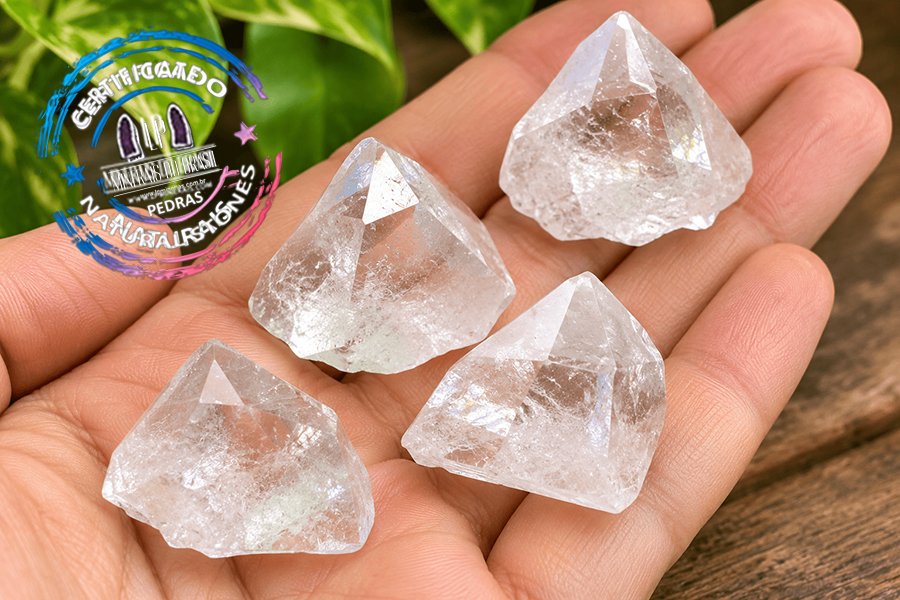
Apophyllite: properties, geological origin, spiritual significance, and the connection between clarity, protection, and consciousness
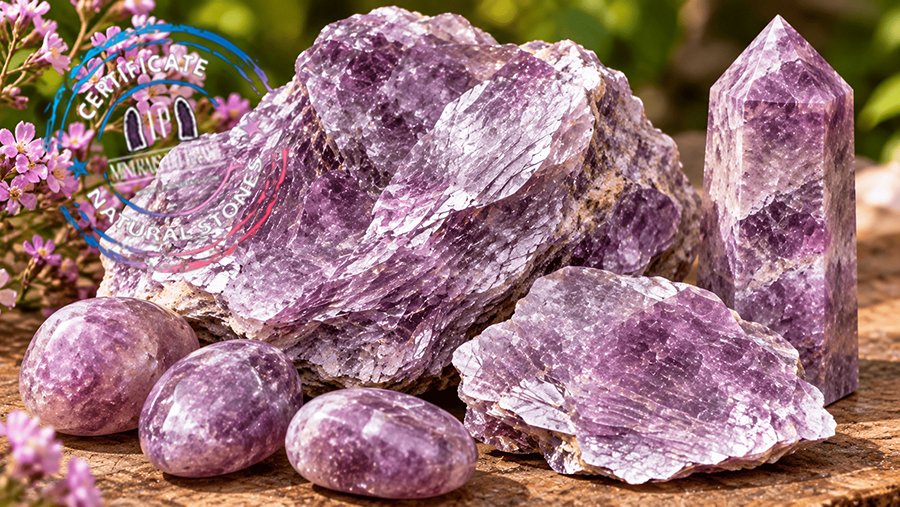
Lepidolite: properties, geological origin, spiritual meaning, and applications of this lilac-colored stone
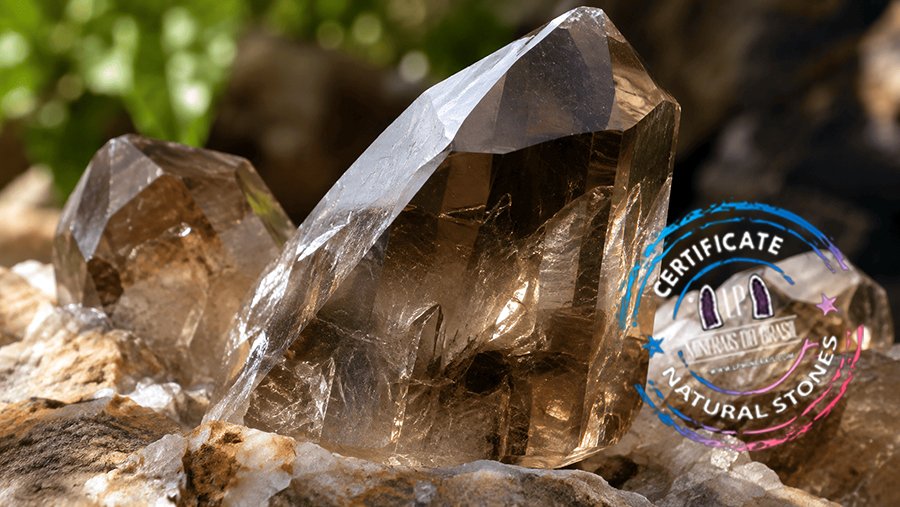
Smoky Quartz: the stone of energetic protection, grounding, and inner strength
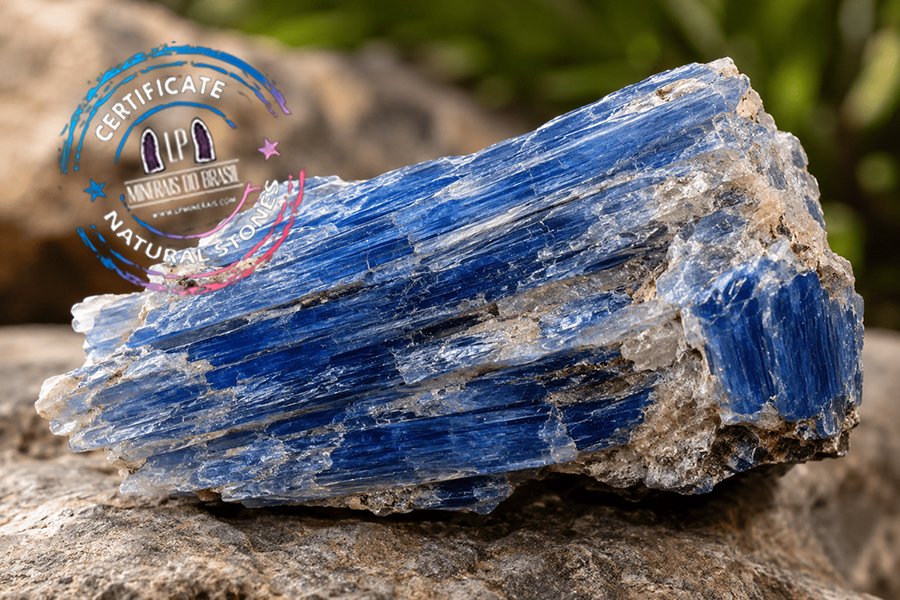
Blue Kyanite: why is this stone of spiritual protection known as the Sword of Archangel Michael?
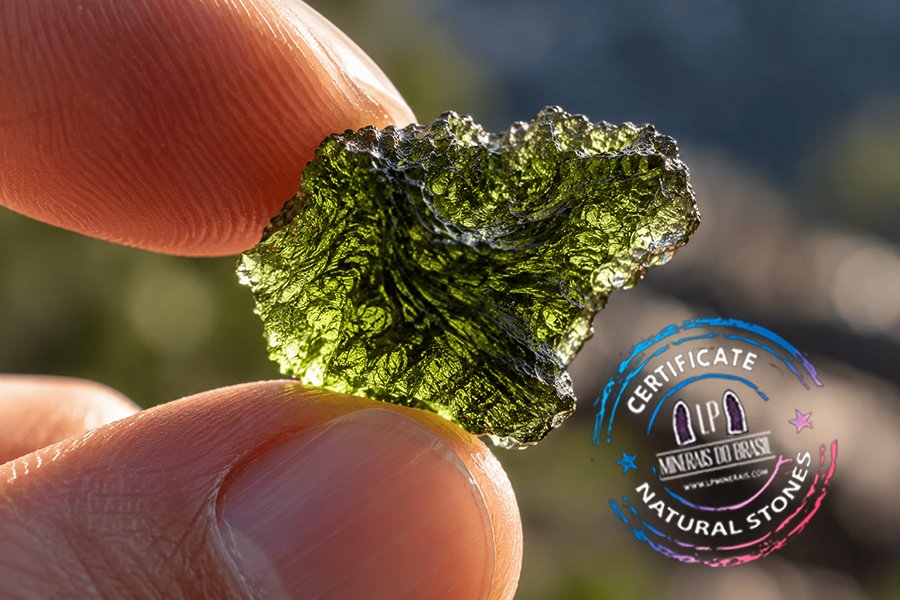
Moldavite: the stone born from a meteorite impact that became a symbol of transformation
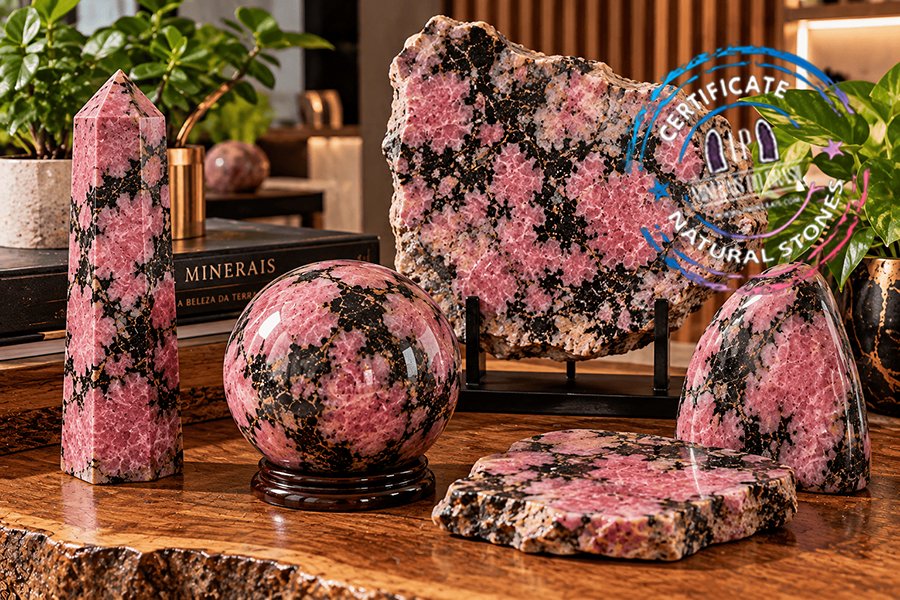
Rhodonite: Why Is It Known as the Stone of Forgiveness and Emotional Healing?
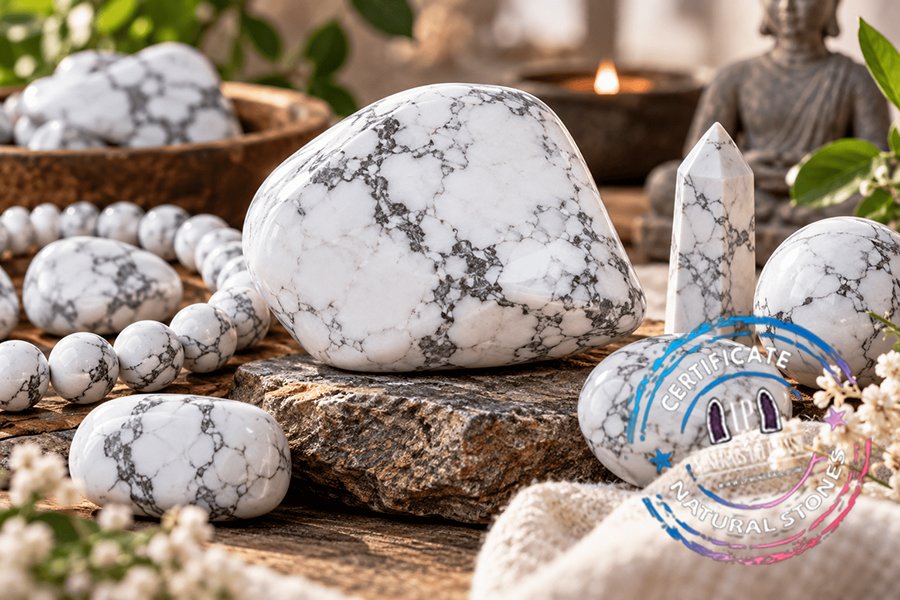
Howlite: what lies behind the Stone of Calm and Inner Silence?
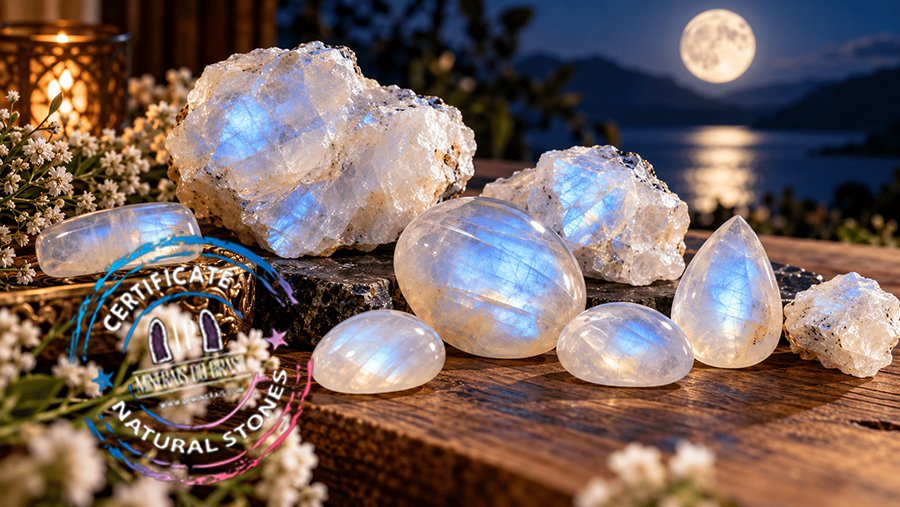
Moonstone: the Stone of Intuition, Feminine Energy, and the Mysteries of the Moon.
Jade: The Stone of Wisdom, Prosperity, and Harmony That Spans Millennia