



In times of rapid change, sensory overload, and difficult decisions, many people seek symbols that convey strength without rigidity. Natural Gray Agate fills this very niche: its understated appearance, marked by shades of gray, white, graphite, and soft transparencies, inspires a sense of quiet stability. Unlike visually intense stones, it does not draw attention through excess, but rather through the harmony of its layers and the elegance of its natural patterns.
In crystal therapy traditions, Gray Agate is often associated with emotional balance, moderate protection, mental clarity, and inner strength. These interpretations belong to the symbolic and holistic realm and do not constitute scientifically proven effects. Nevertheless, they help explain why this stone frequently appears in work environments, meditation spaces, everyday jewelry, and interior design projects that value simplicity and a connection with nature.
From a mineralogical perspective, agate is a banded variety of chalcedony, composed of microcrystalline silica. Its layers can form concentric, parallel, wavy, or irregular patterns, resulting from successive deposits of silica within natural cavities in the rock.
What does Gray Agate symbolize?
The color gray typically occupies a middle ground between light and dark. Therefore, symbolically, it is associated with neutrality, thoughtfulness, and the ability to observe a situation before reacting. In Natural Gray Agate, this symbolism gains depth due to the bands that formed slowly over geological time.
Traditionally, the stone is used to represent stability during times when emotions and thoughts seem to be pulling in opposite directions. Rather than symbolizing sudden changes, it is often associated with gradual processes: maturing a decision, understanding limits, regaining confidence, and rebuilding inner security.
In holistic practices, its most common associations involve:
- emotional stability;
- gentle protection;
- discernment;
- patience;
- grounding;
- trust built over time.
Gray Agate doesn’t need to be introduced as a stone with immediate effects. Its symbolism is much closer to constancy, the ability to remain centered, and the strength that develops quietly.
A subtle energy for those who prefer balance
Some stones are traditionally described as having an intense energetic presence. Natural Gray Agate takes a different path. It is often sought after by people who appreciate a more moderate, stable, and contemplative sensation, without the symbolism of upheaval or radical transformation attributed to other crystals.
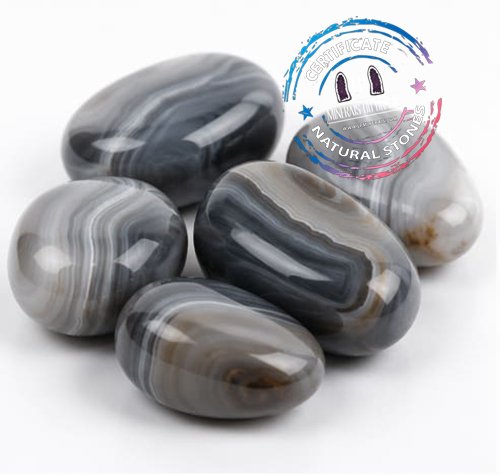
During meditation, it can be used as a focal point for concentration. Its natural patterns invite leisurely observation, almost like tracing the contours of a mineral landscape. The goal is not to ascribe powers to the object, but to use it as a symbolic aid to slow down and focus one’s attention.
In daily life, many people keep a piece on their desk, on a bookshelf, or near books and study materials. Its neutral color blends easily with different environments and can represent the intention to act with greater clarity before making decisions.
When is this stone typically chosen?
Natural Gray Agate tends to spark interest during periods when a person wishes to regain stability without losing touch with reality. Its symbolism is not linked to escapism, but to the ability to navigate changes with serenity.
It may come into play during times such as:
- a career transition;
- the start of a new routine;
- the need to set boundaries;
- the pursuit of greater concentration;
- adapting to gradual changes;
- creating calmer environments.
These applications belong to the symbolic realm and vary according to each person’s individual experience.
The layers that tell a geological story
The beauty of agate begins in spaces that, at first glance, appear empty. Cavities in volcanic rocks or other geological environments can fill with silica-rich solutions. Over time, this material is deposited in successive layers, creating the bands that characterize many agates.
This filling does not occur all at once. Variations in composition, solution concentration, and local conditions alter the appearance of each layer. For this reason, two pieces cut from the same nodule may reveal related patterns, but they are never completely identical.
Agate is composed primarily of fibrous chalcedony, though it may also contain layers of quartzite and areas of crystalline quartz. Scientifically speaking, chalcedony consists of aggregates of microscopic or submicroscopic silica crystals that are impossible to distinguish individually with the naked eye.
Why are some agates gray?
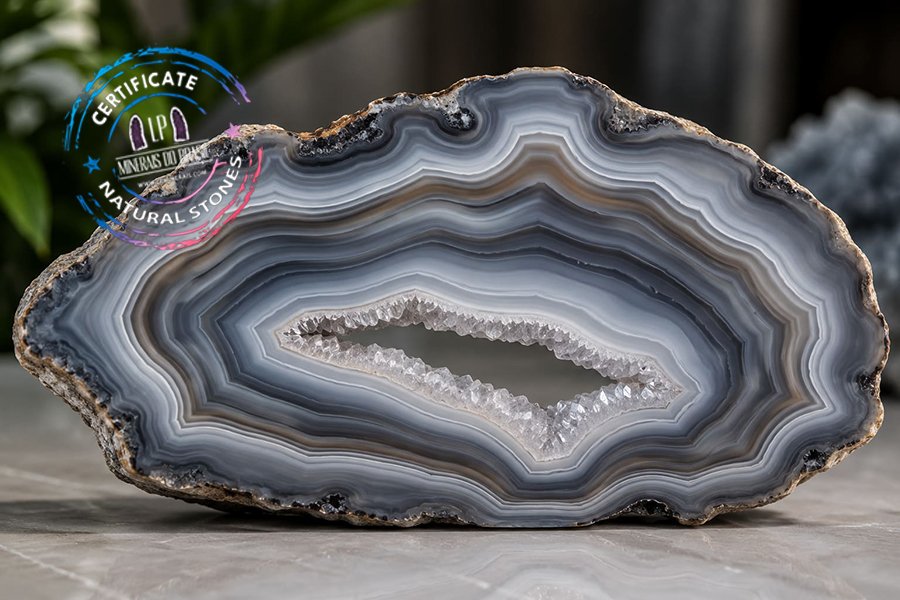
The color of Natural Gray Agate can vary from light gray, bluish gray, graphite, milky white, to partially translucent areas. These shades result from the conditions of formation, the mineral inclusions present, and the way light interacts with the microcrystalline structure.
Not all gray agates feature highly contrasting bands. Some pieces display soft, almost hazy patterns, while others reveal well-defined white lines against a graphite background. Chalcedony occurs naturally in whitish, grayish, bluish tones, and other variations, and gray specimens have also been documented in Brazilian deposits.
This diversity makes it important to distinguish Natural Gray Agate from dyed materials. Colors that are excessively uniform, saturated, or concentrated in fissures may indicate treatment, although a conclusive assessment must be performed by a qualified professional.
Brazil: Tradition, Variety, and Presence in the Mineral Market
Brazil has a strong international presence in the agate market, particularly due to deposits associated with the volcanic rocks of the Paraná Basin. Rio Grande do Sul has established itself as one of the regions best known for the processing, cutting, polishing, and marketing of these stones.
Brazilian agates are transformed into slabs, geodes, coasters, sculptures, jewelry, decorative objects, and collector’s items. In the case of gray varieties, their more neutral aesthetic lends itself well to contemporary architecture and interior design, where natural materials are used without compromising the design’s understated elegance.
For LP MINERAIS ⛏💎📦🗺, the value of this material also stems from its origin, responsible processing, and commercial transparency. A supply chain aligned with Fair Trade principles helps recognize the work of those who extract, select, cut, polish, and prepare each piece for the showroom or for export.
A stone that complements its surroundings
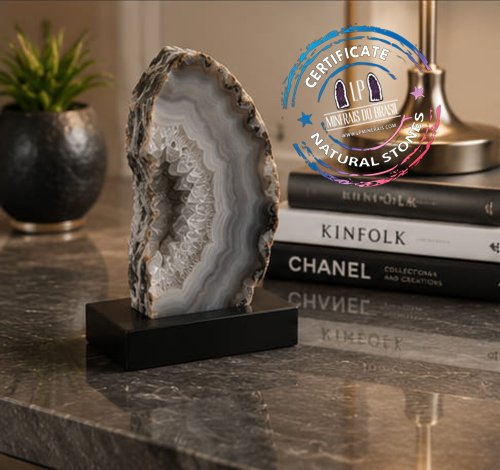
Natural Gray Agate possesses a decorative quality that is difficult to reproduce artificially: it adapts to the space without disappearing into it. Against light marble, wood, concrete, glass, or metal, its bands create texture and depth without introducing a dominant color.
In living rooms, it can be displayed as a geode, a sculpture, or a set of polished pieces. In offices, it complements an organized and professional aesthetic. In meditation spaces, its calmer visual presence contributes to a less cluttered composition.
When backlit, translucent agate slabs reveal internal patterns that do not appear the same way under ordinary light. This feature is used in light fixtures, panels, tabletops, and decorative objects, transforming the stone’s natural structure into the central element of the design.
Jewelry that Embraces Understated Elegance
In jewelry, Gray Agate offers an elegant alternative for those who prefer natural stones with a discreet appearance. Oval cabochons, geometric shapes, beads, and free-form cuts allow the natural bands to be highlighted without requiring overly complex cuts.
The stone pairs especially well with silver, steel, yellow gold, and metals with an antique finish. Depending on the cut, a single piece can display shades of gray, white, translucency, and dark lines, creating a piece of jewelry that stands out for its mineral identity—not just its brilliance.

Because its hardness is similar to that of other forms of chalcedony and microcrystalline quartz, agate offers sufficient durability for various types of jewelry, although strong impacts should still be avoided.
Gemological references place the hardness of quartz and chalcedony varieties at approximately 6.5 to 7 on the Mohs scale.
Its value lies in its pattern, natural appearance, and origin
Natural Gray Agate is not typically classified as a rare gemstone. Its commercial value depends primarily on size, the quality of the polish, the definition of the bands, the integrity of the piece, translucency, and the aesthetic appeal of the patterns.
A specimen with well-defined patterns and natural coloration may attract more interest than a larger piece that is visually unremarkable. Well-balanced geodes, symmetrical slabs, matched pairs, and well-finished objects also command a premium due to the work required for selection and processing.
In collecting, a known origin adds mineralogical context. In interior design, the finish and scale of the piece directly influence the price. In jewelry, cuts that properly highlight the natural bands tend to produce more exclusive results.
What makes a Natural Gray Agate special?
A stone’s value isn’t always tied to its rarity. In many cases, it stems from a combination of natural beauty, the quality of the material, and the way nature has shaped each specimen. Natural Gray Agate is an excellent example of this.
Unlike stones that catch the eye with vibrant colors, it captivates with the refinement of its details. Its natural bands never repeat exactly the same way, transforming each piece into a small geological record spanning millions of years. It is precisely this uniqueness that makes architects, interior designers, jewelers, and collectors appreciate this variety of agate so much.
When a piece features well-defined bands, good translucency, and an excellent finish, its value becomes much more closely tied to its natural beauty than simply to its size.
A closer look reveals much more
A high-quality Natural Gray Agate typically features:
✓ continuous natural bands;
✓ no artificial coloring;
✓ excellent polish;
✓ a characteristic vitreous luster;
✓ unique patterns created by nature itself.
It is precisely these details that distinguish an ordinary piece from one that attracts interest in sophisticated collections and interior design projects.
A Stone That Transcends Trends
Some stones come in and out of fashion as interior design styles or jewelry trends change. Natural Gray Agate seems to follow a different path.
Its neutrality ensures it remains timeless in virtually any era. In contemporary settings, it harmonizes with concrete, light wood, and minimalist lines. In classic spaces, it pairs naturally with marble, precious metals, and traditional furniture.
This versatility explains why it appears in both decorative objects and small sculptures, bookends, lamps, polished geodes, trays, and design pieces.
Rather than merely following trends, it adapts to them.
Between Contemplation and Decoration
There is a curious aspect to Natural Gray Agate: many people choose this stone without knowing its geological history or its energetic symbolism. They simply enjoy the visual sensation it conveys.
Perhaps this is because its patterns resemble landscapes seen from above, gentle waves, or moving clouds. In some specimens, the layers look like true natural paintings.
For this reason, it is a stone widely used in:
- corporate offices;
- medical offices;
- libraries;
- reading rooms;
- meditation spaces;
- contemporary architectural projects.
It doesn’t dominate the space. It complements it.
How can you identify a genuine natural gray agate?
Agate’s popularity has led to the emergence of countless artificially dyed versions. Although many are correctly marketed as treated stones, others end up being mistaken for natural specimens.
A natural gray agate typically features smooth transitions between shades, naturally formed bands, and subtle variations that would be difficult to reproduce artificially.
Some signs warrant attention:
- excessively uniform colors;
- very intense pigmentation;
- concentration of color in cracks;
- unnatural, repetitive patterns.
When in doubt, verifying the piece’s provenance and purchasing from specialized suppliers remain the best ways to ensure authenticity.
🗺 LP MINERAIS Technical Section ⛏💎📦🗺
🗺 » ORIGIN – Brazil, Uruguay, India, Botswana, Mexico, Madagascar, and the United States.
⚛️ » CHEMICAL COMPOSITION – SiO₂ (Silicon Dioxide – banded variety of Chalcedony).
🔩 » MOHS HARDNESS – 6.5 to 7.
🔢 » NUMEROLOGY – There is no mineralogical or scientific consensus regarding a specific numerological meaning.
🔅 » MEANING – Traditionally associated with stability, emotional balance, gentle protection, and discernment.
🅰️ » SUMMARY – A natural variety of agate characterized by bands in shades of gray, white, and graphite.
✅ » SPECIFICATION – A variety of chalcedony (microcrystalline quartz).
🧩 » STATE – Natural mineral.
⚒ » FORMATION – Successive deposition of silica in cavities within volcanic rocks over millions of years.
⚠️ » CARE – Avoid strong impacts and prolonged contact with chemicals.
🛁 » CLEANING – Running water, a soft cloth, and mild soap when necessary.
🎨 » COLOR – Light gray, medium gray, graphite, white, and translucent areas.
☯️ » ZODIAC – Traditionally associated with Gemini in some crystal therapy traditions. There is no universal consensus.
🪐 » SOLAR SYSTEM – Traditionally associated with the planet Mercury in some esoteric traditions.
➰ » CHAKRAS – Often associated with the Root Chakra and the Throat Chakra, depending on the tradition.
♻ » ELEMENT – Traditionally associated with the Earth element.
💎 » RARITY – Not considered rare, but specimens with well-defined natural bands are more highly valued.
🗳 » CHARACTERISTICS – Natural bands, high durability, vitreous luster, and a wide variety of patterns.
Frequently Asked Questions About Natural Gray Agate
Is Natural Gray Agate a natural stone?
Yes. It is a natural variety of chalcedony formed by geological processes that occurred over millions of years.
How can you tell if a Gray Agate is real?
Examine the natural appearance of the bands, the color variations, and the piece’s origin. If in doubt, a gemological analysis can confirm its authenticity.
Can Natural Gray Agate get wet?
Yes. Occasional contact with water does not usually cause damage. It is only recommended to dry it completely after cleaning.
Is Natural Gray Agate rare?
No. However, pieces with excellent natural patterns, high translucency, and a high-quality finish are highly valued.
What is Natural Gray Agate used for?
In addition to jewelry, it is widely used in home decor, collecting, mineral crafts, and, traditionally, in meditation and for harmonizing spaces.
What is the difference between Natural Gray Agate and Onyx?
Although both can have dark hues, Natural Gray Agate has visible natural bands and belongs to the chalcedony family. Onyx is also a variety of chalcedony, but it has a different structure and patterns, usually with more regular parallel bands.
Does Natural Gray Agate pair well with other stones?
In crystal healing traditions, it is often used in combination with Clear Quartz, Amethyst, Rose Quartz, and Black Tourmaline, depending on the intended use. These combinations fall within the realm of holistic practices.
Conclusion
Natural Gray Agate demonstrates that elegance is not always associated with exuberance. Its layers, slowly formed by nature, tell a geological story spanning millions of years and transform each piece into a unique specimen.
At the same time, its traditional symbolism—often linked to stability, discernment, and balance—makes it one of the most prized stones for those seeking to combine natural beauty, meaning, and versatility. Whether used to create a subtle piece of jewelry, enhance a sophisticated setting, or complement a mineralogical collection, Natural Gray Agate remains a timeless choice that transcends trends without losing its identity.
By: Doris S. Rosa
Howlite: what lies behind the Stone of Calm and Inner Silence?
Moonstone: the Stone of Intuition, Feminine Energy, and the Mysteries of the Moon.
Jade: The Stone of Wisdom, Prosperity, and Harmony That Spans Millennia
Angelite: The Stone of Serenity, Intuition, and Spiritual Connection
Green Aventurine: the Stone of Prosperity, Opportunity, and New Paths
Orange Calcite: The Solar Energy That Awakens Creativity and Movement
Black Obsidian: origin, formation, properties, and meaning of one of the best-known protective stones.
Carnelian: origin, formation, mineralogy, and the vibrant energy of a stone linked to action.
Fluorite: Mineralogy, Formation, Colors, and Meaning of a Mineral that Organizes Light and Color
Red Jasper: Mineralogy, Vitality, and the Ancestral Strength of an Earth-Connected Stone