



Some stones immediately impress with their brilliance. Others captivate with the intensity of their colors. Angelite takes a different path: its soft blue—often accompanied by delicate white areas—conveys a serene appearance that perfectly matches the symbolism that has come to be associated with it in the world of crystals.
Known primarily for its associations with serenity, communication, intuition, and spiritual connection, Angelite has found its place in collections, meditation spaces, decorative objects, and harmonization practices. Its light blue hue also makes it an easily recognizable stone—although there are similar materials on the market that can cause confusion.
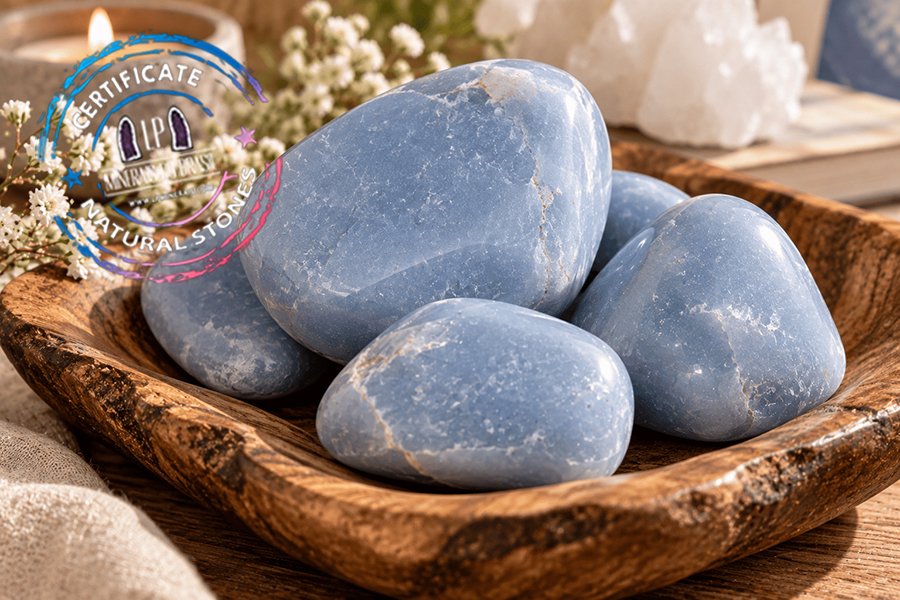
Behind this almost ethereal appearance lies a fascinating mineralogical history. Angelite is not a distinct mineral species: “Angelite” is the commercial name given to a blue variety of anhydrite, a mineral composed primarily of anhydrous calcium sulfate.
And understanding this origin even helps explain one of the most important rules for anyone who owns an Angelita: it requires special care regarding water and humidity.
So, what exactly is Angelita?
Mineralogically, Angelita corresponds to anhydrite, whose chemical formula is CaSO₄. The name “anhydrite” itself refers to the absence of water in its chemical structure, distinguishing it from gypsum, which is a hydrated calcium sulfate.
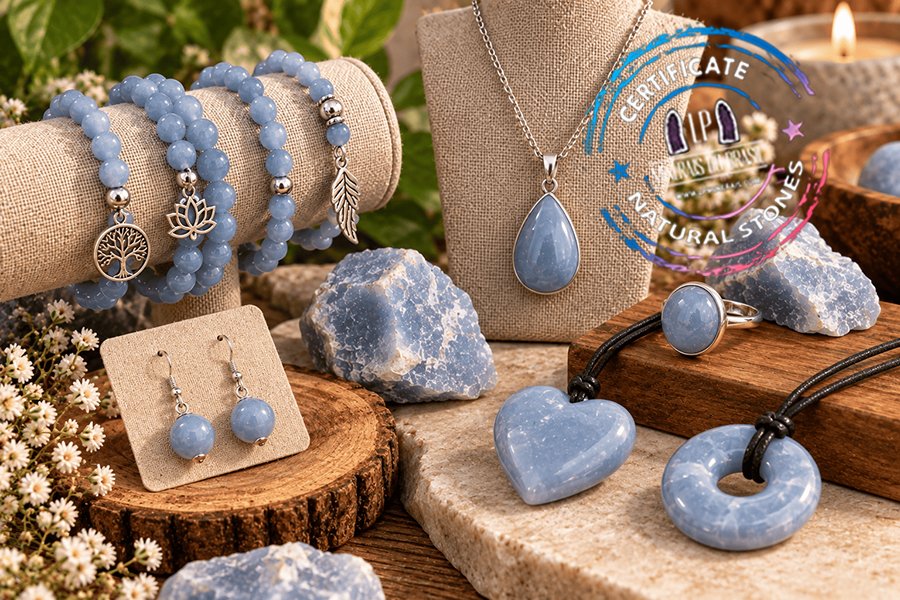
The stone sold as Angelite typically ranges in color from very light blue to grayish blue and may contain whitish areas and natural variations in hue. In polished pieces, its smooth, almost opaque appearance is particularly attractive.
Another important characteristic is its relatively low hardness, ranging from approximately 3 to 3.5 on the Mohs scale. This means that Angelita is considerably more delicate than quartz, agate, and various other stones commonly used in jewelry.
This characteristic does not diminish its appeal. On the contrary: it helps determine which applications are most suitable and what care should be taken with each piece.
A stone that deserves gentle handling
Angelita’s serene appearance curiously aligns with the way it should be handled.
Because it is relatively soft, it can scratch and chip more easily. Polished pieces should be stored separately from harder minerals, especially quartz, which can scratch their surface when they come into contact inside boxes or containers.
It is also recommended to avoid prolonged exposure to water. Anhydrite can undergo changes when hydrated; therefore, submerging an Angelita for cleaning is not recommended.
This also means that popular methods of “energetic cleansing” involving containers with water or water and salt are not appropriate for this stone.
Understanding mineralogy, therefore, is not merely a matter of scientific curiosity. It directly influences the preservation of the crystal.
Where does Angelite come from?
Angelite became commercially known primarily through blue specimens from Peru, a country strongly associated with the stone in the mineral and crystal market.
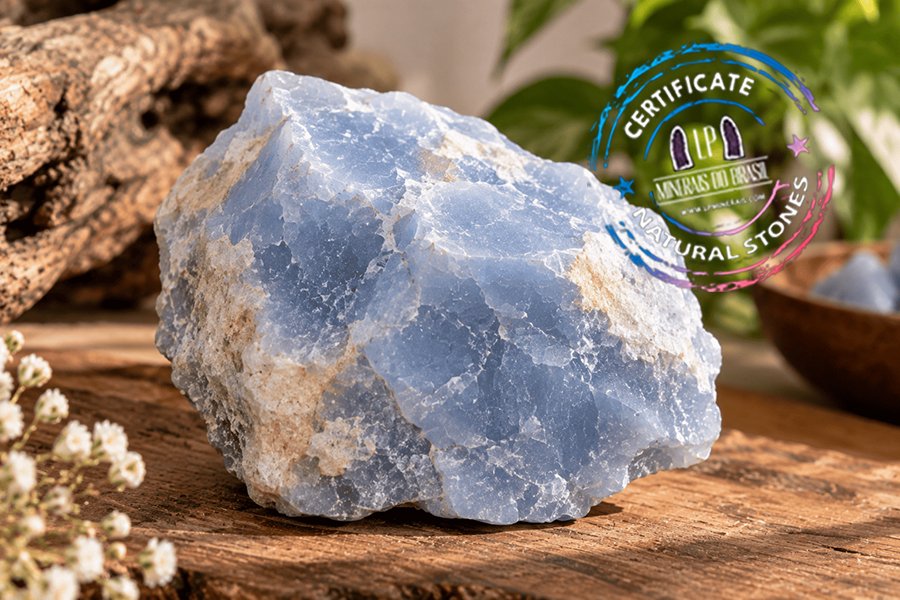
Anhydrite, as a mineral species, can occur in different geological contexts and locations. Its formation is often related to evaporitic environments, in which salt-rich solutions undergo processes of evaporation and mineral precipitation. It can also appear in other geological environments related to the transformation of minerals containing calcium sulfate.
In the commercial market, however, the name “Angelita” has become primarily associated with the blue material used for polished pieces, tumbled stones, sculptures, and ornamental objects.
Provenance remains a key consideration. For professional buyers, collectors, and dealers, clear information about origin and identification helps distinguish a natural mineral from imitations or materials sold solely because of their similar color.
Can Angelita be confused with other blue stones?
Yes—and observing only the color is never sufficient for a reliable identification.
Depending on the piece, Angelite may resemble Blue Calcite, Celestite, or other light-blue minerals. However, these are mineralogically distinct materials, each with its own composition, crystal structure, hardness, and physical properties.
Celestite, for example, is a strontium sulfate, while calcite is a calcium carbonate. Visual similarity does not make these minerals varieties of the same stone.
It’s also important to exercise caution with e-commerce photographs. Lighting, editing, and color balance can make a stone appear much bluer than it actually is.
For consumers, provenance and a reliable supplier are good starting points. For definitive identification of questionable or higher-value materials, mineralogical or gemological methods are more reliable than home tests.
Angelite and the Symbolism of Inner Peace
It is precisely in the energetic realm that Angelite has built much of its popularity.
In crystal healing traditions, it is often described as a stone of serenity, spiritual insight, and conscious communication. Its symbolism is linked to the idea of reducing inner noise to create space for a calmer perception of thoughts, emotions, and situations.
This does not mean eliminating emotions or avoiding difficulties. The traditional interpretation of Angelite is much more closely related to the way one navigates these moments: with calm, reflection, and less impulsive communication.
Its blue color has also historically reinforced its symbolic association with the sky, the expansion of consciousness, and spiritual dimensions. The trade name “Angelita” itself has contributed to its modern connection with practices involving spiritual protection, inner guidance, and angelic connection.
These interpretations belong to the spiritual and cultural realm of crystal therapy. They do not constitute medical treatments or scientifically proven therapeutic effects.
Communication, Intuition, and Expression
Angelite is traditionally associated primarily with the throat chakra, which is symbolically linked to communication and expression. Some traditions also establish connections with higher energy centers associated with intuition and spiritual perception.
For this reason, its use is not usually limited to silence or meditation. There is an interesting dimension linked to the ability to speak clearly and, at the same time, to know how to listen.
In personal practices, it can be chosen for moments involving important conversations, the need to express feelings, or situations where one wishes to curb impulsive responses.
In the professional setting, this symbolism also finds its place. An Angelita on a desk can serve as a decorative object and, for those who follow energy practices, as a reminder to communicate more calmly during meetings, negotiations, and professional relationships.
Its role, in this context, is symbolic—not a promise of external results.
Angelita in Meditation and Living Spaces
The stone’s naturally serene appearance makes it well-suited for spaces dedicated to rest, reading, and contemplation.
In meditative practices, some people prefer to simply hold a tumbled stone or place it nearby during breathing exercises. Others include it in altars or arrangements intended for introspection and spirituality.
Angelite can also be symbolically combined with other stones. With Amethyst, it creates an arrangement traditionally focused on spirituality and introspection. With Rose Quartz, it can be incorporated into practices related to emotional serenity and acceptance. When paired with clear quartz, it often appears in sets designed to promote clarity and meditation.
In interior design, larger pieces or polished forms work especially well in spaces with neutral tones, wood, natural fibers, and light-colored elements. Its soft blue creates a pop of color without visually overwhelming the space.
How can you use Angelite in your daily life?
How you use Angelite depends mainly on the stone’s shape and the intention of the person choosing it.
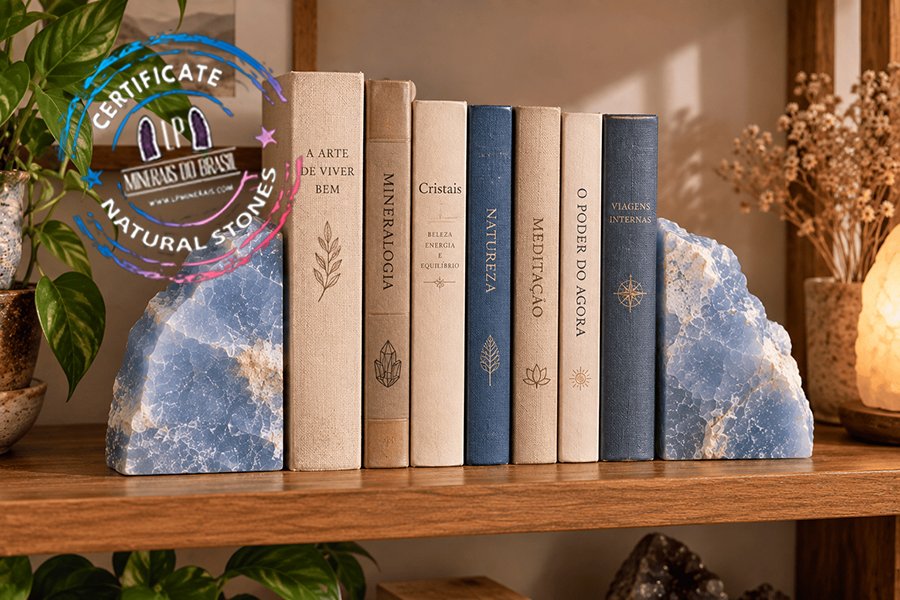
Tumbled stones are practical for collections, meditation, and small decorative spaces. Rough specimens appeal to those who appreciate the mineral’s appearance more directly. Sculptures, free-form pieces, and polished items can be displayed on tables, shelves, and in spaces for contemplation.
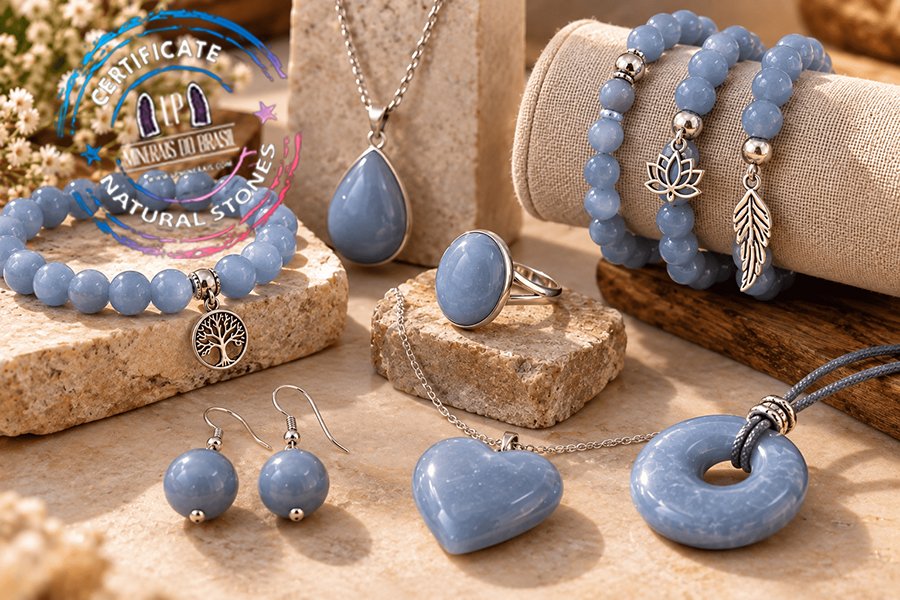
In jewelry and costume jewelry, Angelita can be featured in pendants, necklaces, earrings, and bracelets, but its low hardness requires care. Rings are more exposed to impacts and friction and therefore need even greater attention.
This is a great example of how beauty and mineralogy must go hand in hand: not every stone should be treated as if it had the durability of quartz.
How to clean and care for Angelite?
Here’s a simple rule to keep in mind: Angelita prefers dry and gentle care.
To remove dust, use a soft, dry cloth. If absolutely necessary, a only slightly damp cloth may be used with caution, drying the piece immediately afterward. Prolonged immersion should be avoided.
Harsh chemicals, abrasives, or ultrasonic cleaning without professional guidance are also not recommended.
For energy-cleansing practices, those who follow these traditions may opt for methods that do not rely on water, such as sound, smudging appropriate to one’s personal practice, or placing the crystal near—without contact—other crystals used symbolically for this purpose.
LP MINERALS Table ⛏💎📦🗺
🗺 » ORIGIN: a commercial material known especially for deposits in Peru
⚛️ » CHEMICAL COMPOSITION: CaSO₄ — anhydrous calcium sulfate
🔩 » MOHS SCALE: approximately 3 to 3.5
🔢 » NUMEROLOGY: traditionally associated with the number 1
🔅 » MEANING: serenity, communication, intuition, and spiritual connection
🅰️ » SUMMARY: a stone of gentle symbolism, associated with inner peace and conscious expression
✅ » SPECIFICATION: a blue variety of anhydrite marketed as Angelite
🧩 » FORM: found in its raw state, tumbled, polished, and crafted into decorative pieces
⚒ » FORMATION: primarily related to geological processes involving sulfates, including evaporitic environments
⚠️ » CARE: Avoid impacts, scratches, chemicals, and prolonged exposure to water
🛁 » CLEANING: preferably with a soft, dry cloth; avoid soaking
🎨 » COLOR: light blue to grayish blue, often with whitish areas
☯️ » ZODIAC: traditionally associated with Aquarius
🪐 » SOLAR SYSTEM: Uranus
➰ » CHAKRAS: Throat chakra and, in some traditions, the higher energy centers
♻ » ELEMENT: Air
💎 » RARITY: moderate commercial availability; quality varies depending on color, integrity, and finish
🗳 » CHARACTERISTICS: soft blue, delicate appearance, and low hardness
Frequently Asked Questions About Angelite
Is Angelite really a natural stone?
Yes. Angelita is the trade name used for a natural blue variety of the mineral anhydrite. As with other stones, a reliable source is important to avoid misidentified materials.
Can Angelita get wet?
It is best to avoid immersion and prolonged contact with water. Anhydrite has mineralogical characteristics that make prolonged exposure to moisture unsuitable for its preservation.
Are Angelita and Celestite the same stone?
No. Although they may have similar hues, they have different compositions. Angelita is anhydrite, essentially CaSO₄; Celestite is a strontium sulfate mineral.
What is the energetic purpose of Angelite?
Traditionally, it is used in practices related to serenity, communication, meditation, intuition, and spiritual connection. These associations are symbolic and stem from crystal healing traditions.
Can I use Angelite at work?
Yes. As a decorative element, its soft blue color works well in offices and client-facing spaces. Energetically, some people use it as a symbol of calm communication and balance in professional relationships.
Can Angelite be used in jewelry?
Yes, but it requires care. With a hardness of approximately 3 to 3.5 on the Mohs scale, it is more susceptible to scratches and impacts than stones such as quartz, amethyst, or aventurine.
How can you tell Angelite apart from Blue Calcite?
They may look similar in certain specimens, but they are different minerals. Identification based solely on photographs is not recommended; composition, hardness, and other mineralogical properties allow them to be distinguished.
The beauty of finding tranquility amid the hustle and bustle
Perhaps it is precisely this combination of physical delicacy and symbolism that makes Angelite so intriguing. It is not a stone meant to be handled carelessly—and, interestingly, the entire tradition surrounding it speaks precisely of attention, serenity, listening, and sensitivity.
Its blue need not be intense to catch the eye. Whether in a collection, a delicate piece of jewelry, or a meditation space, Angelita offers a quiet beauty. For those who identify with its traditional meaning, it also becomes a symbol that not all progress needs to happen through force: some paths begin when we manage to quiet the noise and perceive what’s around us with greater clarity.
Within the LP MINERAIS ⛏💎📦🗺 philosophy, getting to know a stone means seeing beyond its color. It means understanding its mineralogical nature, respecting its care requirements, correctly recognizing its identity, and valuing a supply chain based on information, ethical sourcing, responsible selection, and Fair Trade principles—whether for collecting, decoration, jewelry, showrooms, or the export market.
Doris S. Rosa
Howlite: what lies behind the Stone of Calm and Inner Silence?
Moonstone: the Stone of Intuition, Feminine Energy, and the Mysteries of the Moon.
Jade: The Stone of Wisdom, Prosperity, and Harmony That Spans Millennia
Green Aventurine: the Stone of Prosperity, Opportunity, and New Paths
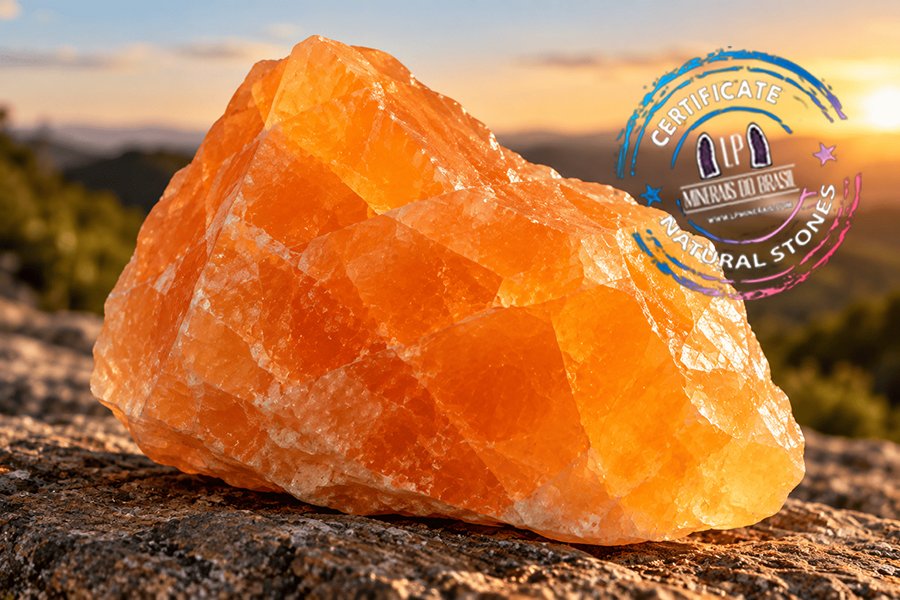
Orange Calcite: The Solar Energy That Awakens Creativity and Movement
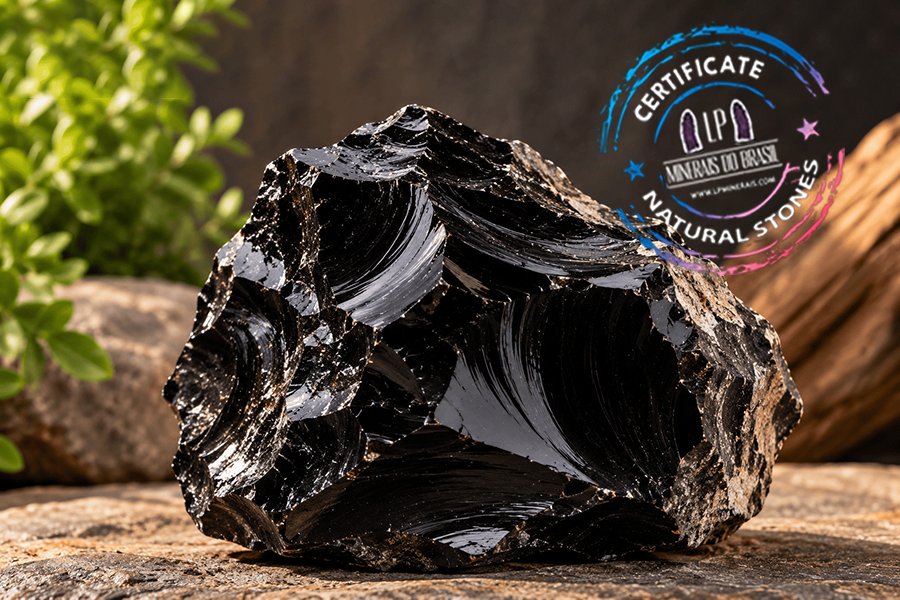
Black Obsidian: origin, formation, properties, and meaning of one of the best-known protective stones.
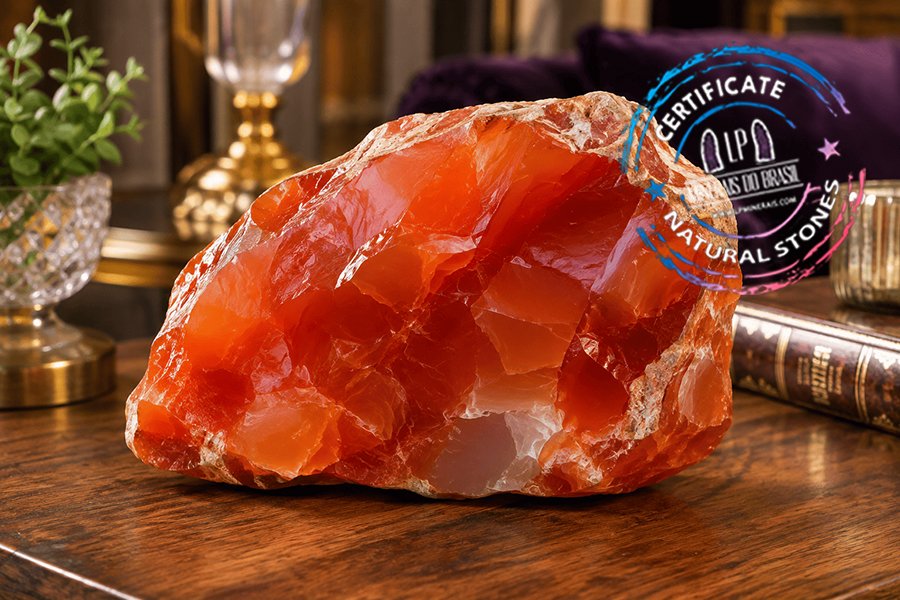
Carnelian: origin, formation, mineralogy, and the vibrant energy of a stone linked to action.
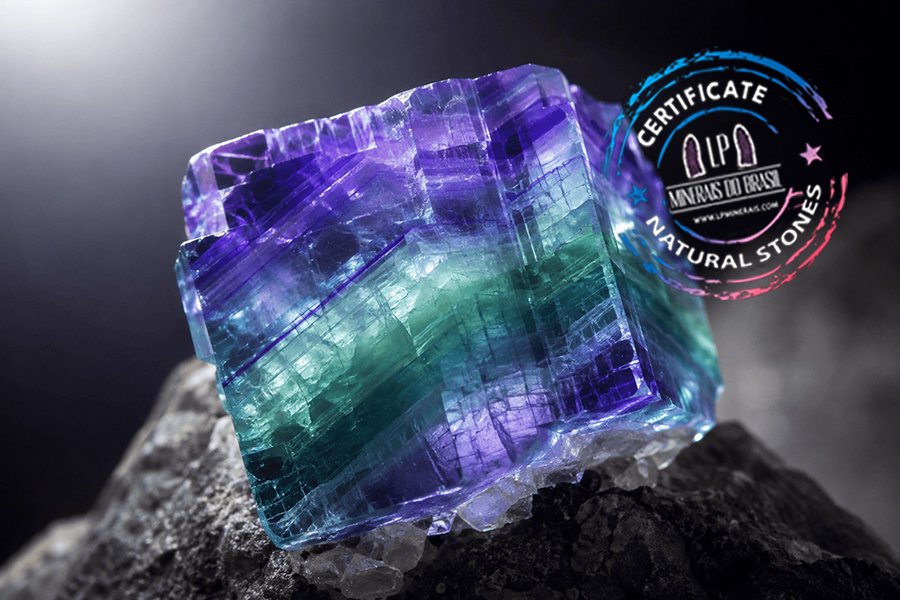
Fluorite: Mineralogy, Formation, Colors, and Meaning of a Mineral that Organizes Light and Color
Red Jasper: Mineralogy, Vitality, and the Ancestral Strength of an Earth-Connected Stone
Hematite: The Strength of Iron, Grounding, and the Presence That Comes from the Earth