




When polished, it seems to absorb light rather than simply reflect it. This appearance has contributed to its association, throughout history, with protection, mystery, introspection, and the ability to reveal what remains hidden.
From a geological standpoint, however, there is a fundamental characteristic that needs to be clarified from the outset: obsidian is not technically a crystalline mineral. It is a natural volcanic glass, formed when silica-rich lava cools too quickly for its components to have time to organize into crystals. As a result, its internal structure is amorphous, similar to that of artificially produced glass, although its origin is entirely natural.
This characteristic helps explain some of its most impressive properties: its extremely smooth surface when polished, its vitreous luster, and, above all, its ability to produce exceptionally sharp edges when fractured. These properties made obsidian an important material for various human societies long before it became known as an ornamental stone or a crystal used for energy purposes.
Today, it occupies two equally fascinating roles. In geology, it is an almost instantaneous record of the cooling of silica-rich magma. In the tradition of crystal therapy—especially in lineages focused on protection, grounding, and self-knowledge—Black Obsidian is considered one of the most intense and profound stones.
How Black Obsidian Forms
The formation of obsidian is primarily linked to silica-rich magmas, usually of a composition similar to rhyolite. This type of magma is quite viscous, meaning it has difficulty flowing freely.
When this lava reaches the surface or nears it and cools very rapidly, the atoms in the material are unable to organize themselves into a complete crystalline structure. The result is a natural glassy mass.
It is precisely this absence of an ordered crystalline lattice that distinguishes obsidian from minerals such as quartz, calcite, or fluorite.
In simple terms, we can imagine two scenarios:
- if the molten material cools slowly, the crystals have time to grow;
- if it cools rapidly under the right conditions, it can solidify as volcanic glass.
Obsidian represents this second path.
It is usually found associated with lava flows and volcanic domes rich in silica. Depending on the movement of the lava, the inclusions present, and the cooling conditions, different textures, bands, and visual effects can emerge.
Why Is Black Obsidian So Dark?
At first glance, it seems contradictory that a glass formed from silica-rich lava could have such an intense black color.
The explanation lies mainly in the small amounts of iron and the microscopic inclusions distributed throughout the volcanic glass. Extremely small crystals of iron-rich minerals—including magnetite—along with other microscopic particles can absorb much of the visible light, producing the characteristic black appearance.
In other varieties, variations in these inclusions and their oxidation state can create different colors. For this reason, obsidian does not come only in black.
Known varieties include:
- Black Obsidian;
- Mahogany Obsidian;
- Snowflake Obsidian;
- Golden Obsidian;
- Silver Obsidian;
- Rainbow Obsidian.
The golden and silver effects may be linked, for example, to tiny bubbles that aligned during the flow of lava, while certain iridescent colors are related to the arrangement of microscopic inclusions within the glass.
In the case of Black Obsidian, however, it is precisely the depth of its color that constitutes one of its most prized characteristics.
Structure, Hardness, and Fracture
Since it lacks an organized crystalline structure, Obsidian also does not have a crystalline system per se.
This information is important because many commercial descriptions automatically classify stones as cubic, trigonal, or hexagonal. For obsidian, this would be incorrect.
It is amorphous.
Its hardness typically ranges from approximately 5 to 5.5 on the Mohs scale, although slight variations may occur depending on its composition.
Its best-known physical characteristic is its conchoidal fracture. When broken, it produces curved surfaces similar to the inside of a shell. This pattern can result in extremely thin and sharp edges, a behavior typical of glass.
This property has been of enormous importance in human history.
Obsidian in the History of Civilizations
Long before the development of metals, peoples from different regions realized that obsidian could be worked to produce extraordinarily sharp surfaces.
It was used to make tools, arrowheads, and objects for everyday and ritual use in various ancient societies. Archaeological evidence of obsidian artifacts has been found in various parts of the world, especially in regions near ancient volcanic systems.
In Mesoamerica, its importance was particularly significant. The stone held functional, commercial, and symbolic value, playing a role in trade networks that allowed volcanic materials to be transported over great distances.
Polished objects and mirror-like surfaces were also produced. Black obsidian’s ability to reflect images against a dark background contributed to its heightened symbolism in various cultural practices.
This historical connection between the mirror, darkness, and revelation is especially interesting when we consider the meaning that would later be attributed to the stone within energy traditions.
The idea of “seeing what is hidden” has become one of the most powerful symbolic images associated with obsidian.
Black Obsidian and the Concept of Inner Truth
Even before we delve into its energetic dimension, there is a symbolic characteristic that helps us understand why Black Obsidian has such a unique reputation.
It is not traditionally viewed as a stone with a gentle energy.
In crystal therapy, its identity is deeply connected to protection, grounding, self-knowledge, and consciously confronting patterns that need to be recognized and transformed.
For this reason, the phrase “inner truth” in the title is not merely poetic. It captures one of the most recurring aspects of its traditional interpretation: Obsidian is often described as a stone that invites deep observation, helping us to perceive behaviors, emotions, and patterns that we normally prefer to avoid.
This characteristic requires that its energetic approach be taken with depth.
It is not enough to simply say that it “protects against negative energies.”
Black Obsidian has a much broader tradition linked to energetic protection, grounding, awareness of one’s own shadows, breaking patterns, personal boundaries, strength in the face of transformational processes, and the ability to remain connected to reality while engaging in deep inner work.
Black Obsidian: Protection, Grounding, and Profound Transformation
If there is one stone whose energetic tradition demands depth, it is Black Obsidian. In crystal therapy approaches associated with authors such as Judy Hall and Robert Simmons & Naisha Ahsian, it is described as an intense stone, primarily linked to protection, grounding, inner truth, and the recognition of patterns that need to be transformed.
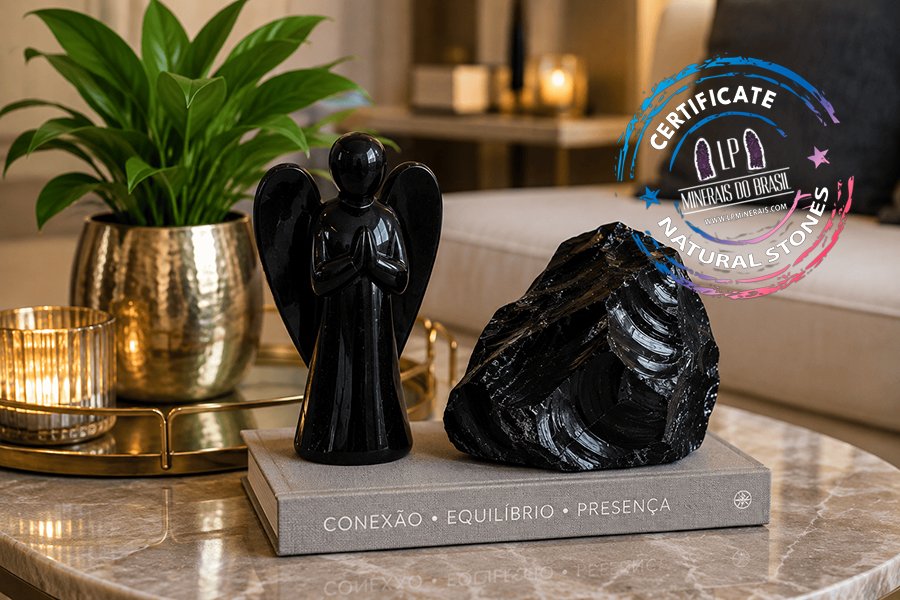
Its energy is not usually described as delicate or simply comforting. Obsidian works symbolically with what lies beneath the surface. Just as its origin stems from volcanic fire and an extremely rapid transformation of matter, its energetic interpretation is deeply linked to processes of change, revelation, and strengthening.
This is precisely why reducing Black Obsidian to the phrase “stone against negative energy” would mean losing a large part of its identity. Protection is fundamental, but there is something beyond it: the ability to cultivate enough inner strength to look within without losing touch with reality and one’s own center.
Energetic Protection and Boundaries
Protection is probably the best-known characteristic of Black Obsidian. Traditionally, it is used with the intention of creating a firm energetic barrier against influences considered unwanted, especially in charged environments or situations involving significant interaction with other people.
There is, however, an important difference between protection and isolation.
In a deeper energetic interpretation, Obsidian does not necessarily mean hiding from the world. It is much more closely related to strengthening personal boundaries: recognizing what belongs to you and what is being absorbed from the environment, relationships, or external circumstances.
For this reason, it is often chosen by people who work in busy places, interact with many people throughout the day, or feel the need to maintain greater stability in the face of environmental influences.
Its traditional uses focus especially on:
- energetic protection;
- strengthening personal boundaries;
- grounding;
- stability;
- high-traffic environments;
- self-awareness practices;
- moments of transformation.
This protection has a very “earthly” quality. Obsidian does not invite escape; it invites presence.
Grounding: Returning to the Present
Black Obsidian has a very strong energetic connection to grounding.
In crystal therapy, grounding means bringing one’s attention back to the body, the present moment, and concrete reality. It is particularly important when there is excessive distraction, racing thoughts, or a tendency to remain constantly focused on future concerns.
In this regard, Obsidian forms a fascinating contrast with stones like Selenite. While Selenite is traditionally associated with elevation, the higher centers, and the expansion of consciousness, Obsidian reminds us that all expansion must find a foundation.
It leads downward.
To the earth.
To what is concrete.
It is precisely for this reason that it is often associated with the Base or Root Chakra (Muladhara), an energy center traditionally linked to security, stability, survival, physical presence, and connection to the Earth.
This association helps explain why Obsidian is so highly valued in energy work that requires a balance between spirituality and material reality.
The Black Mirror and Inner Truth
Perhaps this is the most fascinating aspect of Obsidian.
For centuries, polished obsidian surfaces have been used as mirrors. This physical characteristic eventually found an extraordinary parallel in its energetic interpretation: obsidian has also become a symbolic mirror of the inner world.

In the tradition of crystal therapy, it is often described as capable of facilitating the perception of patterns, behaviors, and motivations that normally remain hidden beneath justifications, habits, or defense mechanisms.
It is not merely a matter of observing what we like about ourselves.
Obsidian is linked to the willingness to recognize what needs to be understood.
A repetitive behavior. A relationship that constantly pushes our boundaries. A thought pattern that prevents change. A choice we know needs to be reevaluated.
In this sense, its energy isn’t simply comforting. It’s revelatory.
And there is a huge difference between the two.
Obsidian does not represent judgment. Its symbolism is related to the clarity needed to perceive what exists and, based on that perception, to consciously choose what to do.
Obsidian and Shadow Work
Within various contemporary approaches to self-knowledge, the term “shadow” is used to represent aspects of ourselves that we avoid acknowledging or integrating. This concept has become particularly compatible with the symbolism of Black Obsidian.
Its dark surface serves almost as a perfect metaphor.
The shadow does not necessarily signify something bad. It can represent fears, insecurities, repressed desires, old patterns, or personal traits that have not yet been understood.
The energetic tradition of Obsidian is precisely related to the courage to look into these inner realms.
For this reason, it can be considered an important stone for periods of personal transformation—not because it does the work for the person, but because it symbolically fosters self-honesty, steadfastness, and self-awareness.
This aspect explains why Obsidian is often considered an intense stone. Deep introspective work can stir up significant emotions and memories; therefore, there is no need to turn its use into an extreme experience. Depth can unfold gradually.
The stone’s true power lies in awareness, not in excess.
Black Obsidian and Transformation
Few geological origins align so perfectly with the energetic symbolism attributed to a stone.
Obsidian is born of fire.
It is lava that leaves the Earth’s interior, encounters new conditions, and rapidly transforms into volcanic glass. What was once incandescent matter becomes a shiny black surface.
This origin has created a powerful archetype of transformation.
In the energy tradition, Obsidian is often sought during periods when an old structure needs to be let go of to make way for a new phase. It could be a change in behavior, the conscious closing of a cycle, or simply the decision to leave behind habits that no longer make sense.
Its symbolic message is not “change for the sake of change.”
It is about recognizing, letting go, and rebuilding on a truer foundation.
That is why protection and transformation are inseparable in Obsidian. Often, setting boundaries is precisely what enables transformation.
Emotional Strength Without Hardening
Black Obsidian is also traditionally associated with emotional strength, but this interpretation needs to be understood correctly.
Strength does not mean ignoring emotions.
Much less does it mean becoming indifferent.
Its symbolism points to the ability to remain present in the face of intense emotions without allowing them to automatically dictate every decision.
This characteristic makes the stone useful for introspective practices in which a person wishes to better understand their own reactions.
Instead of simply asking, “What am I feeling?”, the symbolism of Obsidian invites you to go further:
Why does this affect me this way?
Has this pattern happened before?
Is there something I need to acknowledge?
This inner exploration lies at the heart of your energetic identity.
Black Obsidian in Meditation
Meditation with Obsidian offers a very different experience from that typically associated with crystals such as Selenite or Amethyst.
Here, the main intention is not necessarily to elevate consciousness to subtle states. It is to deepen perception while keeping your feet symbolically firmly planted on the ground.
A tumbled stone can be held during a meditative practice, while a larger piece can remain near the chosen location.
A particularly effective approach is to begin the meditation by observing your breath and the contact between your body and the ground. Only after that should you set your intention.
Simple questions can guide the practice:
- What do I need to see more clearly?
- Where do my boundaries need to be strengthened?
- What pattern do I keep repeating?
- What has already served its purpose and can be let go of?
- What do I need to consciously transform?
Obsidian pairs particularly well with meditations on presence, grounding, and self-awareness.
Black Obsidian in Your Home
Inside the home, its energetic use is usually strongly linked to protection.
The entrance to the home is one of the most traditional places to use it. A piece of obsidian can be placed near the door with the intention of establishing an energetic boundary between the outside environment and your personal space.
Offices and workplaces are also good places to use it, especially where there is heavy foot traffic.
In therapy rooms, Obsidian can support grounding practices, though it’s a good idea to balance its presence with stones that have gentler or purifying properties.
Some particularly suitable locations are:
- the entrance to the home;
- the office;
- workplace;
- meditation room;
- altar;
- therapeutic space;
- places where you wish to enhance protection and stability.
It is not necessary to fill your home with obsidian. A single meaningful piece, chosen and placed with intention, can have much more impact than several stones scattered about aimlessly.
Black Obsidian at Work
In the professional environment, its symbolism takes on another dimension.
Energetic protection remains important, but the stone can also represent discernment, boundaries, and objectivity.
There are professional situations where knowing how to say “no” is just as important as knowing how to cooperate. There are also environments where conflicts, demands, and differing personalities make it difficult to separate professional issues from personal life.
Obsidian can be used precisely as a symbol of this boundary.
Placed on a desk or in a designated space, it can represent the intention to stay centered, avoid unnecessarily absorbing surrounding tensions, and make decisions with greater firmness.
For entrepreneurs and professionals who deal with many people on a daily basis, this interpretation is especially relevant.
Prosperity and Obsidian: A Less Obvious Connection
Black Obsidian isn’t usually the first stone that comes to mind when talking about prosperity. Pyrite and Citrine, for example, have a much more direct association with abundance and material fulfillment.
However, there is an interesting interpretation of obsidian in this context.
Prosperity also depends on recognizing what blocks growth.
Fear of change, repeatedly postponed decisions, unbalanced professional relationships, difficulty setting boundaries, or unconscious financial patterns can interfere with one’s ability to move forward.
In this sense, Obsidian does not simply symbolize “attracting money.”
It represents removing internal obstacles, strengthening decisions, and building a more conscious foundation for growth.
It is an approach to prosperity linked to transformation.
Energetic Combinations with Black Obsidian
Obsidian’s intensity allows for extremely interesting combinations. The key is to choose the second stone according to your desired intention.
Black Obsidian Selenite
One of the most well-rounded combinations for spaces.
Obsidian represents grounding, protection, and depth. Selenite adds purification, clarity, and elevation.
Earth and light.
One anchors; the other lifts.
This combination can be especially beneficial in entryways, therapeutic spaces, and places dedicated to spiritual practice.
Black Obsidian Black Tourmaline
Here, the focus is strongly on protection and grounding.
These are stones with distinct yet complementary identities. Black Tourmaline has a long tradition as a protective stone, while Obsidian adds its dimension of insight and inner transformation.
Black Obsidian Clear Quartz
Clear Quartz is traditionally associated with clarity and the amplification of intentions.
Paired with Obsidian, it creates an interesting combination for self-discovery work: depth accompanied by clarity.
Black Obsidian Amethyst
A fitting combination when seeking to unite introspection and serenity.
Obsidian directs attention to what needs to be acknowledged; Amethyst adds a more contemplative and spiritual quality to the process.
Black Obsidian Rose Quartz
This may be one of the most interesting combinations when inner work requires delicacy.
Obsidian invites truth.
Rose Quartz adds a sense of warmth and acceptance.
This combination reminds us of something important: deep self-knowledge doesn’t have to mean being hard on yourself.
The Guardian and Mirror Archetypes
If one had to condense the energetic identity of Black Obsidian into two archetypes, they would likely be these:
the Guardian and the Mirror.
The Guardian sets boundaries. It protects what needs to be preserved. It keeps its feet firmly planted and recognizes when something crosses the line.
The Mirror reveals.
It does not create what we see. It merely allows us to see.
This is a fundamental distinction for understanding the energetic tradition of Obsidian. Its depth does not lie in attributing the origin of our fears or emotions to the stone, but in using it as an energetic and symbolic tool for awareness, protection, and transformation.
Therefore, its darkness need not be interpreted as negative.
In Obsidian, black represents depth, restraint, and that which still needs to be brought into consciousness.
It reminds us that light is not the only way to see.
Sometimes, we need a dark mirror to perceive what excessive brightness has failed to reveal.
Black Obsidian: Uses, Authenticity, Care, and Preservation
Black Obsidian possesses characteristics that explain its enduring presence in human history for thousands of years. Long before it found its way onto altars, into therapeutic spaces, and into crystal collections, it was already prized for its unique physical properties. Today, it is found across various markets: collecting, interior design, gemstone cutting, jewelry, decorative objects, and—most notably—the holistic realm.
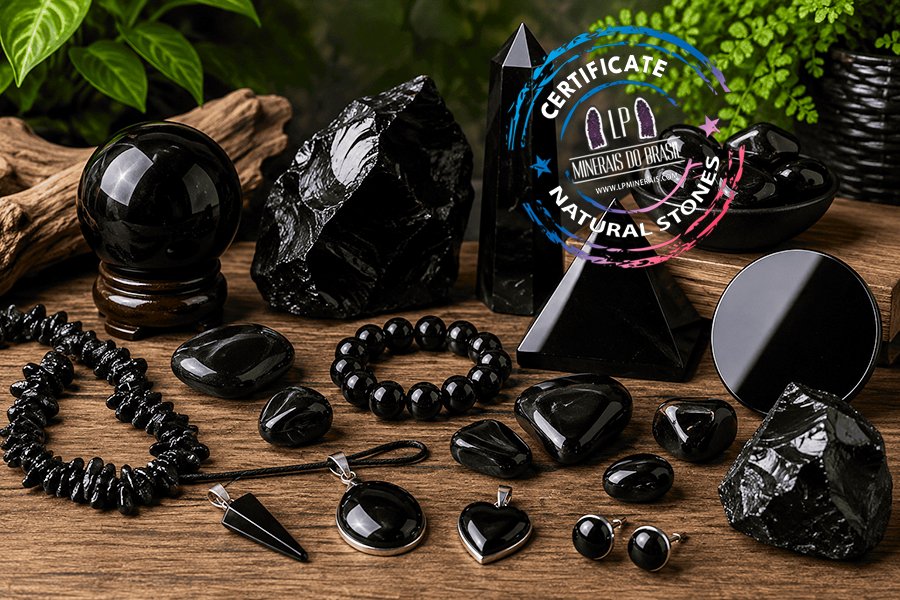
In the mineral trade, specimens with a deep black color, good luster, and careful finishing are used in tumbled stones, spheres, obelisks, sculptures, mirrors, pendants, and decorative objects. However, because it is a natural volcanic glass, obsidian requires expertise to identify. A black appearance and glassy luster, on their own, are not enough to guarantee authenticity.
This attention to provenance becomes even more important when the stone is chosen for energy practices. Knowing what you are acquiring—its nature, origin, and characteristics—is part of a more conscious relationship with minerals and natural materials.
Black Obsidian in Decor and Holistic Spaces
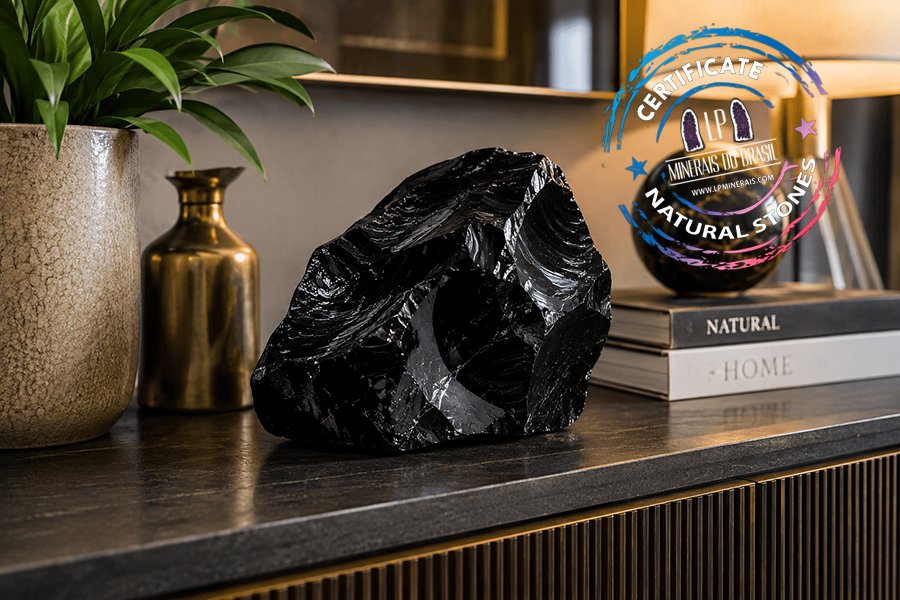
Few stones create a visual contrast as striking as Black Obsidian. When polished, its shiny black surface works particularly well in contemporary, sophisticated, or minimalist settings. Spheres, free-form pieces, and obelisks can become true focal points in interior design.
In holistic spaces, however, its placement can also be chosen based on energetic intent. Near the entrance, it is traditionally used as an element of protection and to define the space. In meditation rooms, it represents grounding and introspection. In healing spaces, it can be incorporated into arrangements focused on protection and stability.
Its presence is strong without being overwhelming.
A single sphere of Black Obsidian on natural wood, for example, creates a contrast between the volcanic element and organic matter. When placed alongside Selenite, the contrast also becomes energetic: black and white, depth and elevation, grounding and purification.
This duality makes Obsidian a particularly interesting stone for projects that combine decoration and energetic intent.
Jewelry, Fashion Jewelry, and Personal Use
Black Obsidian can be cut and polished to an excellent finish, producing cabochons, beads, pendants, earrings, bracelets, and other adornments. Its intense black color allows for combinations with both silver and gold metals.
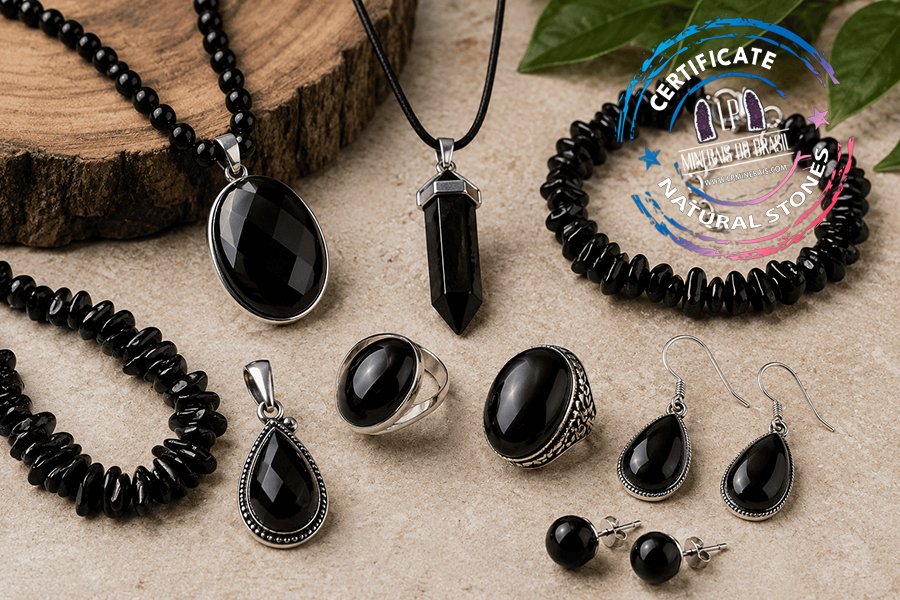
For personal energetic use, pendants and bracelets are especially sought after because they keep the stone close to the wearer throughout daily life. Within the tradition of crystal therapy, this use is primarily associated with protection and grounding.
Still, it is important to remember that obsidian can chip when subjected to impact. Although it is harder than selenite, for example, its glass-like nature requires caution.
Chipped pieces can develop very sharp edges. If this happens, you should stop wearing it as jewelry until the piece has been properly assessed or repolished.
How to Identify Natural Black Obsidian
Identification requires attention because artificial black glass may be sold as natural stones.
Natural obsidian typically has a vitreous luster, and in thinner fragments or under intense lighting, some pieces may reveal a certain translucency, often in dark shades. Small inclusions, natural irregularities, and flow structures may also be present.
This does not mean that all obsidian must have visible imperfections. Natural specimens can be quite homogeneous.
The following factors aid in evaluation:
- reputable source and supplier;
- typical vitreous luster;
- conchoidal fracture on broken surfaces;
- possible natural flow structures;
- absence of characteristics incompatible with natural volcanic glass;
- gemological analysis when commercial identification requires greater certainty.
Bubbles, for example, must be interpreted with expertise. Obsidian may contain vesicles and structures related to its volcanic formation; therefore, simply using the presence or absence of bubbles as a “definitive test” would be inappropriate.
Similarly, destructive home tests are not recommended. When authenticity and value warrant further investigation, professional identification is always superior to improvised methods.
Value, Market, and Buyer Profile
Common black obsidian is relatively affordable compared to rare gemstones, but this does not mean that all pieces have the same value.
Size, polish quality, uniformity, shape, provenance, craftsmanship, and presentation directly influence the price. Varieties with specific optical effects or unusual patterns may fall into different price ranges than conventional Black Obsidian.
In geological collecting, provenance also adds to the interest. A documented specimen from a specific volcanic occurrence holds a different significance than a piece simply sold without a known origin.
Obsidian’s audience is quite diverse:
- crystal therapy practitioners;
- holistic therapists;
- collectors;
- consumers of natural stones;
- designers and decorators;
- jewelry and accessory manufacturers;
- specialty stores;
- wholesale and export buyers.
For professional suppliers, transparency in identification and provenance strengthens responsible trade. As part of LP MINERAIS ⛏💎📦🗺’s approach, working with mineralogical expertise, ethical sourcing, and Fair Trade relationships adds value that goes beyond the piece’s mere appearance.
Physical Cleaning and Care
Obsidian has a surface that is relatively easy to maintain when compared to highly porous or soluble minerals. Still, its glassy nature requires care, especially to prevent drops and impacts.
For daily cleaning, a soft, slightly damp cloth is usually sufficient. When necessary, clean water may be used, followed by careful drying. Abrasive products, rough sponges, and sudden temperature changes should be avoided.
The main precautions are:
- avoid drops and impacts;
- do not use abrasives;
- store jewelry in a way that prevents it from being subjected to shocks;
- check for any chips before wearing jewelry;
- avoid thermal shock;
- transport larger pieces with adequate protection.
Even a seemingly sturdy sphere is still volcanic glass. This detail should never be overlooked.
Cleansing and Energetic Renewal
Energetically, Black Obsidian is traditionally used for protection, grounding, and releasing unwanted energies. For this reason, many crystal therapy practices recommend periodic cleansing, especially when the stone is kept in busy environments or is frequently used in sessions and personal practices.
Cleansing can be performed in a simple and intentional manner.
Smudging, sound, contact with the earth under safe conditions, or other methods compatible with the stone can be part of this care routine. Some people also prefer to place it near Selenite, combining the grounding energy of Obsidian with the purifying properties traditionally attributed to Selenite.
More important than turning cleansing into a rigid set of rules is establishing a practice that is consistent with the stone’s use.
An Obsidian kept at the entrance to a therapeutic space, for example, may require more frequent energetic attention than a piece stored in a collection.
LP MINERAIS Technical-Energetic Guide ⛏💎📦🗺
🗺 » ORIGIN: Volcanic regions in different parts of the world, with known occurrences in the Americas, Europe, Asia, and other areas of silica-rich volcanism.
⚛️ » CHEMICAL COMPOSITION: Natural volcanic glass rich in silica, generally associated with felsic magmas. Since it is not a mineral species with a fixed composition, it does not have a single chemical formula like quartz or calcite.
🔩 » MOHS SCALE: Approximately 5 to 5.5.
🔢 » NUMEROLOGY: Correspondences vary depending on the numerological tradition used; there is no universal mineralogical association.
🔅 » MEANING: Protection, grounding, inner truth, self-knowledge, boundaries, and transformation.
🅰️ » SUMMARY: Natural volcanic glass with an amorphous structure, recognized by its deep black color, vitreous luster, and conchoidal fracture. Energetically, it plays a prominent role in protection and grounding practices.
✅ » SPECIFICATION: Natural volcanic rock/glass; it is not a crystalline mineral species.
🧩 » FORM: Rough, tumbled, polished, cut, in spheres, obelisks, free-form shapes, sculptures, mirrors, beads, and accessories.
⚒ » FORMATION: Rapid cooling of silica-rich lava, preventing the extensive development of a crystalline structure.
⚠️ » CARE: Protect from drops, impacts, and thermal shock. Fragments and chipped pieces may have very sharp edges.
🛁 » CLEANING: Physically, use water and a soft cloth, followed by drying. Energetically, methods such as smudging, sound, earth, and pairing with purifying stones are traditionally used.
🎨 » COLOR: Black, with variations in intensity and effects depending on inclusions, structure, and variety.
☯️ » ZODIAC: Astrological correspondences vary among different schools of crystal therapy.
🪐 » SOLAR SYSTEM: Planetary correspondences are not uniform across traditions; when used, they should be understood within the symbolic system adopted.
➰ » CHAKRAS: Primarily the Base or Root Chakra, related to grounding, security, presence, and connection to the Earth.
♻ » ELEMENT: Earth and Fire appear as particularly consistent associations in different interpretations: Earth for its grounding nature and Fire for its volcanic origin and symbolism of transformation.
💎 » RARITY: Common Black Obsidian is not considered rare, although specific sources, exceptional pieces, and varieties with distinctive visual effects may be of greater commercial and collectible interest.
🗳 » CHARACTERISTIC: Volcanic glass with a strong historical and energetic identity, traditionally associated with protection, grounding, self-knowledge, and profound transformation.
Frequently Asked Questions About Black Obsidian
What is the energetic purpose of Black Obsidian?
It is traditionally used primarily for energetic protection, grounding, strengthening boundaries, and self-awareness. It is also strongly associated with processes of transformation and the recognition of inner patterns.
Is Black Obsidian a protective stone?
Yes. Protection is one of the most traditional associations of Black Obsidian in crystal therapy. Its energetic properties also involve grounding, discernment, and strengthening personal boundaries, making its interpretation broader than simply “warding off negativity.”
Is Black Obsidian a mineral?
Technically, no. Obsidian is a natural volcanic glass with a predominantly amorphous structure. This is one of the most important pieces of information for understanding it correctly.
Which chakra is associated with Black Obsidian?
It is primarily associated with the Root Chakra, which is linked to stability, security, presence, grounding, and connection to the Earth.
Where should you place Black Obsidian in your home?
The entryway is one of the most traditional places to place it when the intention is energetic protection. It can also be placed in offices, meditation spaces, altars, and areas where you wish to enhance grounding and stability.
Can I use Black Obsidian every day?
Many people use Obsidian daily in pendants, bracelets, or as pocket stones. However, since it is traditionally considered an intense and deeply introspective stone, one’s individual relationship with it should be taken into account. There is no need to force prolonged periods of use when a more gradual approach seems more appropriate.
What is the difference between Black Obsidian and Black Tourmaline?
They are completely different materials from a mineralogical standpoint and also have distinct nuances in their energetic traditions. Black Tourmaline is a crystalline mineral belonging to the tourmaline group. Obsidian is volcanic glass.
Energetically, both have a strong tradition of protection and grounding, but Obsidian is especially known for its aspects of self-knowledge, revelation, and inner transformation.
Does Black Obsidian go well with Selenite?
It’s one of the most interesting combinations. Obsidian represents grounding, protection, and depth, while Selenite is traditionally associated with purification, clarity, and elevation.
The combination creates a powerful symbolic balance between Earth and light.
How can you tell if a piece of Black Obsidian is genuine?
A reliable source is essential. A vitreous luster, conchoidal fracture, and natural flow patterns can aid in identification, but no single visual detail should be treated as absolute proof. For higher-value pieces, gemological or mineralogical analysis is the safest approach.
Can Black Obsidian be used in meditation?
Yes. Within the tradition of crystal therapy, it is particularly well-suited for practices such as grounding, presence, introspection, pattern recognition, and conscious transformation.
Does Black Obsidian attract prosperity?
Its connection to prosperity is more indirect than that traditionally attributed to Pyrite or Citrine. Obsidian is associated with recognizing and transforming limiting patterns, strengthening decision-making, and building a firmer foundation—aspects that can be integrated into energy practices focused on personal and material development.
Is Black Obsidian rare?
The common black variety is not considered rare. Its value increases based on factors such as size, finish, origin, craftsmanship, and special visual characteristics.
Conclusion
Black Obsidian is a stone of contrasts. It is born of fire, yet represents grounding. It possesses an intense luster, though its color reveals depth. It can be polished to a mirror-like surface, and for this very reason, it has become a powerful symbol of introspection.
Its history began long before modern crystal therapy. Ancient peoples recognized its physical properties, crafted tools and objects from it, and established deep cultural connections with this extraordinary volcanic glass. Today, science, history, aesthetics, and energetic tradition continue to converge in this same dark, brilliant material.
In the realm of energy, protection is just the beginning of its story.
Black Obsidian represents boundaries, presence, grounding, and the courage to acknowledge what needs to change. Its energy is traditionally associated not with fleeing from difficulties, but with the steadfastness needed to navigate transformative processes while maintaining a solid foundation.
Perhaps that is why its symbolism is so powerful.
Obsidian does not promise to hide what troubles you.
It represents the courage to see, to protect what deserves to remain, and to transform what has already run its course.
For LP MINERAIS ⛏💎📦🗺, working with a stone like Black Obsidian also means valuing what sustains a responsible mineral market: knowledge, authenticity, provenance, Fair Trade relationships, appreciation for the mineral supply chain, and respect for the consumer—from the showroom to the export market.
By: Doris S. Rosa.
Howlite: what lies behind the Stone of Calm and Inner Silence?
Moonstone: the Stone of Intuition, Feminine Energy, and the Mysteries of the Moon.
Jade: The Stone of Wisdom, Prosperity, and Harmony That Spans Millennia
Angelite: The Stone of Serenity, Intuition, and Spiritual Connection
Green Aventurine: the Stone of Prosperity, Opportunity, and New Paths
Orange Calcite: The Solar Energy That Awakens Creativity and Movement
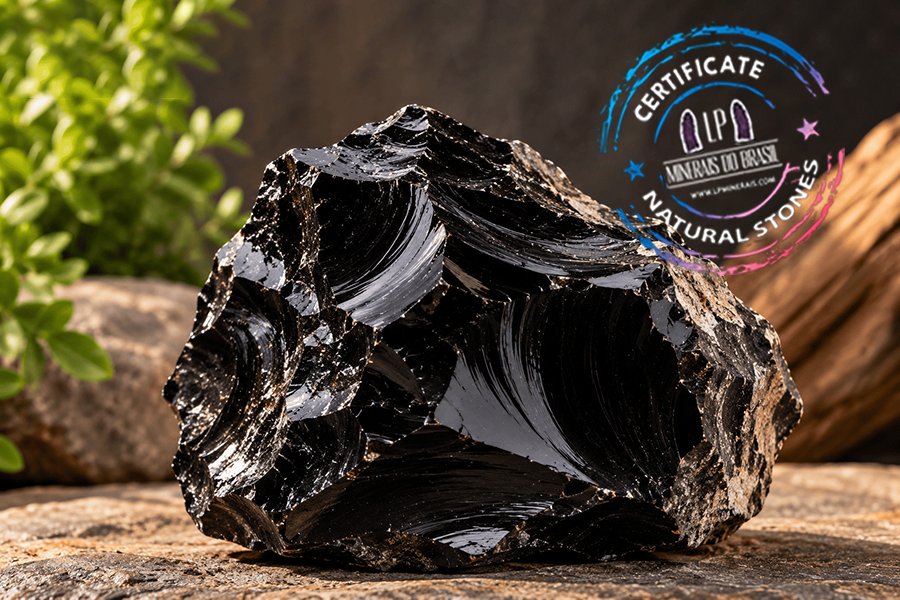
Black Obsidian: origin, formation, properties, and meaning of one of the best-known protective stones.
Carnelian: origin, formation, mineralogy, and the vibrant energy of a stone linked to action.
Fluorite: Mineralogy, Formation, Colors, and Meaning of a Mineral that Organizes Light and Color
Red Jasper: Mineralogy, Vitality, and the Ancestral Strength of an Earth-Connected Stone