







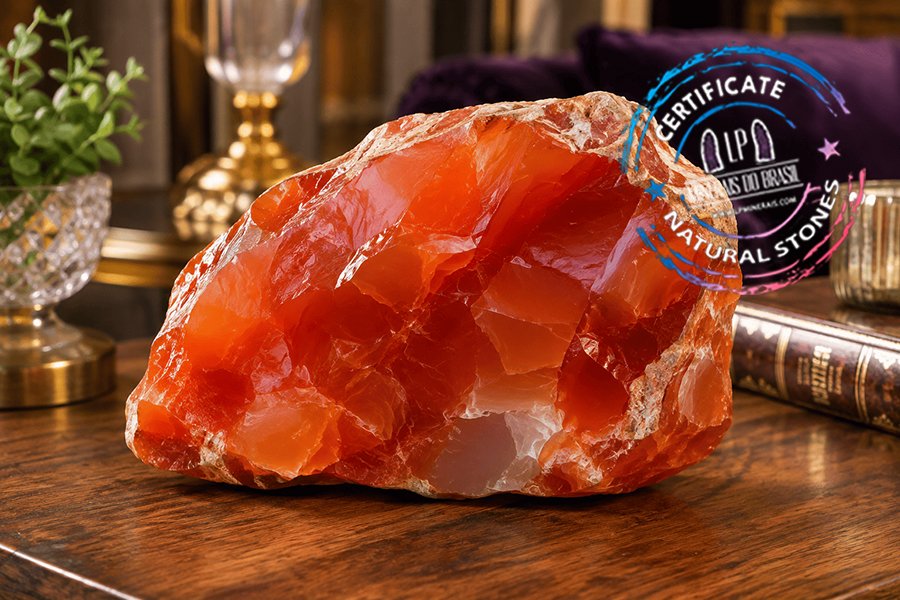
Carnelian stands out for the intensity of its warm colors. Shades of orange, orange-red, amber, rust, and reddish-brown can all appear within the same family of materials, creating translucent or denser stones that seem to concentrate the very light of fire. This striking appearance has made carnelian an ornamental gemstone used for thousands of years, and even today, it remains widely used in jewelry, interior design, collecting, and the natural stone market.
Mineralogically, carnelian is not a distinct species. It is a variety of chalcedony, belonging to the microcrystalline quartz family, composed primarily of silicon dioxide (SiO₂). Its structure consists of extremely fine aggregates of silica, which is why it lacks the large, individual crystals we associate with clear quartz or amethyst.
Its characteristic color is primarily due to the presence of iron compounds, especially oxides and hydroxides distributed throughout the material. It is precisely this interaction between silica, iron, geological conditions, and natural transformations that defines Carnelian’s visual identity.
But its importance extends beyond mineralogy. Throughout history, reddish and orange stones from this group have been used in jewelry, beads, carvings, and personal items. In the field of crystal therapy, Carnelian has traditionally been associated with vitality, creativity, courage, motivation, and the ability to turn intention into action.
It is a stone whose mineral and symbolic characteristics point in the same visual direction: warmth, presence, and action.
What Is Carnelian? Understanding Its True Mineralogical Identity
Carnelian belongs to the broad family of chalcedony, a microcrystalline material within the quartz system. This means that its basic composition is SiO₂, but its structure should not be imagined as a single, perfectly formed quartz crystal. It consists of microscopic aggregates, which are responsible for characteristics such as a compact texture, luster after polishing, and good durability for ornamental applications.
As a member of this group, it has a hardness of approximately 6.5 to 7 on the Mohs scale. This hardness has historically contributed to its use in beads, seals, carvings, and jewelry: the stone polishes well and withstands daily wear much better than softer minerals.
Carnelian typically ranges from translucent to nearly opaque, depending on the concentration of inclusions, the thickness of the piece, and its internal structure. When cut into thin slices or cabochons, the passage of light can reveal a depth of color that does not appear with the same intensity in the raw material.
Among its most recognizable characteristics are:
- a composition predominantly of SiO₂;
- belonging to the chalcedony group;
- a hardness of approximately 6.5–7 on the Mohs scale;
- a generally waxy to vitreous luster when well polished;
- absence of true cleavage;
- often conchoidal fracture;
- colors ranging from orange, red, amber, and reddish-brown.
This combination makes carnelian relatively durable, versatile, and suitable for various forms of processing.
How is carnelian formed in nature?
The formation of carnelian is directly related to the processes that give rise to chalcedony. Silica-rich solutions can circulate through cavities, fractures, and voids in rocks. Over geological time, the silica precipitates into microscopic aggregates, filling these spaces and forming compact masses.
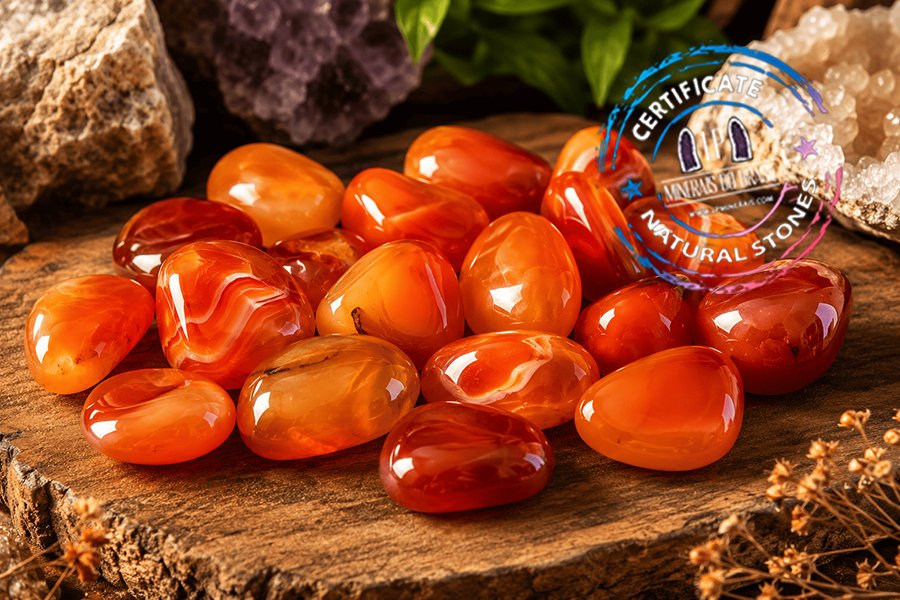
This process occurs particularly in environments associated with volcanic rocks, where cavities left by gases or fractures provide spaces for silica deposition. The presence and oxidation state of iron decisively influence the appearance that will allow a given material to be classified as carnelian.
This explains why the stone can exhibit considerable differences from one deposit to another. Some pieces feature a bright orange color and high translucency; others range toward deep red or brown. There may also be irregular color distributions, internal clouding, and small natural variations that help define the character of each specimen.
From a commercial standpoint, understanding this formation prevents treating all orange chalcedony as if it were visually identical. Color, translucency, uniformity, finish, and origin directly influence the perceived quality and intended use of each lot.
Why is Carnelian orange or red?
Color is probably the most recognizable characteristic of carnelian. Its color palette is primarily determined by the presence of iron, whose compounds can produce hues ranging from orange-yellow to red and reddish-brown.
Differences in hue also depend on the concentration and state of these components within the chalcedony. For this reason, there is no single “correct” color for carnelian. The market includes lighter, orange, reddish, and darker materials, provided they exhibit characteristics consistent with this variety.
Orange Carnelian
Orange carnelian is one of the most popular forms, especially in tumbled stones, beads, cabochons, and decorative pieces. Translucent specimens can take on an intense luminosity when light passes through them, revealing shades of amber, honey, and burnt orange.
In the realm of energy, this color has reinforced its traditional association with creativity, the joy of accomplishment, movement, and vitality. It is precisely the variety that most clearly connects to the symbolism of the sacral chakra in crystal therapy practices.
Red Carnelian
As the chromatic intensity deepens, carnelian can take on reddish-orange and reddish-brown tones. Visually, these pieces have a denser, earthier presence than the translucent orange varieties.
Energetically, this color shift also influences its interpretation. The redder hues are often associated with courage, determination, the strength to take action, and a connection to the physical dimension of experience, bringing Carnelian’s symbolism closer to themes of grounding and fulfillment.
Light Carnelian, Amber, and Reddish-Brown
There are also stones in softer tones, ranging from peach to amber and yellowish-orange, as well as very dark stones that visually resemble reddish-brown. This variation requires careful attention because the commercial distinction between carnelian, other chalcedonies, and certain varieties of sard may not be consistently applied by all sellers.
Therefore, commercial names should never replace mineralogical analysis. The more unusual the appearance of a piece advertised as carnelian, the greater the concern should be regarding its identification and origin.
Carnelian and Agate: Close Relatives, but Not Exactly the Same
One of the most common questions arises from the relationship between Carnelian and Agate. Both belong to the chalcedony family and have an essentially siliceous composition, but the names are used to highlight different characteristics of the material.
Agate is recognized primarily for its banding, with layers or zones that can display varied colors and patterns. Carnelian, on the other hand, is traditionally identified by its orange to brownish-red coloration and tends to have a more homogeneous or gently variable appearance, without the characteristic banding that defines many agates.
This mineralogical similarity also explains why the market may feature intermediate materials or commercial names that blend the two categories. Responsible communication should reflect the stone’s actual structure rather than choosing a name simply because it seems more commercially appealing.
For collectors, designers, and professional buyers, this distinction enhances the quality of the selection and avoids overly simplified classifications.
A Stone Steeped in History
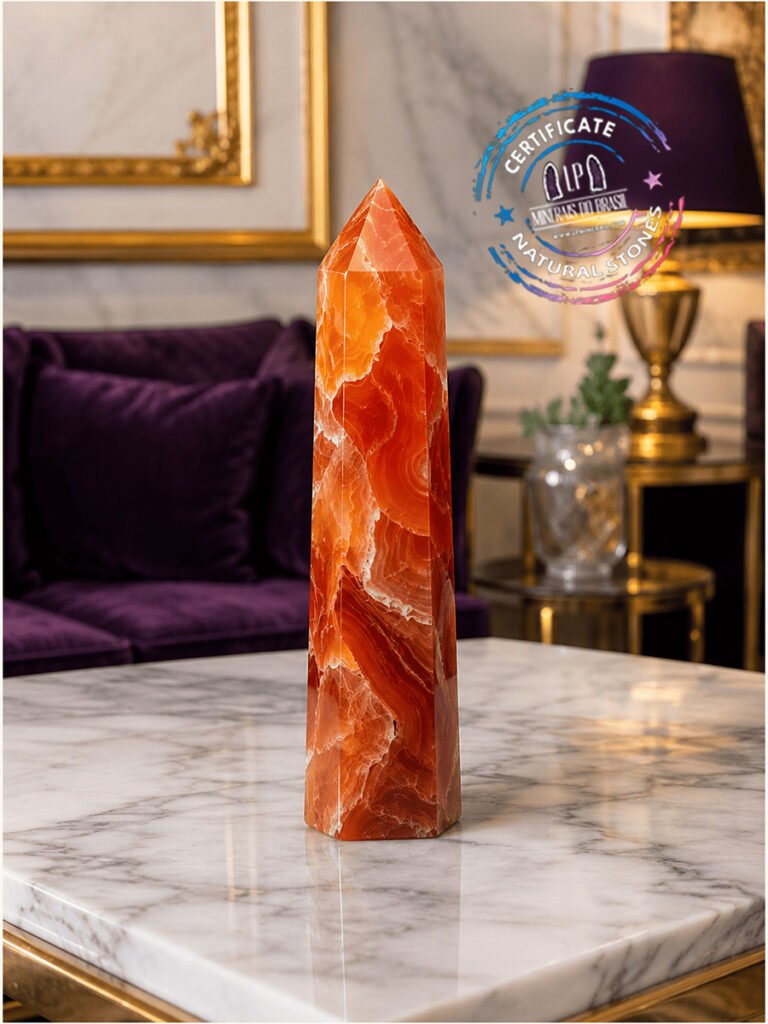
Carnelian has an ancient relationship with humankind. Its combination of beauty, durability, and relative ease of working allowed it to be used in beads, jewelry, amulets, seals, and engraved objects across various ancient cultures.
Its color has also contributed to building a strong symbolic significance. Reds and oranges naturally evoke blood, fire, heat, the sun, and vitality—elements that have spanned various cultural systems. Carnelian eventually came to embody meanings related to strength, protection, courage, and presence.
This history helps us understand why its contemporary energetic dimension did not simply arise as a modern association based on color. There is a symbolic continuity between the material, human use, and cultural perception, although specific interpretations vary according to era and tradition.
Today, this same stone circulates in completely different contexts: it may be found in a mineralogical collection, in a piece of contemporary jewelry, in a Brazilian artisanal piece, in an international showroom, or on a work desk, where it serves as a symbolic object.
Carnelian in Jewelry and Design
Carnelian’s relatively high hardness makes it well-suited for use in jewelry. Unlike very delicate minerals, chalcedony offers good resistance to everyday wear and tear, although no gemstone should be treated as indestructible.
Cabochons particularly highlight its chromatic depth. Beads allow for the creation of sequences of different shades, while carvings and ornamental shapes take advantage of the stone’s uniformity and its ability to polish well. Earrings, bracelets, necklaces, rings, and costume jewelry can feature carnelian either as the focal point or in combination with other stones.
In interior design, larger pieces, free-form shapes, polished objects, and rough stones create warm pops of color in neutral settings. Wood, natural fibers, gold-toned metals, and earthy tones tend to complement its appearance particularly well.
This versatility broadens its commercial appeal: jewelers, artisans, designers, interior decorators, collectors, retailers, and buyers in the holistic market may seek out Carnelian for entirely different reasons.
The Energetic Meaning of Carnelian: When Intention Must Turn into Action
Within crystal healing traditions, Carnelian is widely recognized as a stone associated with vitality, creativity, courage, and motivation. Its symbolism is not predominantly contemplative. It belongs to the realm of action: beginning, producing, experimenting, creating, and regaining momentum when stagnation sets in.
This interpretation has a profound symbolic logic. Its warm color connects the stone to fire, the flow of life, and movement. At the same time, its compact mineral nature conveys an image of energy that need not be dispersed: there is intensity, but also structure.
For this reason, Carnelian is traditionally used when the intention involves:
- stimulating creativity and initiative;
- strengthening confidence to start projects;
- cultivating courage and determination;
- regaining enthusiasm in the face of apathy;
- channeling energy toward achievement;
- promote presence and engagement with everyday life.
These associations belong to the traditional repertoire of crystal therapy and do not represent proven medical effects. Their symbolic value lies precisely in serving as an anchor of intention for movement and fulfillment.
Creativity, work, and prosperity: the archetype of the achiever
Carnelian’s energetic dimension gains particular strength in professional and creative settings. It is often used by people who need to transform ideas into something tangible: artists, artisans, entrepreneurs, designers, and professionals involved in creation, presentation, and initiative.
Its traditional association with prosperity should be understood in this context. Carnelian does not symbolize passive wealth or money coming without action. Its meaning is more closely tied to the ability to produce, showcase talents, seize opportunities, and sustain initiative. Prosperity, in this archetype, arises from movement.
On a work desk or in a creative space, the stone can represent a very simple question: what needs to stop being just an idea and start taking shape?
It is this combination of passion, creativity, and fulfillment that sets Carnelian apart from stones whose symbolism is focused primarily on introspection. Its traditional invitation is not to remain observing indefinitely. It is to perceive, choose, and act.
For LP MINERAIS ⛏💎📦🗺, this identity also finds practical expression within the mineral sector itself: a natural stone whose beauty spans jewelry, crafts, home decor, collecting, showrooms, and the international market—one that is valued when knowledge, provenance, and a responsible supply chain accompany its presentation.
Carnelian thus brings together two inseparable stories: the geological history of silica transformed by the presence of iron and the human history of a stone that has long represented warmth, presence, and movement. Building on this foundation, authenticity, treatments, value, rarity, conservation, chakras, elements, the zodiac, combinations, and energetic applications further enrich the personality of this material.
How can you tell if a carnelian is genuine?
Identifying natural carnelian requires more than just looking at an orange-colored stone. Since it belongs to the chalcedony group, it shares several physical characteristics with agates and other siliceous materials. Furthermore, treatments designed to intensify colors have historically been common in the chalcedony trade, making provenance especially important when seeking well-identified natural material.
Carnelian has a hardness of approximately 6.5 to 7 on the Mohs scale, polishes well, and can range in appearance from translucent to more opaque. Its color does not need to be perfectly uniform: variations in intensity, small internal cloudiness, and natural color transitions may occur. At the same time, none of these characteristics alone proves authenticity.
It is also important to distinguish between natural stone and treated natural stone. Treatment does not necessarily turn a mineral into an imitation, but it must be disclosed when known. For professional buyers, collectors, and jewelers, commercial transparency is an important part of the material’s value.
Carnelian, Agate, and Sard: What Are the Differences?
The distinctions between certain varieties of chalcedony can be confusing, especially since historical and commercial nomenclature is not always used in a completely uniform manner. Carnelian is traditionally characterized by hues ranging from orange to orange-red and brownish-red, usually with some degree of translucency.
Agate is distinguished primarily by the presence of bands, layers, or internal patterns. The term “sard, ” on the other hand, is traditionally applied to more brown or reddish-brown chalcedony varieties, which are generally darker. Between carnelian and sard, there may be materials that are visually intermediate, making overly rigid classifications ill-suited for some specimens.
In practice, certain criteria help clarify the distinction:
- Carnelian: orange to brownish-red, often translucent;
- Agate: characterized mainly by banding or zoning;
- Sard: typically browner, darker, and deeper in color;
- Dyed agate: may have artificially intensified colors and should not be sold as natural carnelian without proper identification.
Understanding these differences improves the purchasing process, the grading of lots, and communication with consumers who want to understand what they are buying.
Is Carnelian rare? What determines its value?
Carnelian is not generally considered a rare mineral variety. It is found in various regions around the world, and material is available for jewelry, crafts, tumbled stones, and decorative objects. However, the availability of the variety does not mean that all pieces have the same quality or value.
Attractive color, translucency, size, homogeneity suitable for the design, the absence of detrimental fractures, and the quality of the polish can all influence the price. For cut pieces, the finish, symmetry, and efficient use of the material also play a role. Specimens with well-documented provenance may generate additional interest among specialized buyers.
In wholesale and export markets, other criteria take precedence: quality standardization, grading, available quantity, consistency across lots, finish, and provenance. Thus, there is no universal price simply because a stone is carnelian.
Jewelry, Decor, and Buyer Profile
The durability of chalcedony makes carnelian an excellent ornamental stone. Its hardness allows it to be used in rings, earrings, bracelets, necklaces, pendants, beads, and cabochons, provided that normal care and maintenance are followed. Polishing can significantly intensify the depth of its orange and reddish tones.
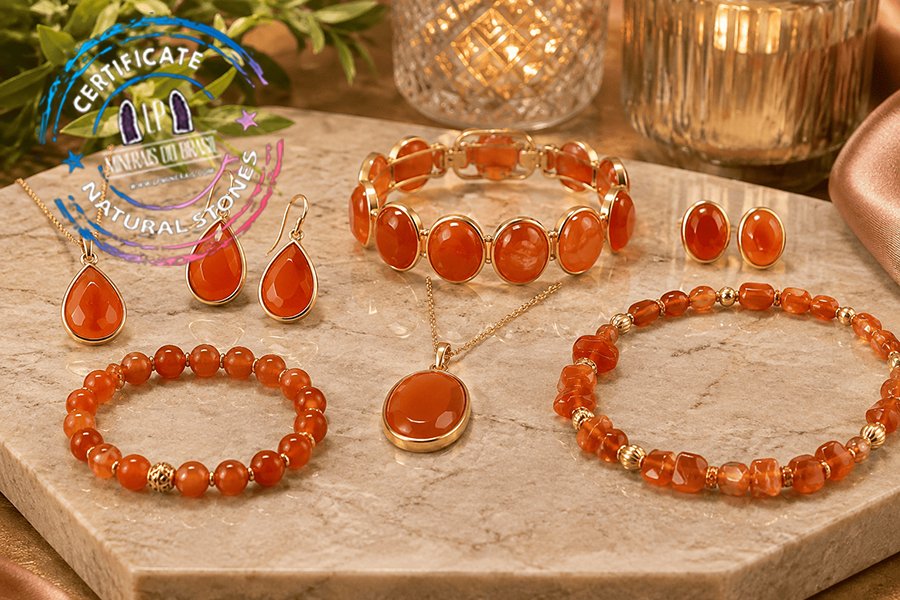
In interior design, carnelian offers another important feature: a warm color without the need for external visual pigmentation. Rough stones create a more mineral and organic aesthetic, while polished pieces work well in contemporary arrangements, on trays, tables, desks, and spaces designated for meditation.
Its audience, therefore, is quite broad. It may appeal to collectors, jewelers, artisans, interior designers, and consumers in the energy sector. This diversity of applications also contributes to its enduring presence in the international natural stone market.
How to Clean and Care for Carnelian?
Although it is considerably more resistant than minerals such as Fluorite, Calcite, and Selenite, Carnelian should not be treated as indestructible. Strong impacts can cause fractures, and contact with harder materials can damage carefully polished surfaces.
For daily care, clean water, a soft cloth, and gentle cleaning are usually sufficient for simple Carnelian pieces. Harsh chemicals, sudden temperature changes, and abrasive procedures should be avoided, especially on jewelry that also contains metals, adhesives, or other minerals.
In energetic cleansing, methods such as sound, intention, meditation, and moonlight can be used within holistic practices. Physical and energetic cleansing should remain conceptually separate: one preserves the material; the other pertains to the symbolic ritual associated with the stone.
Chakra, Element, Planet, and Zodiac
Carnelian is traditionally associated with the sacral chakra, a correspondence that is particularly consistent with its symbolism of creativity, movement, the joy of accomplishment, and vital energy. Redder specimens may also be related to the root chakra in certain approaches, aligning their interpretation with presence, stability, and action in the material world.
The element of Fire is one of carnelian’s most characteristic correspondences. Symbolically, it represents transformation, enthusiasm, initiative, and the ability to set energy in motion. This relationship helps explain why the stone appears so frequently in practices aimed at creativity and fulfillment.
In planetary correspondences, Mars is traditionally associated with carnelian in various symbolic systems, particularly due to themes such as courage, drive, and action. Astrological associations may vary depending on the tradition, and it is best to treat them as interpretive correspondences rather than universal classifications.
In relation to the zodiac, carnelian is often associated with signs such as Aries, Leo, and Virgo in various systems. These associations do not mean that people of other signs cannot use it; in crystal work, intention and personal affinity remain important factors.
Carnelian for Creativity, Courage, and Prosperity
The symbolic depth of Carnelian becomes apparent when its energy is no longer reduced to the word “motivation.” Traditionally, it represents energy that is available for use. There is a difference between desiring something and mobilizing personal resources to bring it about; it is precisely in this transition that the Carnelian archetype becomes significant.
At work, it can be used symbolically by those who need to present projects, create, negotiate, produce, or regain initiative. For artists and artisans, its association with creativity is particularly well-known. For entrepreneurs, its symbolism can be directed toward the courage needed to turn planning into action.
The association with prosperity follows the same logic. Rather than representing passive wealth, Carnelian is often linked to prosperity built through initiative, creativity, and the ability to seize opportunities. This interpretation remains consistent with its energetic tradition without turning the stone into a promise of financial gain.
Meditation, Environments, and Combinations with Other Stones
In meditation, Carnelian can accompany practices aimed at identifying blocks related to initiative, fear of starting, or difficulty in turning ideas into concrete actions. Holding the stone or keeping it nearby can serve as a symbolic focal point while setting a specific intention.
In professional settings, it can be placed on creative desks, in studios, offices, and commercial spaces. At home, living rooms and areas designated for creative activities are particularly well-suited to its energetic nature. On altars, it can represent fire, vitality, courage, or manifestation through action.
Some traditionally compatible combinations are:
- Carnelian Citrine: creativity, fulfillment, and prosperity;
- Carnelian Garnet: vitality, determination, and the power to act;
- Carnelian Clear Quartz: direction and clarity of intention;
- Carnelian Black Tourmaline: action accompanied by grounding;
- Carnelian Tiger’s Eye: confidence, focus, and practical achievement.
The combination should always be based on intention. Collecting many stones without understanding their symbolism does not necessarily make the practice any deeper.
Technical-Energetic Section
🗺 » ORIGIN — Found in various regions of the world, associated with geological environments conducive to chalcedony formation.
⚛️ » CHEMICAL COMPOSITION — Silicon dioxide, SiO₂.
🔩 » MOHS SCALE — Approximately 6.5–7.
🔢 » NUMEROLOGY — Correspondences vary across traditions; there is no universal mineralogical number.
🔅 » MEANING — Vitality, creativity, courage, motivation, and fulfillment.
🅰️ » SUMMARY — An orange to brownish-red variety of chalcedony, historically used in jewelry and ornamentation.
✅ » SPECIFICATION — A variety of microcrystalline chalcedony.
🧩 » FORM — Rough, tumbled, cut, polished, carved, or set in jewelry and decorative objects.
⚒ » FORMATION — Precipitation of microcrystalline silica, with iron compounds responsible for its characteristic color.
⚠️ » CARE — Avoid strong impacts, abrasives, harsh chemicals, and thermal shock.
🛁 » CLEANING — Gentle physical cleaning; energetically, methods such as sound, intention, and moonlight can be used.
🎨 » COLOR — Orange, amber, orange-red, and reddish-brown.
☯️ » ZODIAC — Frequently associated with Aries, Leo, and Virgo, with variations across traditions.
🪐 » SOLAR SYSTEM — Mars is a recurring traditional correspondence.
➰ » CHAKRAS — Primarily the sacral chakra; reddish varieties may also be related to the root chakra.
♻ » ELEMENT — Fire.
💎 » RARITY — It is not generally rare; quality and specific characteristics influence its value.
🗳 » CHARACTERISTICS — A durable chalcedony with warm colors, excellent polish, and a long history of use in jewelry.
FAQ — Frequently Asked Questions About Carnelian
How can you tell if carnelian is genuine?
Identification should consider color, translucency, hardness, chalcedony structure, and origin. For significant pieces, professional evaluation is preferable to destructive testing.
Can carnelian get wet?
For a simple, intact piece, brief contact with clean water is generally not a problem. Jewelry and composite pieces require specific care due to the presence of other materials.
Is Carnelian rare?
Not generally speaking. Specimens of exceptional quality, from specific sources, or with special characteristics may be of greater interest and value.
What is the energetic purpose of carnelian?
It is traditionally associated with vitality, creativity, courage, motivation, and the ability to turn intention into action.
Is carnelian good for work?
Within the tradition of crystal therapy, it is widely used symbolically in activities that require creativity, initiative, personal presentation, and achievement.
Are Carnelian and Agate the same?
Not exactly. Carnelian is a variety of chalcedony characterized mainly by its warm colors, while the term “agate” is strongly associated with materials that have distinctive banding.
Can carnelian be used in jewelry?
Yes. Its hardness and ability to be polished to a high luster make it a traditional gemstone in jewelry, used in cabochons, beads, carvings, and other forms.
How can you energetically cleanse carnelian?
Sound, intention, meditation, and moonlight are alternatives used in holistic practices that do not require physically aggressive methods.
Conclusion
Carnelian combines mineral durability, history, and an instantly recognizable color palette. Its nature as a variety of chalcedony explains its durability and versatility, while its iron compounds create the warm color palette that has made it highly valued in jewelry, ornaments, and objects throughout different historical periods.
In the symbolic realm, its character remains equally intense. Creativity, courage, vitality, and fulfillment form the core of an energetic tradition that speaks not only of possessing energy but of directing it. Carnelian represents the movement that transforms possibility into concrete experience.
For the mineral market, understanding authenticity, treatments, grading, origin, and quality is essential to valuing this stone without commercial exaggeration. In a responsible, Fair-Trade supply chain, information and transparency become part of the mineral’s intrinsic value, especially when the material is destined for jewelry, showrooms, collecting, or export.
By: Doris S. Rosa
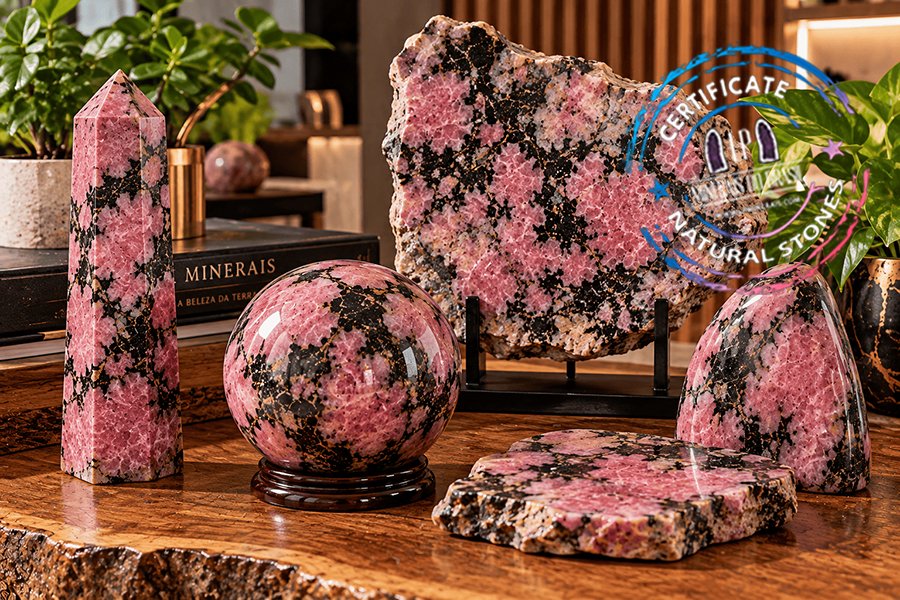
Rhodonite: Why Is It Known as the Stone of Forgiveness and Emotional Healing?
Howlite: what lies behind the Stone of Calm and Inner Silence?
Moonstone: the Stone of Intuition, Feminine Energy, and the Mysteries of the Moon.
Jade: The Stone of Wisdom, Prosperity, and Harmony That Spans Millennia
Angelite: The Stone of Serenity, Intuition, and Spiritual Connection
Green Aventurine: the Stone of Prosperity, Opportunity, and New Paths
Orange Calcite: The Solar Energy That Awakens Creativity and Movement
Black Obsidian: origin, formation, properties, and meaning of one of the best-known protective stones.
Fluorite: Mineralogy, Formation, Colors, and Meaning of a Mineral that Organizes Light and Color
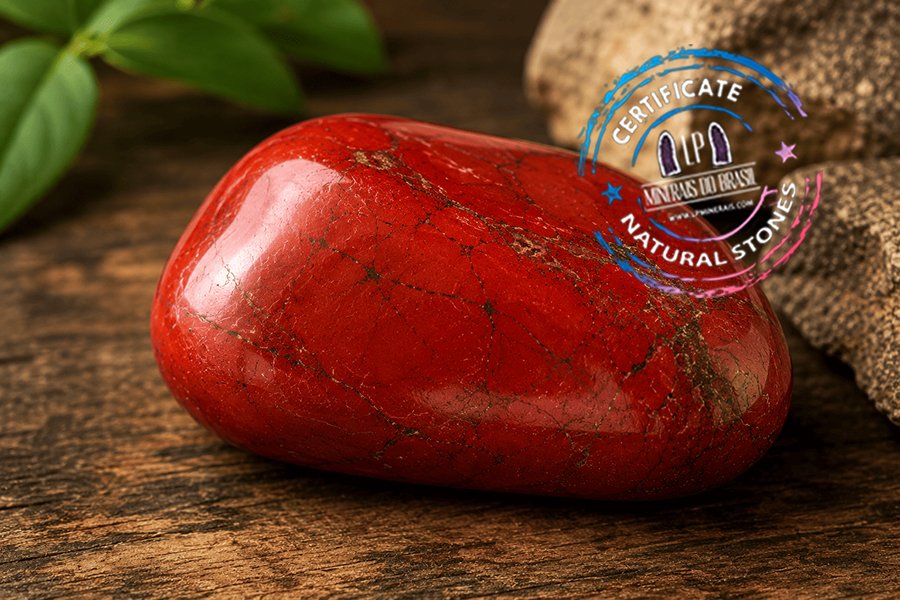
Red Jasper: Mineralogy, Vitality, and the Ancestral Strength of an Earth-Connected Stone