




Fluorite is one of the most fascinating mineral species found in nature. Renowned for its impressive variety of colors, transparency, and crystalline perfection, it captures the interest of geologists, mineralogists, gemologists, collectors, and crystal enthusiasts around the world. Its beauty goes beyond aesthetics: it is a mineral that plays a fundamental role in industry, holds enormous scientific significance, and occupies a prominent position among the most admired ornamental stones.
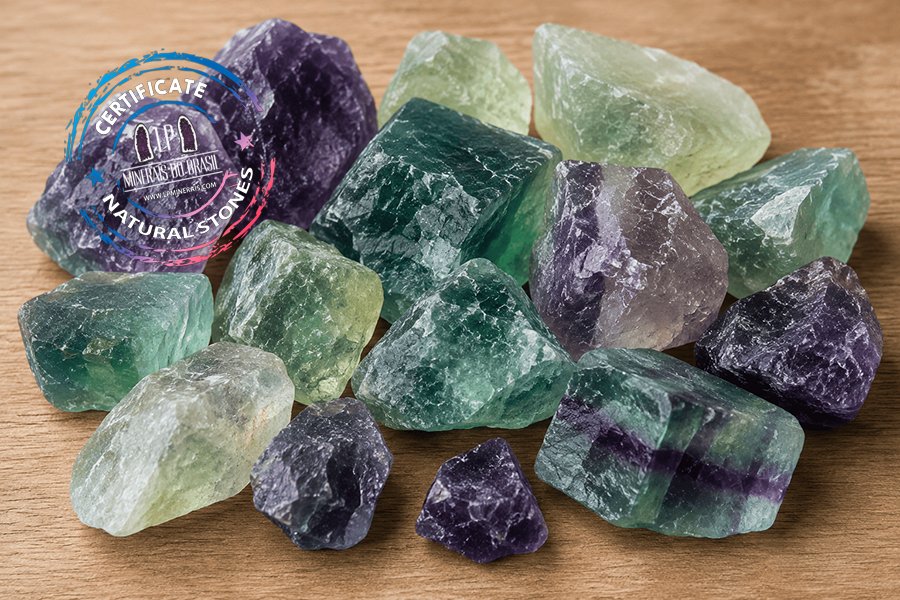
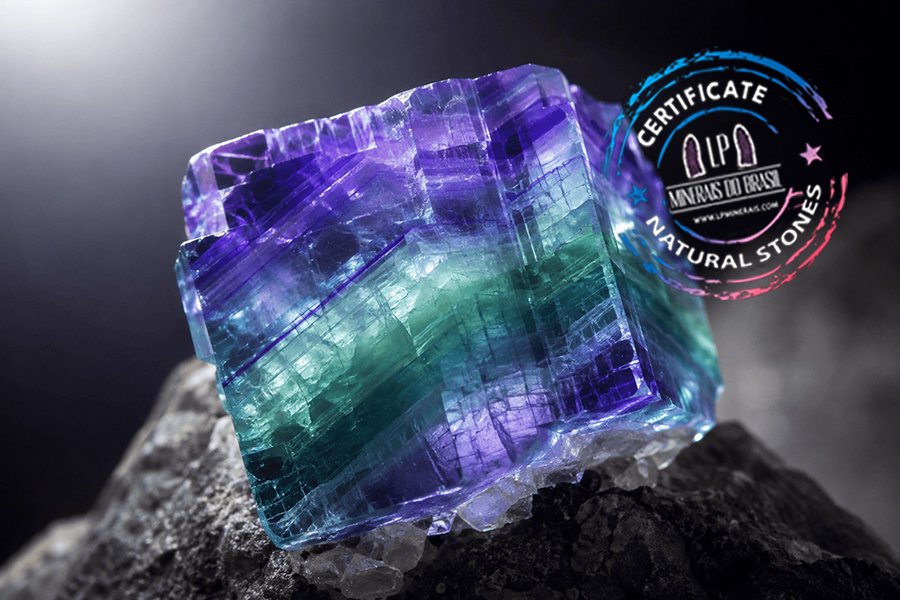
Although it is often associated with green and purple specimens, fluorite exhibits an extraordinary range of colors, occurring also in shades of blue, yellow, pink, colorless, black, and even in multicolored combinations that resemble true works of natural art. This visual richness stems directly from the geological processes that shaped it over millions of years.
Long before gaining prominence among collectors and practitioners of crystal therapy, fluorite had already captured the interest of ancient peoples due to the ease with which it could be worked and the beauty of its crystals.
Today, it continues to be considered one of the most important mineral species for both scientific research and the international mineral market.
More than just an ornamental stone, fluorite is an excellent example of how relatively simple geological processes can produce crystals of extraordinary geometric perfection and mineralogical diversity.
Origin and Geological Formation of Fluorite
The history of fluorite begins deep within the Earth’s crust, where hydrothermal fluids extremely rich in chemical elements circulate through fractures and cavities in the rocks. These heated fluids dissolve various minerals along their path, and as the temperature decreases or pressure changes, the elements present begin to crystallize.
It is in this environment that calcium and fluorine combine to form calcium fluoride (CaF₂) crystals, giving rise to fluorite. Depending on the physicochemical conditions present during this process, the crystals can grow slowly over thousands or even millions of years, developing extremely well-defined shapes.
Hydrothermal deposits represent the primary source of fluorite on the planet, although the mineral can also occur in veins, cavities within igneous rocks, metamorphic environments, and sedimentary deposits associated with specific chemical processes.
The presence of various trace elements during crystallization accounts for much of the enormous diversity of colors found in this mineral. Small amounts of yttrium, europium, iron, organic matter, or structural defects caused by natural radiation alter the way light interacts with the crystals, producing their wide color palette.
Among the main geological environments where fluorite is found are:
- Metal-rich hydrothermal veins.
- Deposits associated with limestone.
- Cavities in igneous rocks.
- Metamorphic environments.
- Deposits related to lead, zinc, and silver mining.
These different environments explain why fluorite is often found associated with various other minerals, forming crystalline aggregates of great beauty.
Chemical Composition and Mineralogical Characteristics
From a chemical standpoint, fluorite is a relatively simple mineral. Its composition consists essentially of calcium fluoride, whose chemical formula is CaF₂.
Despite its chemical simplicity, its crystalline structure produces some of the most interesting physical properties in mineralogy.
Fluorite belongs to the halide class, a group of minerals consisting of natural compounds in which halogens—such as fluorine, chlorine, bromine, and iodine—combine with metals. Within this class, fluorite is by far the best-known and most economically important species.
Its chemical purity makes colorless specimens relatively transparent. However, even minor impurities or structural alterations are sufficient to produce a wide variety of natural colors.
Among its main mineralogical characteristics are:
- Chemical composition: Calcium fluoride (CaF₂).
- Mineral class: Halides.
- Transparency: Transparent to translucent.
- Luster: Vitreous.
- Cleavage: Perfect octahedral.
- Fracture: Subconchoidal to irregular.
- Average density: approximately 3.1 to 3.2 g/cm³.
One of fluorite’s most striking characteristics is its perfect cleavage. This means that, when subjected to impact, it tends to break along extremely well-defined crystallographic planes, forming fragments with smooth, regular surfaces. This property is important both for its identification and for its handling.
Crystal System and Nature’s Perfect Geometry
Few minerals illustrate the mathematical precision found in nature as well as fluorite.
It crystallizes in the cubic (isometric) crystal system, characterized by three crystallographic axes of equal length that are perpendicular to one another. This symmetry allows for the formation of highly balanced and geometrically perfect crystals.
The cube is the best-known crystalline form of fluorite and perhaps one of the most iconic images in mineralogy. However, this is not its only form.
Depending on growth conditions, octahedral crystals, combinations of cubes and octahedra, massive aggregates, or granular masses may also form.
The crystals typically have extremely smooth faces, intense luster, and transparency that varies depending on the degree of purity.
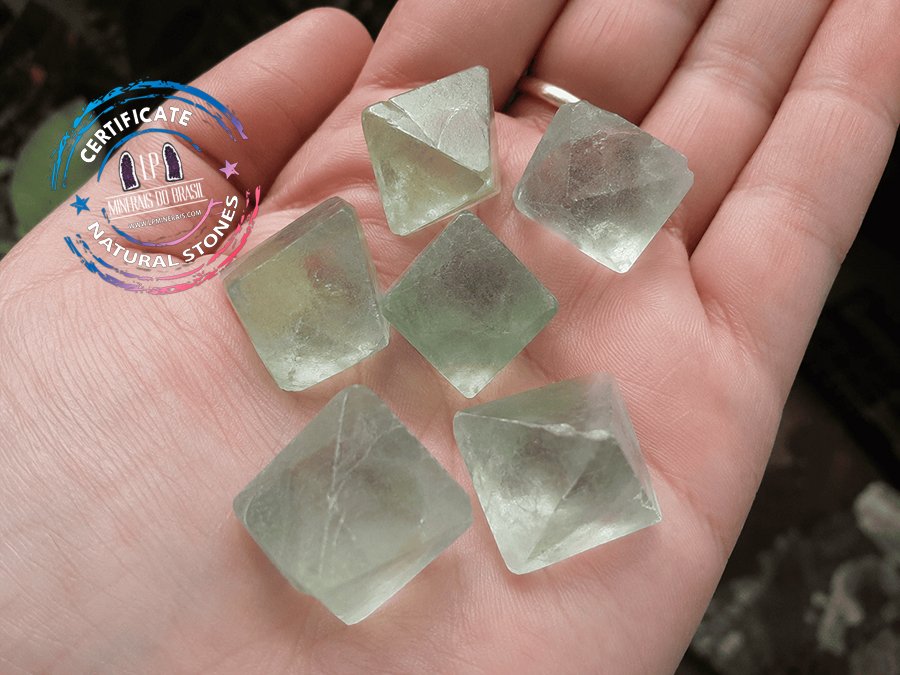
Among the most common crystal habits are:
- Perfect cubes.
- Octahedra.
- Cubo-octahedra.
- Massive aggregates.
- Crystal druses.
- Interpenetrating crystals.
The geometric perfection of these crystals makes fluorite one of the most popular minerals in educational crystallography collections, and it is frequently used to demonstrate concepts related to symmetry and crystal growth.
Mohs Scale and Physical Properties
On the Mohs Scale, used worldwide to measure the scratch resistance of minerals, fluorite has a hardness of 4.
This means it is relatively soft compared to minerals such as Quartz (7), Topaz (8), or Diamond (10). In contrast, it is harder than minerals such as Gypsum (2) and Calcite (3).
Its moderate hardness directly influences its applications, requiring specific precautions during transportation, cutting, and use in jewelry.
In addition to hardness, other physical properties contribute to its identification:
- Mohs hardness: 4.
- Intense vitreous luster.
- Variable transparency.
- Perfect cleavage in four directions.
- Low impact resistance due to cleavage.
- Good response to ultraviolet light in many specimens.
A particularly interesting characteristic is fluorescence. Several specimens emit visible glow when exposed to ultraviolet radiation, a phenomenon that gave rise to the term “fluorescence” itself. However, not all fluorite exhibits this behavior, as it depends on the presence of specific impurities in the crystal structure.
Optical Phenomena and the Origin of Its Colors
Fluorite’s extraordinary diversity of colors results from the interaction between its crystal structure and small amounts of chemical elements present during its formation.
Contrary to what many people imagine, the coloration is not always caused by elements replacing calcium in the crystal structure. In many cases, crystal defects induced by natural radiation create color centers capable of altering light absorption.
This combination makes fluorite one of the most colorful minerals known.
The most common varieties include:
- Green.
- Purple.
- Blue.
- Yellow.
- Pink.
- Colorless.
- Black.
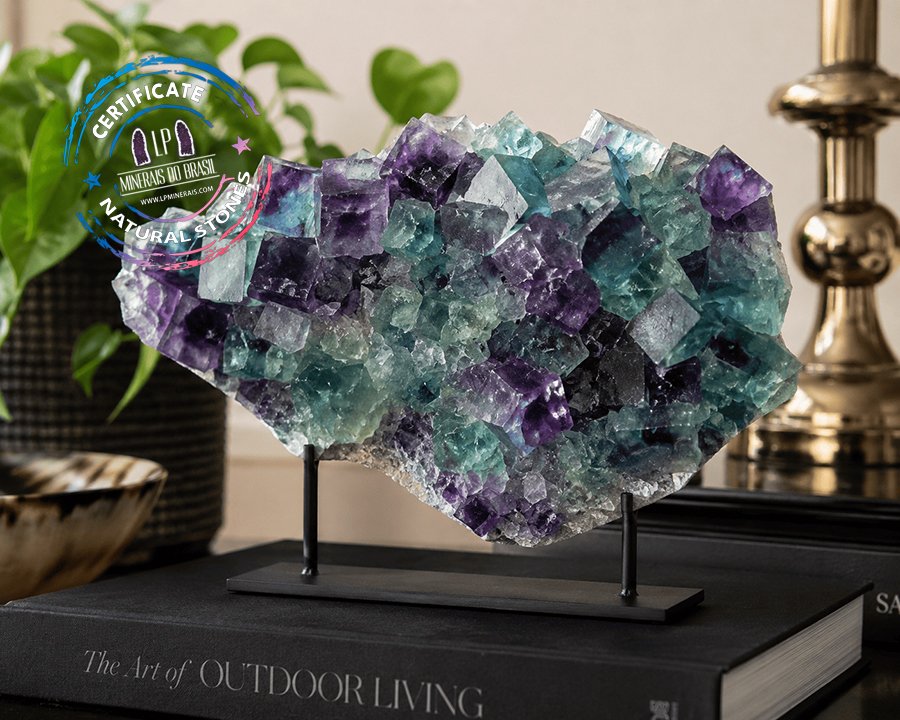
- Multicolored (Rainbow Fluorite).
Many crystals exhibit internal zoning, forming colored bands that record different stages of crystal growth. These natural bands are an important tool for geological studies, allowing researchers to reconstruct the environmental conditions present during their formation.
History, Etymology, and Scientific Curiosities
The name “Fluorite” derives from the Latin word *fluere*, meaning “to flow.” The name was chosen because the mineral was used as a flux in metallurgy, lowering the melting point of certain ores and facilitating industrial processes.
Throughout history, various civilizations have used fluorite to produce decorative objects, vases, sculptures, and ornamental pieces. In Ancient Rome, high-quality specimens were highly prized and considered luxury items.
Centuries later, the mineral became essential to the development of the chemical, metallurgical, and optical industries.
Another notable fact is its connection to the science of light. The phenomenon of fluorescence was given this name precisely because it was initially studied using samples of fluorite, forever cementing the importance of this mineral in the history of physics and mineralogy.
Fluorite also played a significant role in the development of specialized lenses for scientific equipment, thanks to its unique optical properties.
This combination of natural beauty, scientific importance, and industrial applications explains why fluorite remains one of the most studied and admired mineral species in the world.
Applications of Fluorite: Beauty, Science, and Versatility
Once you understand its geological origin and mineralogical characteristics, it becomes easy to see why fluorite has found a place in such diverse fields. Few minerals manage to combine scientific importance, economic value, and strong aesthetic appeal all at once. From large industrial complexes to private collections, its presence demonstrates how a single mineral can serve completely different purposes without losing its natural allure.
Its use depends directly on the quality of the crystals. While purer specimens are used in the chemical and optical industries, crystals with intense color and excellent formation attract the interest of jewelers, interior designers, and collectors.
Among its main applications are:
- the steel industry;
- hydrofluoric acid production;
- production of special glass and lenses;
- precision optical equipment;
- jewelry;
- interior design;
- mineral collecting.
This diversity demonstrates that fluorite is much more than just an ornamental stone, occupying a strategic position in both science and the mineral market.
Fluorite in Jewelry and Decor
Although its hardness of 4 on the Mohs scale requires some care, fluorite has been gaining ground in contemporary jewelry thanks to its transparency and impressive variety of colors. Delicate cuts highlight its natural banding, creating unique pieces of jewelry that are hard to match with other gemstones.
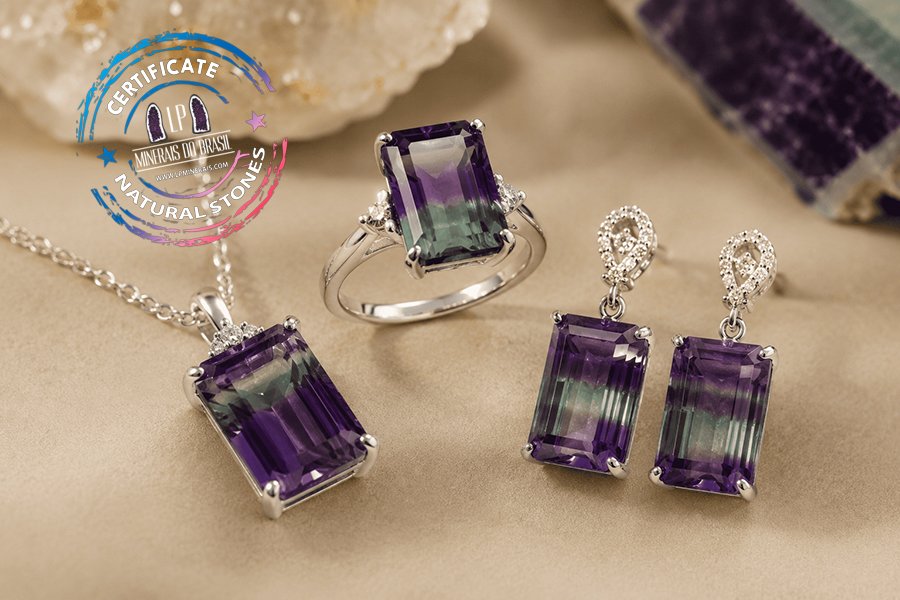
Because it is relatively sensitive to impacts and scratches, it is typically used in pieces subject to less wear, such as pendants, earrings, and necklaces. In exclusive collections, the crystal’s natural beauty is often valued above the cut itself.
In interior design, large crystals and druses become true sculptural elements. Sophisticated spaces use fluorite as a focal point, especially in libraries, offices, living rooms, and spaces dedicated to contemplation.
Its transparency, combined with the natural transitions between different shades, allows each specimen to function as a small work of art created by nature itself.
Collecting and Mineralogical Value
Among collectible minerals, fluorite has held a prominent position for decades. Its cubic crystal system produces extremely well-defined crystals, a characteristic that delights both beginners and experienced collectors alike.
The most highly valued specimens feature:
- perfectly developed crystals;
- high transparency;
- intense luster;
- vibrant colors;
- natural zoning;
- absence of damage to the crystal faces;
- associations with quartz, pyrite, calcite, barite, or galena.
Provenance also has a strong influence on the value of the piece. Classic mines in England, Spain, China, Mexico, and Namibia have produced specimens considered world-class benchmarks for their crystallographic quality and color intensity.
How to Identify Natural Fluorite
The growing demand for the mineral has also led to the emergence of imitations made from glass and synthetic materials. Fortunately, certain characteristics make it possible to distinguish natural fluorite from artificial reproductions.
One of the most obvious is the internal color zoning. In many natural crystals, different growth phases have produced well-defined bands that are difficult to reproduce faithfully in artificial materials.
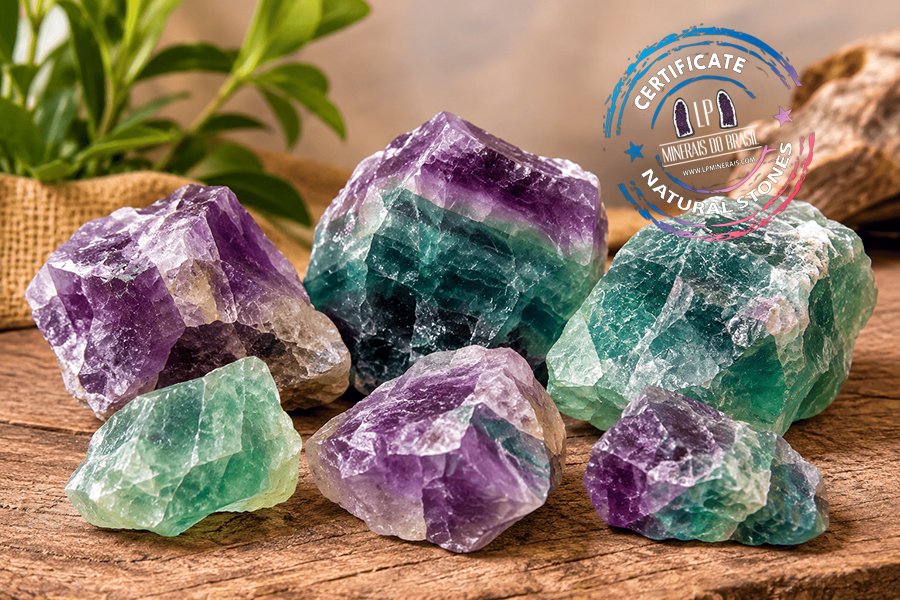
Another important aspect is its perfect cleavage. When broken, fluorite tends to form extremely regular planes—a behavior quite different from that of ordinary glass.
Some signs of authenticity include:
- natural bands of color;
- microscopic inclusions;
- characteristic vitreous luster;
- well-formed cubic or octahedral crystals;
- octahedral cleavage;
- possible fluorescence under ultraviolet light (when present).
Purchasing from specialized suppliers remains the safest way to ensure authenticity and provenance.
Market Value and Buyer Profile
The market value of fluorite varies depending on factors such as transparency, color intensity, crystal size, rarity of the deposit, and the specimen’s aesthetic quality.
Multicolored crystals, known commercially as Rainbow Fluorite, tend to attract significant interest due to the natural contrast between green, violet, blue, and colorless bands. Similarly, harmonious mineral associations significantly increase collectors’ interest.
The audience interested in fluorite is quite diverse:
- mineral collectors;
- geologists and mineralogists;
- jewelry makers;
- interior designers;
- interior designers;
- universities;
- museums;
- collectors of natural crystals.
In addition to their beauty, there is growing interest in specimens sourced from responsible mining operations, with traceability and ethical provenance—aspects that are increasingly valued in the contemporary mineral market.
Fluorite in the Tradition of Crystal Therapy
Long before it was studied in laboratories or admired in collectors’ display cases, Fluorite was already recognized by various traditions as a stone associated with mental organization and discernment. In contemporary crystal therapy, it is often described as a crystal that promotes clarity of thought, concentration, and the ability to organize ideas, making it especially sought after by students, researchers, and professionals who deal with large volumes of information on a daily basis.
This symbolic association finds a curious correspondence in its own crystalline structure. The geometric precision of cubic crystals has traditionally inspired the idea of order, balance, and logic. For this reason, many people use fluorite as a source of support during moments that require focus, planning, and conscious decision-making.
It is also traditionally associated with clearing repetitive mental patterns. According to crystal therapy tradition, its energy is said to foster a more objective perception of situations, helping to reduce distractions and promoting greater emotional stability during periods of change or sensory overload.
In study environments, offices, libraries, and places dedicated to intellectual creation, Fluorite is often chosen for its symbolism linked to continuous learning and the organization of thought. In meditative practices, it is often used as an invitation to introspection, helping the practitioner quiet the excess of information to foster more mindful attention to the present moment.
Traditionally, Fluorite is also associated with:
- mental clarity;
- concentration;
- emotional organization;
- learning;
- discernment;
- structured creativity;
- balance between reason and intuition.
This tradition paves the way for an even deeper understanding of the symbolic, spiritual, and energetic aspects of Fluorite, which will be explored later in this article, should the depth of the topic warrant a section dedicated exclusively to crystal therapy.
Energy Cleansing, Preservation, and Care of Fluorite
The beauty of Fluorite is directly related to the delicacy of its crystalline structure. With a hardness of 4 on the Mohs Scale and perfect cleavage, it is a mineral that deserves special attention to preserve both its appearance and its physical integrity. Unlike more resistant crystals, even minor drops or impacts can cause permanent fractures.
When used as a decorative piece or in crystal therapy practices, it is recommended to keep it in places protected from constant friction and prolonged exposure to intense sunlight. Some varieties, particularly those with violet and blue hues, may experience a gradual loss of color intensity after long periods of direct sun exposure.
Recommended Care
- Avoid drops and impacts;
- Do not use chemicals or abrasives;
- clean only with a soft, slightly damp cloth;
- store separately from harder minerals, such as quartz and topaz;
- Avoid prolonged exposure to intense sunlight.
Energetic Cleansing
According to crystal healing tradition, Fluorite is often used in practices aimed at energy balancing and mental clarity. For this reason, many people perform periodic cleansing rituals to symbolize the renewal of their energy.
Traditionally used methods include:
- smudging with natural herbs;
- gentle moonlight, especially during a full moon;
- using selenite for energization;
- placing the stone on a quartz druse for a few hours;
- meditative intention during cleansing.
As a measure to preserve the stone, many practitioners avoid leaving fluorite submerged in water for long periods, especially when it has natural microcracks.
LP MINERALS Technical Notes ⛏💎📦🗺
🗺 Origin: Hydrothermal deposits, mineral veins, and carbonate rocks in various countries.
⚛️ Chemical Composition: Calcium fluoride (CaF₂).
🔩 Mohs Scale: 4.
🔢 Numerology: Traditionally associated with the number 7.
🔅 Meaning: Mental clarity, organization, discernment, and learning.
🅰️ Summary: A mineral belonging to the halide group, known for its wide variety of colors and the formation of beautiful cubic crystals.
✅ Specifications: Cubic (isometric) crystal system, vitreous luster, transparent to translucent.
🧩 State: Natural; may occur as isolated crystals, druses, and massive aggregates.
⚒ Formation: Crystallization from hydrothermal fluids rich in calcium and fluorine.
⚠️ Care: Avoid impacts, scratches, and prolonged exposure to intense sunlight.
🛁 Cleaning: Use a soft cloth for physical cleaning; for energetic cleansing, use smudging, moonlight, or selenite.
🎨 Colors: Green, violet, blue, yellow, pink, colorless, black, and multicolored.
☯️ Zodiac: Traditionally associated with Pisces, Capricorn, and Aquarius.
🪐 Solar System: Often symbolically linked to Mercury, due to its association with intellect and communication.
➰ Chakras: Third Eye and Crown, depending on the color and the tradition followed.
♻ Element: Air.
💎 Rarity: Relatively abundant, although specimens of high mineralogical quality are highly prized.
🗳 Characteristics: Cubic crystals, wide variety of colors, fluorescence in some samples, and significant scientific and industrial applications.
Frequently Asked Questions (FAQ)
Is Fluorite a rare stone?
No. The mineral species is relatively abundant, but large, transparent, well-formed crystals with intense colors are much harder to find and, therefore, are more valuable.
How can you tell if fluorite is genuine?
Examining the crystal structure, characteristic cleavage, natural color zoning, and the stone’s origin are important factors in identifying an authentic specimen.
Can fluorite be used in jewelry?
Yes. Despite its lower hardness, it is used primarily in earrings, pendants, and necklaces, where it is subject to less mechanical wear.
Can fluorite be exposed to the sun?
Ideally, prolonged exposure to intense sunlight should be avoided, as some varieties may undergo a gradual change in color.
What is fluorite used for in crystal therapy?
According to crystal therapy tradition, it is often used to promote mental clarity, organization, concentration, emotional balance, and to support learning and meditation.
Which stones are traditionally paired with fluorite?
It is often combined with Clear Quartz to enhance clarity, with Amethyst in meditative practices, and with Selenite in symbolic processes of energy cleansing and harmonization.
Conclusion
Fluorite represents one of the most fascinating examples of the Earth’s mineralogical diversity. Its precise crystalline structure, its extraordinary variety of colors, and its importance to science, industry, and collecting demonstrate that its beauty goes far beyond its ornamental value. Each crystal records a long geological process, serving as a testament to the natural dynamics that have shaped the planet for millions of years.
At the same time, the tradition of crystal therapy attributes to fluorite a symbolism centered on clarity, learning, and inner organization—qualities that enhance its appeal among those seeking to integrate contemplation, knowledge, and well-being into their daily lives.
Whether appreciated as a collector’s item, a decorative object, a gemstone, or a crystal for personal use, Fluorite remains a mineral that brings together science, aesthetics, and tradition in a single natural formation, justifying its place among the most admired species in global mineralogy.
By: Doris S. Rosa.
Howlite: what lies behind the Stone of Calm and Inner Silence?
Moonstone: the Stone of Intuition, Feminine Energy, and the Mysteries of the Moon.
Jade: The Stone of Wisdom, Prosperity, and Harmony That Spans Millennia
Angelite: The Stone of Serenity, Intuition, and Spiritual Connection
Green Aventurine: the Stone of Prosperity, Opportunity, and New Paths
Orange Calcite: The Solar Energy That Awakens Creativity and Movement
Black Obsidian: origin, formation, properties, and meaning of one of the best-known protective stones.
Carnelian: origin, formation, mineralogy, and the vibrant energy of a stone linked to action.
Fluorite: Mineralogy, Formation, Colors, and Meaning of a Mineral that Organizes Light and Color
Red Jasper: Mineralogy, Vitality, and the Ancestral Strength of an Earth-Connected Stone