





Some minerals impress with their transparency. Others captivate with their colors or intense luster. Sputnik Aragonite fascinates for a completely different reason: its crystalline form. Instead of growing in compact blocks or well-defined prisms, it forms delicate bundles of crystals that radiate in all directions, creating spherical structures reminiscent of stellar explosions, sea urchins, or tiny galaxies frozen in time.
It’s not hard to see why collectors around the world have nicknamed this mineral “Sputnik.” Just like the first artificial satellite launched into space, its crystals seem to radiate in all directions, creating a geometry that defies the imagination. Each specimen is the result of an extremely specific mineral growth process, impossible to reproduce artificially with the same complexity found in nature.
From a scientific standpoint, it is a crystalline formation of aragonite, a mineral composed of calcium carbonate (CaCO₃). Although it has the same chemical composition as calcite, its crystalline structure is completely different, demonstrating how small variations in geological conditions can give rise to minerals with distinct visual and physical characteristics.
In traditional crystal therapy, energetic interpretations are attributed to aragonite as a mineral, and not specifically to the Sputnik crystal habit. Because it shares exactly the same composition and mineralogical structure, Sputnik Aragonite traditionally receives these same symbolic associations. Among them are grounding, emotional stability, patience, and strengthening the connection with everyday reality. These interpretations belong to the field of holistic practices and are presented as a complement to scientific knowledge, in line with the crystal therapy tradition used as an editorial reference by LP MINERAIS.
Today, Sputnik Aragonite occupies a prominent place in mineralogical collections, sophisticated interior design projects, and contemplative spaces. Its unusual appearance piques the interest of geologists, collectors, designers, and enthusiasts of natural minerals, making it one of the most striking crystalline formations found in nature.
Architecture Built Crystal by Crystal
The formation of Sputnik Aragonite requires very specific geological conditions.
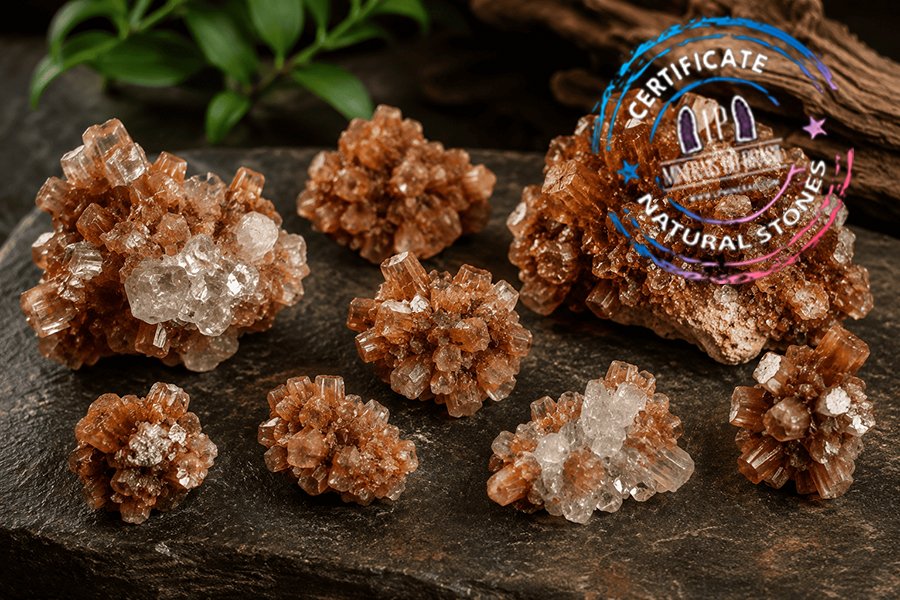
It typically develops in cavities and environments rich in carbonate solutions, where countless crystals begin to grow simultaneously from a single nucleus. Instead of forming isolated prisms, these tiny mineral needles expand radially, creating three-dimensional structures that appear to radiate in all directions.
In mineralogy, this type of growth is called a radial aggregate. It is a relatively rare crystalline habit, responsible for the unique appearance that has made Sputnik Aragonite one of the most sought-after formations among collectors.
The highest-quality specimens typically exhibit:
- uniform radial growth;
- long, well-preserved crystals;
- intact tips;
- a naturally vitreous luster;
- little or no chipping at the ends.
Each specimen represents a unique record of the geological evolution of the deposit where it formed.
Where is Sputnik Aragonite found?
Although aragonite occurs in several countries, Sputnik-type formations depend on very specific conditions to develop.
Among the main producing regions are:
- Morocco;
- Spain;
- Mexico;
- Peru;
- China.
Morocco is internationally recognized as the primary commercial source of these radiated formations, supplying museums, collectors, and companies specializing in ornamental minerals.
A work of nature, not of gem cutting
When observing an Aragonite Sputnik for the first time, many people imagine they are looking at a carefully crafted sculpture.
In reality, none of these forms were created by human hands.
Their beauty results exclusively from the spontaneous growth of crystals over thousands of years, in an extremely slow and delicate process. It is precisely this characteristic that makes each specimen a one-of-a-kind piece, valued by both the scientific community and the natural mineral market.
The Traditional Symbolism of Aragonite
The energetic interpretations traditionally attributed to Aragonite do not stem from the Sputnik shape, but from the symbolic characteristics associated with the mineral itself throughout the literature on crystal therapy.

Aragonite is often associated with grounding, emotional stability, patience, and the strengthening of inner organization. In holistic practices, it is commonly used as a symbol of balance during periods of change, excessive responsibilities, or the need for greater centering.
In the case of Sputnik Aragonite, its radial structure also inspires an additional contemplative interpretation. Many practitioners see in this natural geometry a visual representation of organization arising from a single center, interpreting its countless crystals as a metaphor for gradual growth, perseverance, and the balanced construction of life.
Traditionally, Aragonite is associated with:
- grounding;
- emotional stability;
- patience;
- inner balance;
- perseverance;
- responsibility;
- personal organization;
- connection with nature;
- serenity;
- strengthening one’s presence in the present moment.
Regardless of the approach taken, Sputnik Aragonite remains one of the most impressive demonstrations of nature’s ability to transform slow geological processes into structures of extraordinary beauty and complexity.
A piece that nature has already delivered ready-made
Unlike many ornamental stones, Sputnik Aragonite requires virtually no cutting or polishing to reveal its beauty. Its radial structure is so unique that any excessive intervention would compromise precisely the element that makes it special.
For this reason, most pieces sold remain exactly as they were found in nature. The work performed by specialists focuses solely on cleaning, stabilization when necessary, and selecting a suitable base to highlight its three-dimensional form.
This preservation of the original structure makes each specimen unique. No two Sputnik Aragonites are exactly alike, as slight variations in crystallization conditions alter the direction, length, and number of crystals that grow from the central nucleus.
For collectors, this individuality is one of the mineral’s greatest attractions.
A Natural Highlight in Decor
In recent years, natural minerals have come to play an increasingly prominent role in architectural and interior design projects. Sputnik Aragonite stands out precisely because it offers an unusual aesthetic without resorting to vibrant colors or artificial finishes.
Its earthy tones blend easily with different decorative styles, while its geometry immediately sparks curiosity.
It is commonly used in:
- sideboards;
- bookshelves;
- coffee tables;
- desks;
- bookcases;
- spaces for contemplation.
When placed on unobtrusive metal or natural wood stands, it becomes a true sculpture created exclusively by the Earth’s geological processes.
The Energetic Tradition of Aragonite
In traditional crystal therapy, Aragonite is often described as a stone of grounding and stability. Unlike minerals associated with spiritual expansion or intense mental activity, it is typically linked to strengthening emotional foundations, a sense of responsibility, and the ability to face daily challenges with greater balance.
According to this tradition, its energy symbolizes gradual growth. Just as its crystals develop slowly over thousands of years, Aragonite also symbolically represents the patient cultivation of maturity, discipline, and inner stability.
These interpretations do not stem specifically from the Sputnik crystal formation, but rather from the characteristics traditionally attributed to the mineral aragonite. The radial shape, however, inspires many practitioners to see in it a visual representation of organization that emanates from a single central point, symbolically reinforcing these same qualities.
Traditionally, aragonite is associated with:
- grounding;
- emotional stability;
- patience;
- perseverance;
- responsibility;
- inner balance;
- personal organization;
- connection with nature;
- serenity;
- strengthening of mindful presence.
These interpretations fall within the realm of holistic practices and vary depending on the tradition followed.
How can you identify a natural Sputnik Aragonite?
Its unusual appearance often raises questions in those seeing it for the first time. Some people even imagine that it is a hand-carved piece.
In reality, nature produces small irregularities that are impossible to reproduce perfectly.
When evaluating a specimen, note:
✔ spontaneous radial growth;
✔ crystals of varying thicknesses;
✔ small natural asymmetries;
✔ a soft, vitreous luster;
✔ predominantly beige, honey, golden, or brown coloring.
Another important aspect is the source. Morocco remains the primary commercial source of high-quality Sputnik aragonites, although similar specimens are also found in other countries.
🗺 LP MINERAIS Technical Note ⛏💎📦🗺
🗺 » ORIGIN — Morocco, Spain, Mexico, Peru, China, and other sedimentary regions.
⚛️ » CHEMICAL COMPOSITION — Calcium carbonate (CaCO₃).
🔩 » MOHS HARDNESS — 3.5 to 4.
🔢 » NUMEROLOGY — Traditionally associated with the number 9 in some esoteric traditions.
🔅 » MEANING — Traditionally associated with grounding, emotional stability, patience, and inner balance.
🅰️ » SUMMARY — Radial formation of aragonite, recognized for its extraordinary crystalline geometry and high mineralogical interest.
✅ » SPECIFICATION — A mineral of the carbonate group.
🧩 » STATE — Natural mineral.
⚒ » FORMATION — Radial growth of crystals in cavities rich in calcium carbonate solutions.
⚠️ » CARE — Avoid impacts, vibrations, and pressure on the crystals, as they are delicate.
🛁 » CLEANING — Use only a soft brush or air blower. Avoid stiff brushes and excessive water.
🎨 » COLOR — Beige, honey, gold, brown, and earthy tones.
☯️ » ZODIAC — Traditionally associated with Capricorn in various crystal therapy traditions.
🪐 » SOLAR SYSTEM — Often associated with Saturn in some esoteric traditions.
➰ » CHAKRAS — Traditionally associated with the Root Chakra.
♻ » ELEMENT — Earth.
💎 » RARITY — Aragonite is relatively common, but complete and well-preserved radial formations are significantly more highly valued.
🗳 » CHARACTERISTIC — A radial crystalline aggregate that forms natural three-dimensional structures of rare beauty.
Frequently Asked Questions About Sputnik Aragonite
Is Sputnik Aragonite a rare stone?
Aragonite is relatively common, but complete, well-preserved specimens with the Sputnik crystal habit are much rarer and highly prized by collectors.
Can Sputnik Aragonite be used in jewelry?
It is not the best choice. Its delicate radiating crystals make this material more suitable for collecting and decoration.
How do you clean Sputnik Aragonite?
Use only an extremely soft brush or an air blower to remove dust, preserving its crystalline structure.
Why is it called “Sputnik”?
The trade name refers to the Sputnik satellite because of its radial shape, which resembles a small star or crystalline explosion.
Does Sputnik Aragonite have different energetic properties than ordinary Aragonite?
Traditionally, no. Crystal healing interpretations refer to the mineral Aragonite. The Sputnik shape simply adds visual symbolism that many practitioners use as contemplative inspiration.
How can you tell if a Sputnik Aragonite is genuine?
Observe the spontaneous growth of the crystals, the small natural irregularities, the origin, and, when necessary, seek a specialized mineralogical evaluation.
Can Sputnik Aragonite be left on display permanently?
Yes, as long as it is protected from impacts, vibrations, and frequent handling to preserve the integrity of its crystals.
Does it have value for collectors?
Yes. Complete, well-preserved specimens with a known provenance are among the crystalline formations most prized by collectors and the international ornamental mineral market.
Conclusion
Sputnik Aragonite demonstrates that some of the most extraordinary forms found in nature arise from silent and extremely slow geological processes. Its radial growth transforms a simple calcium carbonate into a structure that impresses both for its beauty and its scientific interest.
In the tradition of crystal therapy, it shares the symbolic interpretations attributed to aragonite, and is often associated with grounding, emotional stability, and the strengthening of inner balance. Its Sputnik shape adds a contemplative dimension, inspiring organization, gradual growth, and harmony, without altering the mineral’s traditionally recognized associations.
Whether as a collector’s item, a decorative element, or an object of contemplation, the Sputnik Aragonite represents one of the most fascinating expressions of nature’s creativity, uniting science, aesthetics, and tradition in a single crystal.
By: Doris S. Rosa
Howlite: what lies behind the Stone of Calm and Inner Silence?
Moonstone: the Stone of Intuition, Feminine Energy, and the Mysteries of the Moon.
Jade: The Stone of Wisdom, Prosperity, and Harmony That Spans Millennia
Angelite: The Stone of Serenity, Intuition, and Spiritual Connection
Green Aventurine: the Stone of Prosperity, Opportunity, and New Paths
Orange Calcite: The Solar Energy That Awakens Creativity and Movement
Black Obsidian: origin, formation, properties, and meaning of one of the best-known protective stones.
Carnelian: origin, formation, mineralogy, and the vibrant energy of a stone linked to action.
Fluorite: Mineralogy, Formation, Colors, and Meaning of a Mineral that Organizes Light and Color
Red Jasper: Mineralogy, Vitality, and the Ancestral Strength of an Earth-Connected Stone