



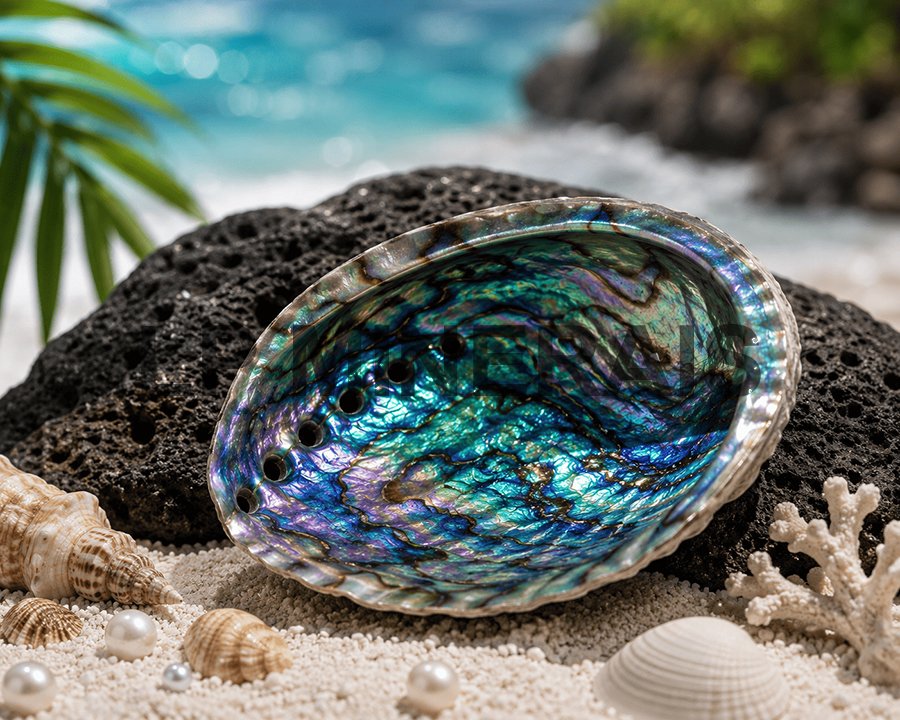
Few natural materials can combine the elegance of jewelry, the richness of marine life, and the allure of iridescent colors quite like abalone. Although it is often referred to as a “stone” in the jewelry market, it is, in fact, the inner layer of the shell of marine mollusks of the genus Haliotis. Its surface displays a spectacular play of light that shifts between shades of blue, green, turquoise, violet, pink, and silver, making each piece absolutely unique.
The characteristic iridescence of abalone does not result from pigments, but from the way millions of microscopic layers of calcium carbonate—arranged by nature itself—reflect and refract light. This optical phenomenon causes its colors to shift depending on the viewing angle, which is why the material has been used for centuries in the production of jewelry, decorative objects, musical instruments, and works of art.

In addition to its aesthetic value, abalone holds immense cultural significance. Indigenous peoples of the North American west coast, communities in Oceania, and various Asian cultures have used its shells for hundreds of years in ceremonies, ritual objects, and ornamental pieces. Traditionally, they symbolize protection, a connection to the sea, renewal, and harmony—interpretations that remain present in various schools of contemporary crystal therapy. These associations fall within the realm of holistic practices and are presented as a complement to scientific knowledge about their biological origin.
Today, abalone holds a prominent position in the international market for high-end design, jewelry, and home décor. Its combination of natural origin, sophisticated luster, and exclusivity makes it one of the most highly valued organic materials for decorative applications.
What is Abalone?
Unlike minerals formed within the Earth’s crust, abalone has a biological origin.
It corresponds to the inner pearlescent layer of the shell produced by marine mollusks belonging to the genus Haliotis. As the animal grows, it deposits successive microscopic layers of calcium carbonate and natural proteins, forming an extremely resistant and visually stunning structure.
This process is similar to that responsible for the formation of pearls and mother-of-pearl, although abalone features a much more intense and varied color palette.
Its composition consists mainly of:
- calcium carbonate (aragonite);
- conchiolin (a natural protein);
- microscopic structures responsible for the iridescence.
Each shell records years of the animal’s growth, making it impossible to find two exactly alike.
Where is the abalone found?
Haliotis species inhabit cold, well-oxygenated waters, clinging to rocks on the seafloor.
The main producing regions include:
- Australia;
- New Zealand;
- South Africa;
- Japan;
- Mexico;
- United States (especially California).
Each region features species with slight differences in color, thickness, and luster intensity—characteristics that directly influence the commercial value of the material.
Currently, a significant portion of the market is supplied by controlled cultivation systems, which help reduce pressure on natural populations and promote more sustainable management practices.
A color palette created by physics
One of the most fascinating facts about abalone is that its colors are not produced by pigments.
The iridescent effect arises from the interaction between light and millions of extremely thin layers of aragonite arranged on a microscopic scale. As the angle of light changes, different wavelengths are reflected, producing the multicolored effect that has made abalone famous worldwide.
This characteristic causes a single piece to display different shades throughout the day, depending on the lighting and the viewing angle.
The most highly prized specimens typically feature:
- deep blue;
- emerald green;
- turquoise;
- violet;
- pinkish highlights;
- uniform luster.
The Traditional Symbolism of Abalone
In cultural and crystal therapy traditions, Abalone is often associated with tranquility, emotional sensitivity, and a connection to the Water element.
Due to its marine origin, it typically represents adaptation, protection, and balance in the face of change. Various holistic practices use the Abalone shell as a vessel for rituals involving aromatic herbs and smudging, while others value its symbolism as a decorative element aimed at creating welcoming and contemplative environments.
Traditionally, abalone is associated with:
- serenity;
- emotional balance;
- protection;
- connection to the sea;
- sensitivity;
- intuition;
- renewal;
- harmony;
- creativity;
- adaptation to change.
Regardless of the approach taken, the abalone demonstrates that some of nature’s most beautiful creations arise not only from within the Earth but also from the extraordinary biodiversity of the oceans.
Abalone in Contemporary Jewelry and Interior Design
Few natural materials offer such a harmonious combination of elegance, lightness, and exclusivity as abalone. Its iridescent luster transforms relatively simple pieces into true visual highlights, which is why designers and artisans have been using it in jewelry, decorative objects, and artistic applications for centuries.

In jewelry, abalone is typically cut into thin sheets and protected by a transparent layer of resin or crystal, preserving its delicate surface. Pendants, earrings, rings, bracelets, and brooches make use of its multicolored reflections, creating pieces that change in appearance depending on how the light hits them.
In interior design, its beauty extends far beyond jewelry. The shell can be used in decorative boxes, mosaics, sculptures, furniture, musical instruments, buttons, handles for handcrafted knives, and design objects, adding a sophisticated and natural touch to any space.
Among the most common applications are:
- designer jewelry;
- decorative mosaics;
- ornamental boxes;
- trays and design objects;
- musical instruments;
- collectibles;
- nautical decorative items;
- containers for traditional incense-burning practices.
Each use highlights the shell’s uniqueness, as no two shells have exactly the same color pattern.
The Traditional Significance of Abalone
Among the organic materials used in crystal therapy, the abalone holds a very special place. Unlike minerals formed by geological activity, its marine origin inspires interpretations related to the movement of water, adaptation, and emotional balance.
According to the tradition of crystal therapy—often aligned with the interpretations presented by authors such as Judy Hall and Robert Simmons & Naisha Ahsian—Abalone is typically associated with emotional acceptance, serenity, and the ability to face change with greater flexibility. Its iridescent sheen also symbolizes the diversity of life’s experiences, reminding us that different perspectives can coexist in harmony. These interpretations belong to the field of holistic practices and do not constitute scientifically proven properties.
In various cultures, the shell is also used as a container for aromatic herbs during purification ceremonies, a tradition that has helped reinforce its symbolism of protection and renewal of environments.
Traditionally, the abalone is associated with:
- serenity;
- emotional balance;
- protection;
- adaptability to change;
- creativity;
- sensitivity;
- connection to the Water element;
- intuition;
- welcoming nature;
- harmony in relationships.
How can you identify a natural abalone?
The commercial success of the Abalone has led to the emergence of imitations made from colored resins, plastics, synthetic films, and composite materials.
Although many replicas are visually appealing, certain details help you recognize a natural shell.
Among the main characteristics are:
✔ reflections that change depending on the angle of the light;
✔ irregular organic patterns;
✔ a deep luster that is never completely uniform;
✔ small natural variations in thickness;
✔ absence of mechanical repetition in the patterns.
In high-quality jewelry, abalone is usually given a clear protective finish, which preserves its surface and increases its durability.
Care and Maintenance
Because it is of organic origin and consists mainly of aragonite and conchiolin, abalone requires different care than that used for more resistant minerals.
Harsh chemicals, perfumes, alcohol, bleach, and household cleaners can dull its luster over time. It is also advisable to avoid impacts and prolonged exposure to intense heat.
Cleaning should be simple and gentle.
We recommend using:
- a soft, slightly damp cloth;
- room-temperature water, when necessary;
- immediate drying with a clean cloth.
Avoid abrasive brushes, chemicals, and prolonged immersion in saltwater or cleaning solutions.
🗺 LP MINERAIS Technical Data Sheet ⛏💎📦🗺
🗺 » ORIGIN — Australia, New Zealand, South Africa, Japan, Mexico, the United States, and other coastal regions.
⚛️ » CHEMICAL COMPOSITION — Calcium carbonate (aragonite) associated with conchiolin.
🔩 » MOHS SCALE — Approximately 3.5.
🔢 » NUMEROLOGY — Traditionally associated with the number 2 in some esoteric traditions.
🔅 » MEANING — Traditionally associated with serenity, protection, emotional balance, and adaptability.
🅰️ » SUMMARY — A pearlescent layer from the shells of mollusks of the genus Haliotis, known for its intense natural iridescence.
✅ » SPECIFICATION — Marine organic material.
🧩 » CONDITION — Natural.
⚒ » FORMATION — Biological growth through the successive deposition of aragonite and conchiolin in the mollusk’s shell.
⚠️ » CARE — Avoid impacts, chemicals, perfumes, and excessive heat.
🛁 » CLEANING — Use a soft, slightly damp cloth and dry immediately.
🎨 » COLOR — Blue, green, turquoise, violet, pink, silver, and multicolored iridescent highlights.
☯️ » ZODIAC — Traditionally associated with Pisces, Cancer, and Aquarius in different traditions.
🪐 » SOLAR SYSTEM — Often associated with the Moon.
➰ » CHAKRAS — Traditionally associated with the Heart Chakra and the Throat Chakra.
♻ » ELEMENT — Water.
💎 » RARITY — A relatively rare material in high ornamental quality, especially specimens with intense natural iridescence.
🗳 » CHARACTERISTIC — Iridescent reflections produced by the microscopic structure of aragonite, rather than by pigmentation.
Frequently Asked Questions About Abalone
Is Abalone a stone?
No. Although it is sold alongside crystals and ornamental gemstones, abalone is the inner layer of the shell of marine mollusks of the genus Haliotis.
Is Abalone natural?
Yes. It is a biological material naturally produced by mollusks as their shells grow.
What is abalone used for?
It is widely used in jewelry, home decor, mosaics, musical instruments, collectibles, and, traditionally, as a container in incense-burning practices.
Can abalone get wet?
Yes. Occasional contact with water usually doesn’t cause problems, but it’s recommended to dry it immediately and avoid prolonged immersion.
Can abalone be left in the sun?
Prolonged exposure to intense sunlight can reduce its luster and damage finishes applied to jewelry.
How can you tell if abalone is real?
Look for its natural iridescence, color changes depending on the light, organic patterns, and the piece’s origin.
Is abalone rare?
There are several species of Haliotis, but specimens with intense luster, large size, and excellent aesthetic quality are significantly more highly valued.
Can abalone be used in decor?
Yes. It is highly prized in sophisticated decor projects, interior design, and artistic objects.
Does abalone have spiritual significance?
In crystal healing traditions, it is often associated with serenity, protection, adaptability, and emotional balance. These interpretations belong to the symbolic realm and vary depending on the tradition in question.
Can abalone be exported?
Yes. The material is widely accepted internationally in jewelry, crafts, home decor, and the luxury market, especially when sourced from responsible supply chains.
Conclusion
Abalone demonstrates that nature produces true works of art both in the depths of the oceans and within the Earth. Its unique iridescence, resulting from the microscopic arrangement of aragonite in the shell, has transformed this organic material into one of the most sought-after elements in jewelry, home decor, and contemporary design.
In addition to its unparalleled beauty, abalone carries a rich cultural heritage and traditional symbolism linked to serenity, protection, and emotional balance, remaining one of the most sophisticated choices for those who appreciate natural materials of marine origin.
Sourced responsibly and used conscientiously, abalone represents the union of biodiversity, art, tradition, and excellence—values that align with LP MINERAIS’ commitment ⛏💎📦🗺 to quality, sustainability, and premium supply.
By: Doris S. Rosa
Howlite: what lies behind the Stone of Calm and Inner Silence?
Moonstone: the Stone of Intuition, Feminine Energy, and the Mysteries of the Moon.
Jade: The Stone of Wisdom, Prosperity, and Harmony That Spans Millennia
Angelite: The Stone of Serenity, Intuition, and Spiritual Connection
Green Aventurine: the Stone of Prosperity, Opportunity, and New Paths
Orange Calcite: The Solar Energy That Awakens Creativity and Movement
Black Obsidian: origin, formation, properties, and meaning of one of the best-known protective stones.
Carnelian: origin, formation, mineralogy, and the vibrant energy of a stone linked to action.
Fluorite: Mineralogy, Formation, Colors, and Meaning of a Mineral that Organizes Light and Color
Red Jasper: Mineralogy, Vitality, and the Ancestral Strength of an Earth-Connected Stone