



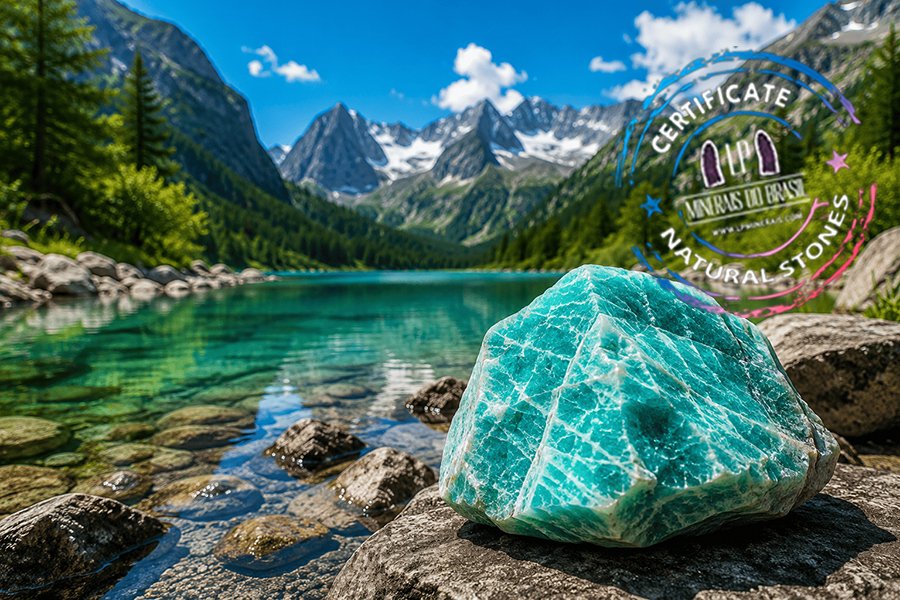
Few minerals can convey a sense of tranquility as immediately as Amazonite. Its delicate shades of blue-green are reminiscent of crystal-clear rivers, glacial lakes, and tropical landscapes, making it one of the world’s most prized ornamental gemstones. In addition to its unique beauty, this feldspar arouses interest due to its geological formation, widespread use in jewelry, and strong presence in symbolic traditions across different cultures.
Although its name suggests a connection to the Amazon Rainforest, there is no evidence that Amazonite was originally discovered in the Amazon River region. The origin of its name remains shrouded in historical hypotheses, likely inspired by the exuberance of the colors associated with the forest and ancient tales of the Amazon warrior women. Today, major deposits are found in countries such as Brazil, Russia, Madagascar, the United States, India, and Ethiopia.
From a mineralogical perspective, amazonite is a green variety of microcline, a mineral belonging to the potassium feldspar group. Its characteristic color results from small amounts of lead combined with natural structural changes brought about over millions of years of geological evolution.
This process creates shades ranging from light green to turquoise blue, often accompanied by delicate white veins that make each specimen unique.
In the tradition of crystal therapy, Amazonite is often described as a stone associated with emotional balance, sincere communication, and the pursuit of inner harmony. Authors such as Judy Hall and Robert Simmons & Naisha Ahsian traditionally associate it with the expression of truth, the strengthening of serenity, and the balance between reason and emotion. These interpretations belong to the field of holistic practices and are presented as a complement to scientific knowledge about the mineral.
Today, Amazonite holds a prominent position among collectors, designers, jewelers, and enthusiasts of natural minerals. Its combination of elegance, relative availability, and excellent durability makes it one of the most versatile ornamental stones on the international market.
A Feldspar That Conquered the World
Feldspars constitute the most abundant group of minerals in the Earth’s crust, accounting for approximately half of all known rocks. Within this vast group, microcline stands out for forming crystals of excellent gemological quality, especially when it develops the green coloration characteristic of Amazonite.
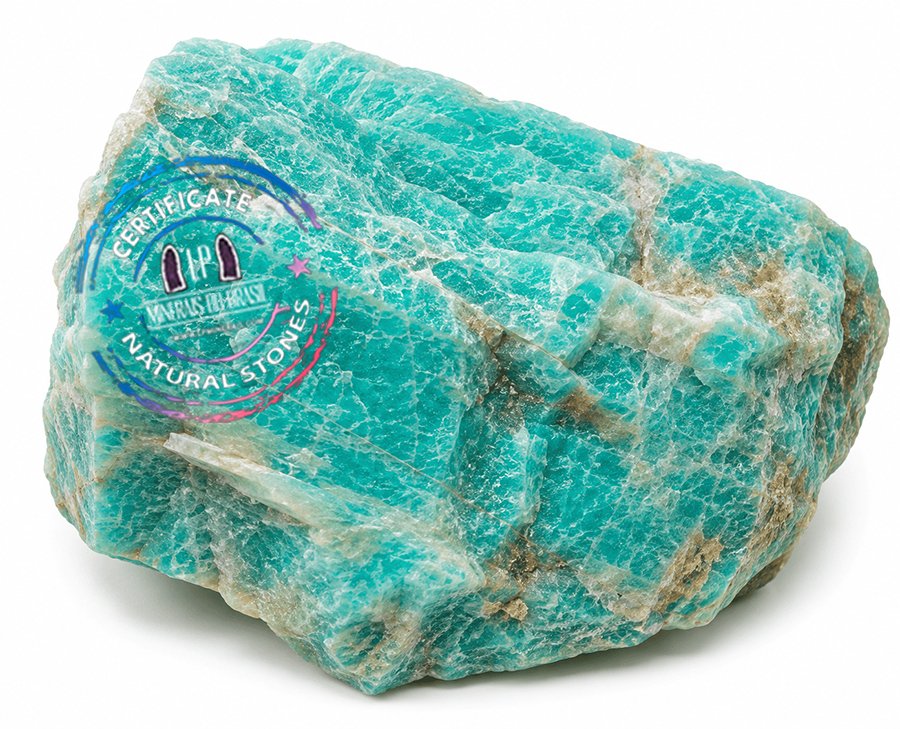
It crystallizes in slowly cooling igneous rocks, primarily granites and pegmatites—geological environments rich in chemical elements that promote the growth of large crystals. Over millions of years, hydrothermal solutions and structural alterations contribute to the development of the hues that have made Amazonite one of the best-known varieties of this mineral.
The highest-quality specimens typically exhibit:
- an intense bluish-green color;
- uniform vitreous luster;
- few visible fractures;
- subtle, natural white veins;
- excellent polish.
The more uniform the color and the greater the intensity of the luster, the higher its ornamental value tends to be.
Where is Amazonite found?
Amazonite has a relatively wide distribution, but only a few regions produce gem-quality material.
Among the main sources, the following stand out:
- Brazil;
- Russia;
- Madagascar;
- the United States;
- India;
- Ethiopia;
- Namibia.
Brazil plays a prominent role in this international landscape. States such as Minas Gerais are home to significant pegmatite deposits that produce Amazonite of excellent quality, used both domestically and for export in jewelry, home décor, and mineral collecting.
This diversity of origins also results in slight variations in color, transparency, and texture—characteristics highly valued by experts and collectors.
Natural Beauty for Jewelry, Decor, and Collections
Thanks to its good hardness and ease of cutting, Amazonite has become one of the most versatile ornamental minerals available on the market.
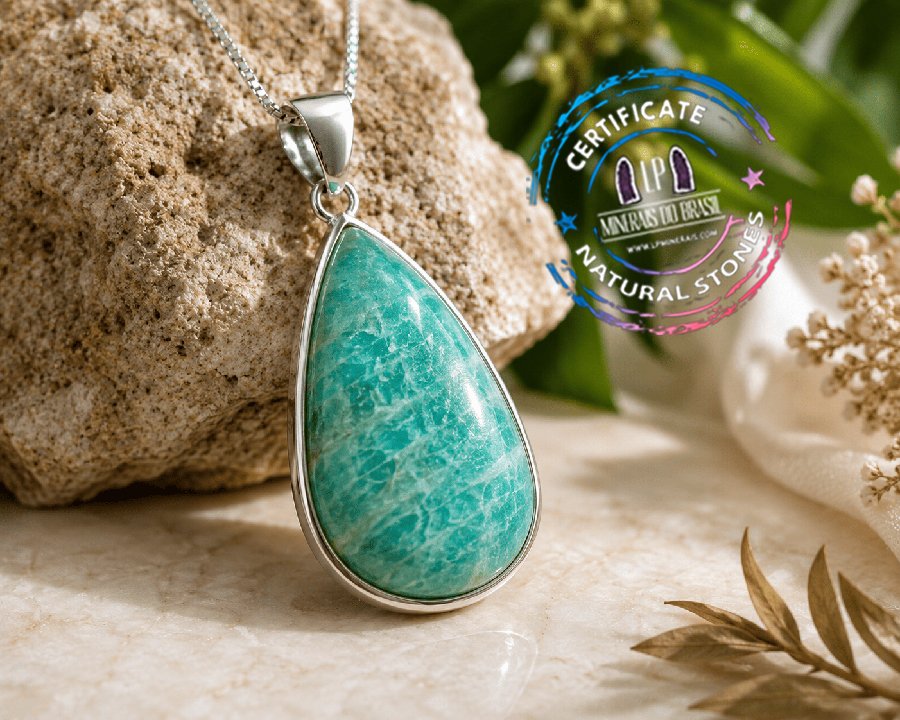
It can be crafted into cabochons, beads, sculptures, spheres, obelisks, pendants, and various decorative objects, retaining its beauty even after years of use when properly cared for.
Among its most common uses are:
- jewelry;
- fine costume jewelry;
- sculptures;
- spheres;
- obelisks;
- decorative pieces;
- mineral collecting;
- high-end crafts.
Its soft hue allows for elegant combinations with silver, gold, wood, marble, and other natural minerals, making it a frequent choice in contemporary design projects.
The Traditional Symbolism of Amazonite
Throughout history, different cultures have attributed symbolic meanings to natural stones, and Amazonite has become one of the stones most closely associated with harmony in human relationships.
In the tradition of crystal therapy, it typically represents a balance between thought and emotion, encouraging clearer, more respectful, and more authentic communication. It is also frequently associated with serenity in the face of daily challenges and the ability to express feelings with greater confidence.
These interpretations are traditionally attributed to the Amazonite mineral itself and not to a specific color or place of origin. In holistic practices, many people use the stone as a symbol of calm, hope, and the strengthening of personal expression.
Traditionally, Amazonite is associated with:
- emotional balance;
- sincere communication;
- serenity;
- harmony;
- hope;
- self-confidence;
- personal expression;
- creativity;
- gentleness in relationships;
- inner well-being.
Regardless of the approach taken, Amazonite remains one of the most elegant ornamental gemstones produced by nature, combining science, history, beauty, and tradition in a single mineral.
A versatile stone for jewelry, home decor, and collecting
The combination of natural beauty, good durability, and ease of cutting has made Amazonite one of the most widely used gemstones on the international market. Its delicate color harmonizes with different design styles, from classic jewelry to contemporary interior design projects.
In jewelry, it is often cut into cabochons, beads, and free-form shapes, highlighting its natural nuances and the subtle white veins characteristic of the mineral. In interior design, it can be found in spheres, obelisks, pyramids, sculptures, bookends, and decorative objects that highlight its elegant appearance without losing the authenticity of the natural stone.
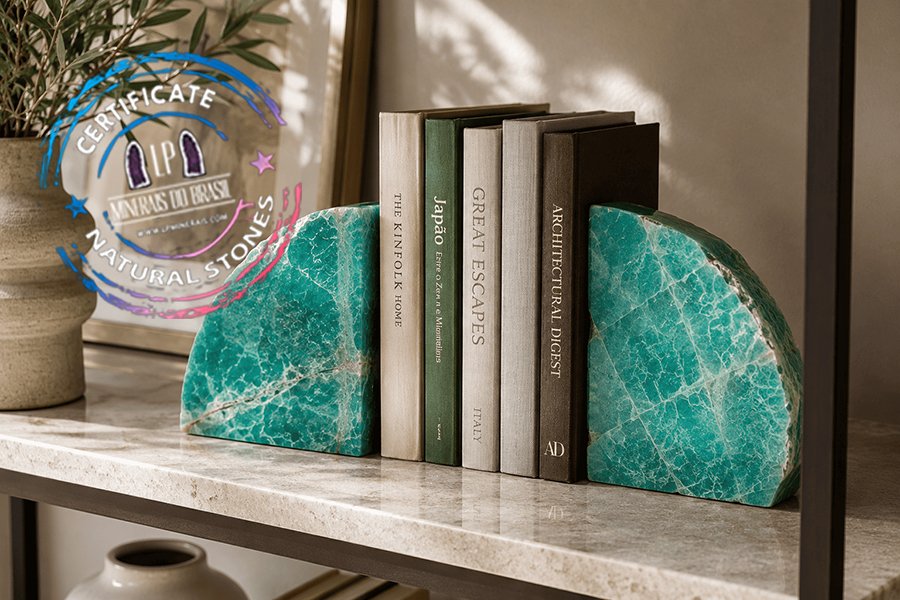
Its versatility allows for use in:
- handcrafted and high-end jewelry;
- pendants and earrings;
- bracelets and necklaces;
- decorative spheres;
- obelisks;
- ornamental sculptures;
- mineralogical collections;
- interior design objects.
This wide range of uses helps ensure that Amazonite remains one of the most sought-after stones by consumers, architects, interior designers, and collectors alike.
The Traditional Meaning of Amazonite
Long before it found its place in contemporary jewelry, Amazonite already aroused interest for its symbolism. In various cultural traditions, its blue-green color came to represent serenity, hope, and balance—qualities that remain central to current crystal therapy interpretations.
According to the tradition described by authors such as Judy Hall and Robert Simmons & Naisha Ahsian, Amazonite is often associated with genuine communication, emotional balance, and harmony between reason and sensitivity. In holistic practices, it is often used as a symbol of tranquility, promoting the sincere expression of feelings and fostering more balanced relationships. These interpretations belong to the realm of spiritual traditions and do not constitute scientifically proven properties.
Its association with nature also reinforces an image of renewal, hope, and confidence, making it one of the most cherished stones among those seeking welcoming and inspiring environments.
Traditionally, Amazonite is associated with:
- sincere communication;
- emotional balance;
- serenity;
- hope;
- harmony;
- creativity;
- self-confidence;
- personal expression;
- gentleness in relationships;
- inner well-being.
How can you identify natural Amazonite?
The popularity of Amazonite has led to the emergence of numerous imitations made from glass, resins, and dyed stones, especially howlite and colored quartz.
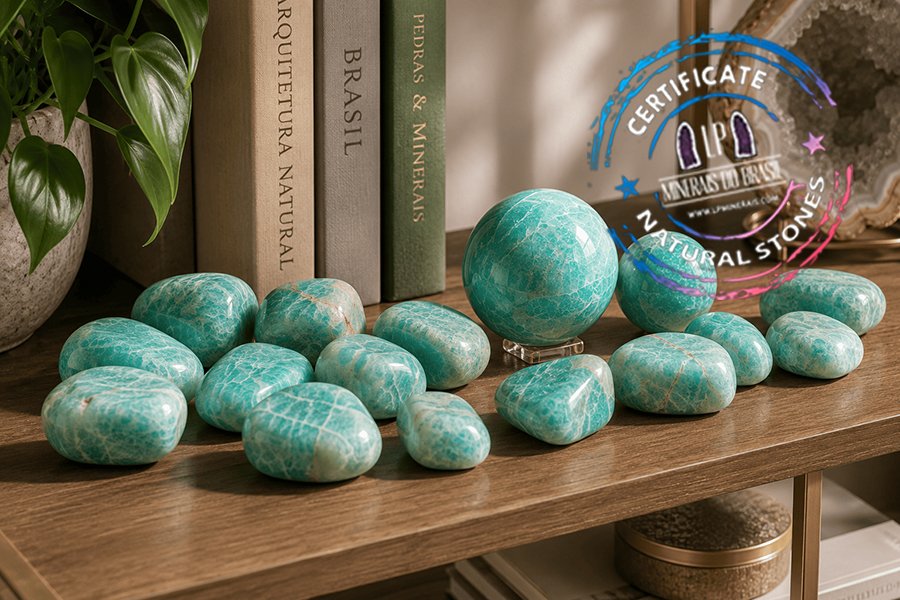
Although some imitations are visually convincing, natural Amazonite has very distinctive characteristics.
Note:
✔ natural green or blue-green coloration;
✔ delicate, irregular white veins;
✔ a soft, vitreous luster;
✔ slight variation in shade between different areas of the stone;
✔ absence of excessively uniform or artificial colors.
Origin is also an important factor in assessing quality, especially for specimens intended for collecting or high-end jewelry.
Care and Maintenance
Amazonite is quite durable for everyday use, but taking a few precautions will help preserve its luster for many years.
Although it has relatively high hardness for a feldspar, strong impacts can cause chips or small fractures.
To care for the stone, it is recommended to:
- wipe it gently with a soft, slightly damp cloth;
- use room-temperature water when necessary;
- dry it immediately after cleaning;
- avoid harsh chemicals;
- store it separately from harder gemstones, such as quartz and topaz.
These simple precautions preserve both the gem’s luster and the integrity of its cut.
🗺 LP MINERAIS Technical Notes ⛏💎📦🗺
🗺 » ORIGIN — Brazil, Russia, Madagascar, the United States, India, Ethiopia, and Namibia.
⚛️ » CHEMICAL COMPOSITION — Potassium aluminum silicate (KAlSi₃O₈).
🔩 » MOHS SCALE — 6 to 6.5.
🔢 » NUMEROLOGY — Traditionally associated with the number 5 in some esoteric traditions.
🔅 » MEANING — Traditionally associated with communication, serenity, hope, and emotional balance.
🅰️ » SUMMARY — A green variety of microcline belonging to the feldspar group, recognized for its characteristic blue-green color.
✅ » SPECIFICATION — Potassium feldspar.
🧩 » STATE — Natural mineral.
⚒ » FORMATION — It crystallizes primarily in granitic pegmatites during the slow cooling of feldspar-rich magmas.
⚠️ » CARE — Avoid strong impacts, chemicals, and prolonged contact with abrasive surfaces.
🛁 » CLEANING — Running water, a soft cloth, and immediate drying.
🎨 » COLOR — Light green, bluish-green, turquoise, and greenish tones with natural white veins.
☯️ » ZODIAC — Traditionally associated with Virgo and Aquarius in various schools of crystal therapy.
🪐 » SOLAR SYSTEM — Often associated with the planet Uranus.
➰ » CHAKRAS — Traditionally associated with the Heart Chakra and the Throat Chakra.
♻ » ELEMENT — Water.
💎 » RARITY — Relatively common, though specimens with intense, uniform coloring have greater commercial value.
🗳 » CHARACTERISTIC — An ornamental feldspar known for its bluish-green color and delicate natural veins.
Frequently Asked Questions About Amazonite
Is Amazonite a rare stone?
No. Amazonite is found in several countries, but specimens with intense color, uniform luster, and few fractures are significantly more valuable.
Can Amazonite be used in jewelry?
Yes. Its hardness makes it suitable for use in rings, earrings, necklaces, bracelets, and pendants, provided it receives proper care.
How do you clean Amazonite?
Use only room-temperature water, a soft cloth, and dry it immediately. Avoid abrasive chemicals.
Can Amazonite get wet?
Yes. Occasional contact with water usually doesn’t cause problems, as long as the stone is dried immediately after cleaning.
How can you tell if Amazonite is real?
Look for its natural coloration, characteristic white veins, glassy luster, and the material’s origin. Excessively uniform colors may indicate imitations.
Does Amazonite fade over time?
When protected from prolonged exposure to intense heat and chemicals, it tends to retain its color for many years.
What is the traditional meaning of Amazonite?
In crystal healing tradition, it typically symbolizes emotional balance, serenity, sincere communication, and hope.
Is Amazonite used in interior design?
Yes. Amazonite spheres, obelisks, sculptures, and decorative objects are highly prized in contemporary interior design projects.
Conclusion
Amazonite demonstrates how one of the most abundant minerals in the Earth’s crust can be transformed into a gem of extraordinary beauty. Its bluish-green color, combined with its delicate luster and the natural characteristics of microcline, has earned it a place in jewelry, interior design, and collecting worldwide.
In addition to its recognized ornamental value, the tradition of crystal therapy associates it with emotional balance, serenity, and authentic communication, complementing the fascination sparked by its geological origin. Whether in an elegant piece of jewelry, a decorative object, or a mineralogical collection, Amazonite remains a symbol of the richness and diversity that nature offers.
By: Doris S. Rosa
Howlite: what lies behind the Stone of Calm and Inner Silence?
Moonstone: the Stone of Intuition, Feminine Energy, and the Mysteries of the Moon.
Jade: The Stone of Wisdom, Prosperity, and Harmony That Spans Millennia
Angelite: The Stone of Serenity, Intuition, and Spiritual Connection
Green Aventurine: the Stone of Prosperity, Opportunity, and New Paths
Orange Calcite: The Solar Energy That Awakens Creativity and Movement
Black Obsidian: origin, formation, properties, and meaning of one of the best-known protective stones.
Carnelian: origin, formation, mineralogy, and the vibrant energy of a stone linked to action.
Fluorite: Mineralogy, Formation, Colors, and Meaning of a Mineral that Organizes Light and Color
Red Jasper: Mineralogy, Vitality, and the Ancestral Strength of an Earth-Connected Stone