



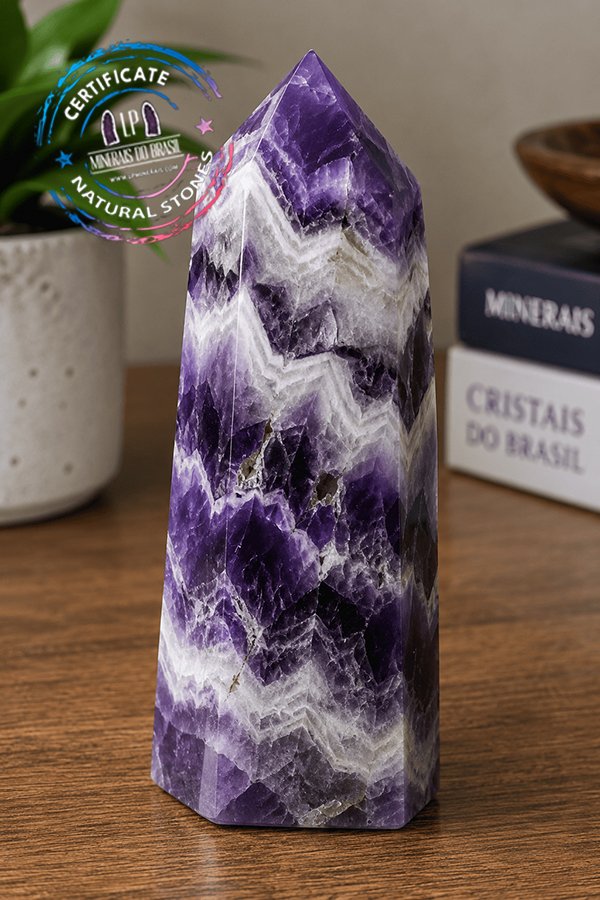
Some gemstones captivate with the intensity of their colors. Others stand out for their transparency or rarity. Chevron Amethyst combines attributes that make it unique: in addition to the traditional violet hue of amethyst, it features natural “V”-shaped patterns formed by alternating layers of amethyst and white quartz. This geometric pattern, created exclusively by nature, transforms each specimen into a true work of mineral art.
When looking at a fine Chevron Amethyst, it’s hard to believe that its perfectly defined lines weren’t drawn by hand. However, they are the result of geological processes that occurred over millions of years, during the simultaneous growth of different varieties of quartz under very specific conditions of temperature, pressure, and the circulation of silica-rich fluids.
In addition to its great mineralogical interest, Chevron Amethyst holds a prominent place in traditional crystal therapy. According to the conceptual framework adopted by LP MINERAIS, based on the classical interpretations of Judy Hall and Robert Simmons, it is often associated with strengthening intuition, mental clarity, energetic protection, and deepening meditative states. These interpretations belong to the field of holistic practices and coexist in a complementary manner with scientific knowledge about the mineral.
Today, Chevron Amethyst is found in mineralogical collections, handcrafted jewelry, decorative objects, and spaces designed for meditation, making it one of the most sought-after varieties for those seeking to combine natural beauty, symbolism, and exclusivity.
How does nature create the Chevron pattern?
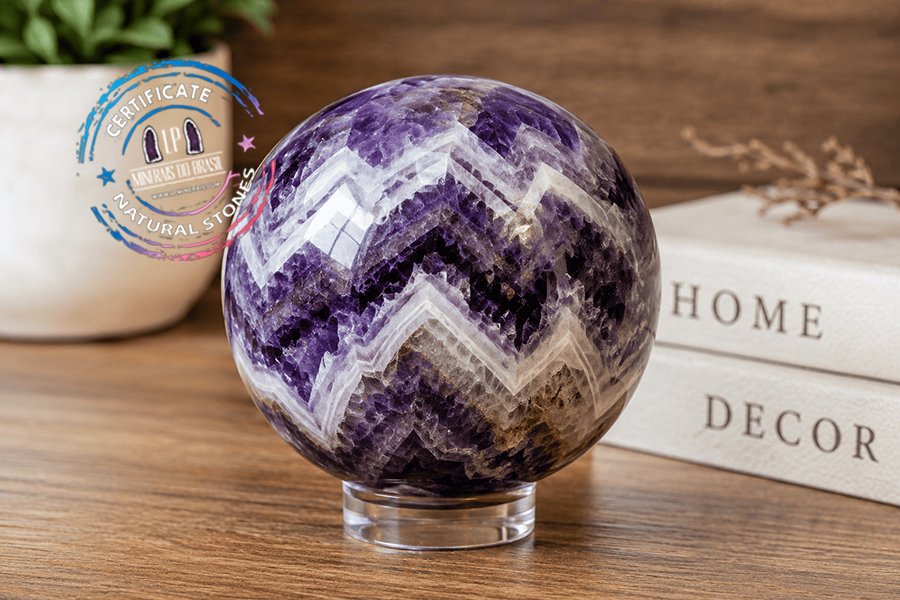
Although it belongs to the quartz family, Chevron Amethyst has a characteristic that sets it apart from conventional amethysts: its “V”-shaped bands.
This pattern emerges when amethyst and milky quartz crystals grow alternately during different phases of mineralization. Small changes in the chemical conditions of the environment cause each layer to take on a distinct color, forming the famous angular bands that resemble fish bones or mountains viewed in profile.
Each deposit produces a unique pattern. Some specimens feature very pronounced bands, while others display smooth transitions between violet and white, further enhancing their uniqueness.
The main producing countries include:
- Brazil 🇧🇷;
- India;
- Russia;
- Namibia;
- Uruguay;
- Zambia.
Brazil holds a prominent position both for the quality of its material and for its tradition of responsible mining and supply to the international market.
Far Beyond Traditional Amethyst
Although it shares the same chemical composition as common amethyst, the Chevron variety tends to spark a different kind of interest among collectors.
Its value lies not only in the intensity of its violet color but primarily in the quality of its natural bands. The more clearly defined the layers are, the greater its aesthetic appeal tends to be.
This leads to many pieces being marketed practically as small sculptures created by nature itself.
In cut specimens, the contrast between white quartz and amethyst creates striking visual effects, enhancing spheres, towers, points, palm stones, and ornamental pieces.
The Energetic Tradition of Chevron Amethyst
Among the key references in modern crystal therapy, Chevron Amethyst is often described as an amplification of the qualities traditionally attributed to amethyst.
Its symbolism is often linked to the expansion of consciousness, the strengthening of intuitive perception, and the organization of thoughts. Many people use this stone during moments of study, meditation, or reflection, seeking to create a quieter environment conducive to concentration.
It is also frequently associated with energetic protection and spiritual development, and is used on altars, in therapeutic spaces, and in environments designed for relaxation.
Traditionally, Chevron Amethyst is associated with:
- strengthening intuition;
- mental clarity;
- energetic protection;
- emotional serenity;
- deep meditation;
- concentration;
- spiritual balance;
- development of inner awareness.
Regardless of the approach taken, its natural beauty remains the main reason why thousands of people choose this extraordinary variety of quartz for collections, home decor, and jewelry of high aesthetic value.
Between Contemplation and Everyday Use
Chevron Amethyst possesses a visual quality that lends itself to contemplation. Its violet and white lines guide the eye from one layer to the next, creating a sense of movement even when the stone remains still. This is why many people choose it for study desks, meditation spaces, personal altars, or environments where they wish to foster an atmosphere of introspection and serenity.
In holistic traditions, it is often used as a symbolic aid in practices of breathing, concentration, and inner observation. The goal is not to attribute guaranteed effects to the stone, but to use it as an element of intention: a visual reminder to slow down, organize one’s thoughts, and return to the present moment.
A small piece can be kept near books, notebooks, or work tools. Larger pieces, such as towers, spheres, and polished stones, become striking decorative objects, especially when the cut highlights the “V” pattern.
A pattern that changes depending on the cut
In Chevron Amethyst, the direction of the cut is decisive. A piece cut transversely may display concentric patterns, while another, cut in a different direction, reveals angular bands, triangles, and lines that converge at the center.
This detail explains why two stones produced from the same block can have completely different appearances. The gem cutter must carefully examine the material before choosing the best direction for the cut, preserving the contrast between the white quartz and the amethyst.
In high-quality pieces, the natural pattern is not hidden—it becomes the primary aesthetic element.
Chevron Amethyst in Professional Settings
Offices, medical offices, and consultation rooms often use natural minerals as focal points for visual balance. The Chevron Amethyst works especially well in these spaces because it combines a striking color with the softness of white quartz, without requiring an overly ornate decor.
On a desk, it can be placed as an object of contemplation. In a reception area, a well-cut sphere or tower adds texture and color to the space. In therapy offices, many people also value the symbolism traditionally associated with serenity, concentration, and energetic protection.
For interior design projects, the stone harmonizes with light wood, marble, neutral fabrics, gold-toned metals, silver, and earthy tones. The violet creates contrast, while the white bands help integrate the piece into the rest of the space.
Jewelry with a Distinct Identity
Although Chevron Amethyst is widely known in tower-shaped pieces, spheres, and tumbled stones, it can also be used in jewelry, especially when the cut preserves its natural bands. Oval cabochons, teardrops, rectangles, and free-form cuts allow the stone’s pattern to become the focal point of the design.
925 silver is one of the most common combinations, as it enhances the cool contrast between violet and white. Yellow gold and rose gold create a warmer, more sophisticated look, especially in designer pieces.
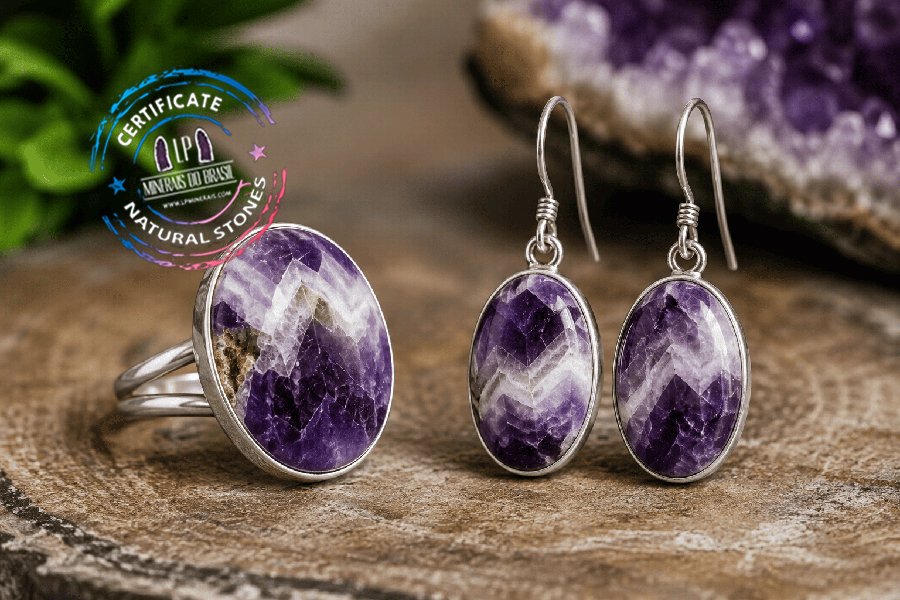
Due to its hardness, the stone can be used in pendants, earrings, and rings. However, like any quartz, it can chip or fracture under strong impact. For everyday rings, a setting that adequately protects the edges is recommended.
How can you tell Chevron Amethyst apart from similar materials?
The banded appearance can lead to confusion with other varieties of quartz, dyed agates, or composite stones. In natural Chevron Amethyst, the violet and white bands typically follow the internal growth of the quartz, exhibiting transitions and small irregularities consistent with its formation.
Extremely uniform coloring, artificially intense coloring, or coloring concentrated in fissures should be viewed with caution. The presence of natural bands does not, by itself, guarantee authenticity, but it is an important identifying feature.
It is also necessary to distinguish Chevron Amethyst from so-called Cacoxenite Amethyst, common Amethyst, and materials marketed under fanciful names. Reliable identification must consider composition, hardness, structure, inclusions, and origin.
What typically increases a piece’s value?
The market price does not depend solely on size. In many cases, a smaller specimen may be more valuable because it features an exceptional pattern.
Among the factors observed are:
- contrast between violet and white;
- definition of the bands;
- intensity and distribution of color;
- quality of polish;
- integrity of the piece;
- symmetry, when applicable;
- known provenance;
- aesthetic rarity of the pattern.
Chevron Amethyst is not considered extremely rare, but visually balanced specimens with well-defined bands and careful cutting hold strong appeal in the interior design, collecting, and jewelry markets.
Cleaning, Care, and Responsible Use
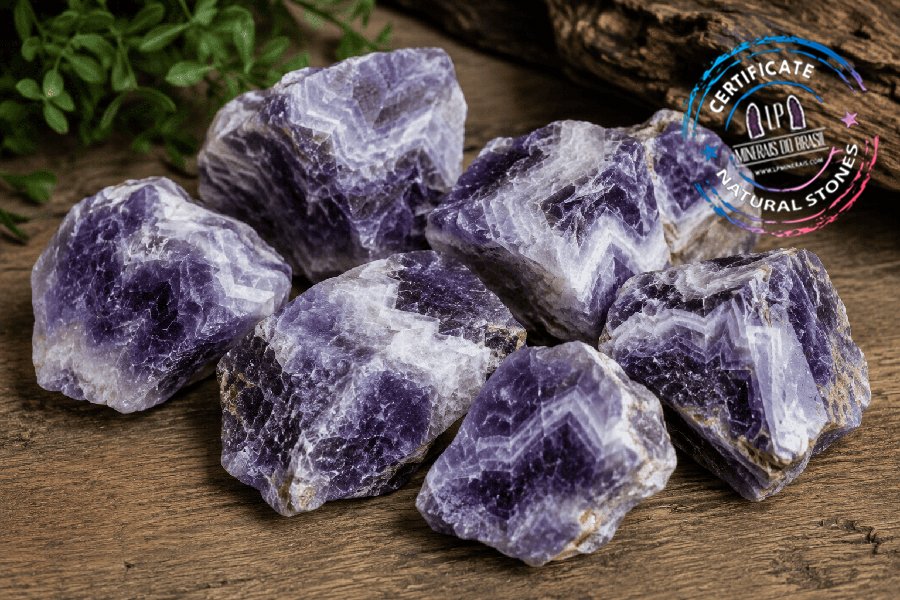
The hardness of quartz makes Chevron Amethyst relatively durable, but this does not mean it is indestructible. Drops, thermal shocks, and contact with chemicals can damage the finish or cause fractures.
Prolonged exposure to intense sunlight should also be avoided. Like other amethysts, some specimens may experience a gradual loss of color when continuously exposed to radiation and heat.
For physical cleaning, room-temperature water, mild soap, and a soft cloth are usually sufficient. The piece must be completely dry before being stored, especially if it has small cavities or unpolished areas.
In energy practices, cleansing methods vary by tradition. Since these interpretations do not pertain to mineralogy, it is more accurate to describe them as symbolic practices rather than procedures capable of scientifically altering the mineral.
🗺 LP MINERAIS Technical Note ⛏💎📦🗺
🗺 » ORIGIN – Brazil, India, Namibia, Zambia, and other regions that produce banded amethyst.
⚛️ » CHEMICAL COMPOSITION – SiO₂, silicon dioxide; a natural combination of amethyst and white quartz.
🔩 » MOHS HARDNESS – 7.
🔢 » NUMEROLOGY – There is no mineralogical or scientific consensus on a specific numerological meaning.
🔅 » MEANING – Traditionally associated with intuition, mental clarity, energetic protection, serenity, and deepening meditation.
🅰️ » SUMMARY – A banded variety of quartz that alternates areas of violet amethyst and white quartz, forming angular or “V”-shaped patterns.
✅ » SPECIFICATION – A banded macrocrystalline quartz variety.
🧩 » STATE – Natural mineral.
⚒ » FORMATION – Alternating growth of amethyst quartz and white quartz in silica-rich environments, under varying crystallization conditions.
⚠️ » CARE – Avoid drops, strong impacts, sudden temperature changes, harsh chemicals, and prolonged exposure to sunlight.
🛁 » CLEANING – Room-temperature water, mild soap, and a soft cloth; dry thoroughly after washing.
🎨 » COLOR – Light violet to deep violet, interspersed with white or milky bands.
☯️ » ZODIAC – Amethyst is traditionally associated with various zodiac signs, especially Pisces and Aquarius; there is no specific universal consensus regarding the Chevron variety.
🪐 » SOLAR SYSTEM – Often linked to Jupiter or Neptune in various esoteric traditions; there is no universal association.
➰ » CHAKRAS – Traditionally associated with the Third Eye Chakra and the Crown Chakra.
♻ » ELEMENT – Often associated with the element of Air or the element of Water, depending on the esoteric school followed.
💎 » RARITY – It is not considered extremely rare, although well-defined patterns, intense colors, and pieces with excellent craftsmanship are more highly valued.
🗳 » CHARACTERISTIC – Violet and white bands that form angular, triangular, concentric, or chevron-like patterns.
Frequently Asked Questions About Chevron Amethyst
Is Chevron Amethyst natural?
Yes. Its pattern results from the natural alternation between amethyst and white quartz during the mineral’s growth.
What is the difference between Chevron Amethyst and regular Amethyst?
Regular Amethyst may have a relatively uniform violet color or areas of varying color. Chevron Amethyst features white and violet bands that form characteristic angular patterns.
How can you tell if a Chevron Amethyst is genuine?
Examine the natural appearance of the bands, the internal variations, the vitreous luster, and the origin. For confirmation, a gemological evaluation is recommended.
Can Chevron Amethyst get wet?
Yes. Brief contact with room-temperature water usually does not cause problems. The piece should be dried after cleaning.
Can Chevron Amethyst be exposed to sunlight?
It is not recommended to leave it continuously exposed to intense sunlight, as the color may fade over time.
What is Chevron Amethyst used for?
It is used in decoration, collecting, jewelry, and, traditionally, in practices of meditation, concentration, and spiritual development.
Is Chevron Amethyst rare?
It is not extremely rare. However, specimens with well-defined bands, an intense violet color, and a high-quality polish are more highly valued.
Can Chevron Amethyst be used at work?
Yes. As a decorative object, it is appreciated in offices and study rooms. In holistic practices, many people use it as a symbol of focus, serenity, and clarity.
Which stones pair well with Chevron Amethyst?
In crystal healing traditions, it is often paired with Clear Quartz, Selenite, Rose Quartz, and Black Tourmaline, depending on the symbolic intention. These pairings have no scientific basis.
Is Chevron Amethyst mined in Brazil?
Yes. Brazil has significant deposits of amethyst and banded materials used in the mineral, decorative, and gemstone markets.
Is it suitable for export and wholesale?
Yes. Tumbled stones, towers, spheres, rough pieces, and cabochons are in international demand. Classification by color, pattern, size, finish, and origin facilitates professional marketing and export.
Conclusion
Chevron Amethyst reveals how small changes during a mineral’s growth can produce patterns with great visual impact. Its violet and white bands reflect different stages of crystallization and transform each piece into a one-of-a-kind geological composition.
On a symbolic level, it has traditionally been associated with introspection, intuition, serenity, and energetic protection. In mineralogy and the market, it stands out for its durability, its variety of applications, and the interest it sparks among collectors, designers, jewelers, and buyers of decorative pieces.
When sourced responsibly, finished with care, and handled with commercial integrity, Chevron Amethyst also represents the union of natural beauty, technical expertise, and a more transparent mineral supply chain—principles aligned with Fair-Trade practices, the LP MINERAIS showroom, and its premium supply chain ⛏💎📦🗺.
By: Doris S. Rosa
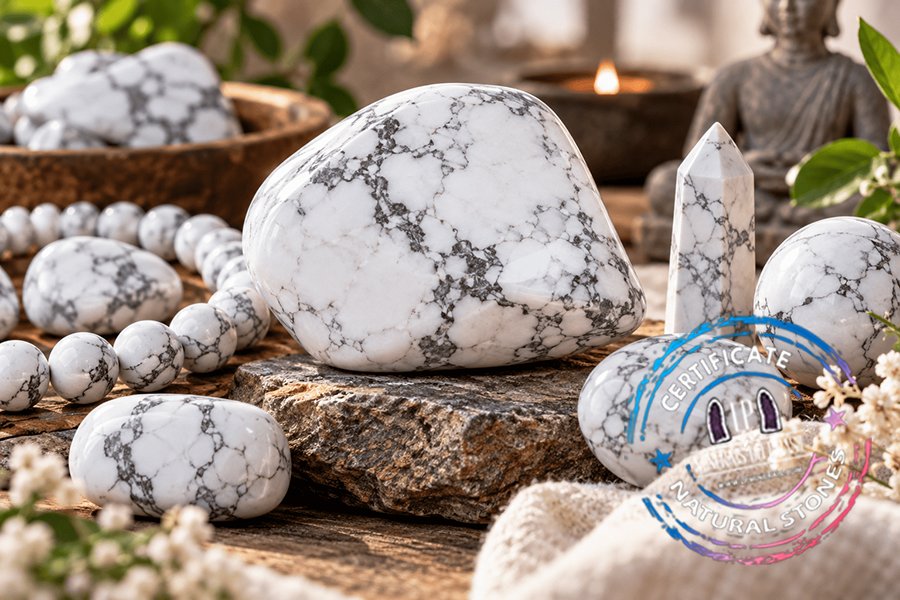
Howlite: what lies behind the Stone of Calm and Inner Silence?
Moonstone: the Stone of Intuition, Feminine Energy, and the Mysteries of the Moon.
Jade: The Stone of Wisdom, Prosperity, and Harmony That Spans Millennia
Angelite: The Stone of Serenity, Intuition, and Spiritual Connection
Green Aventurine: the Stone of Prosperity, Opportunity, and New Paths
Orange Calcite: The Solar Energy That Awakens Creativity and Movement
Black Obsidian: origin, formation, properties, and meaning of one of the best-known protective stones.
Carnelian: origin, formation, mineralogy, and the vibrant energy of a stone linked to action.
Fluorite: Mineralogy, Formation, Colors, and Meaning of a Mineral that Organizes Light and Color
Red Jasper: Mineralogy, Vitality, and the Ancestral Strength of an Earth-Connected Stone