



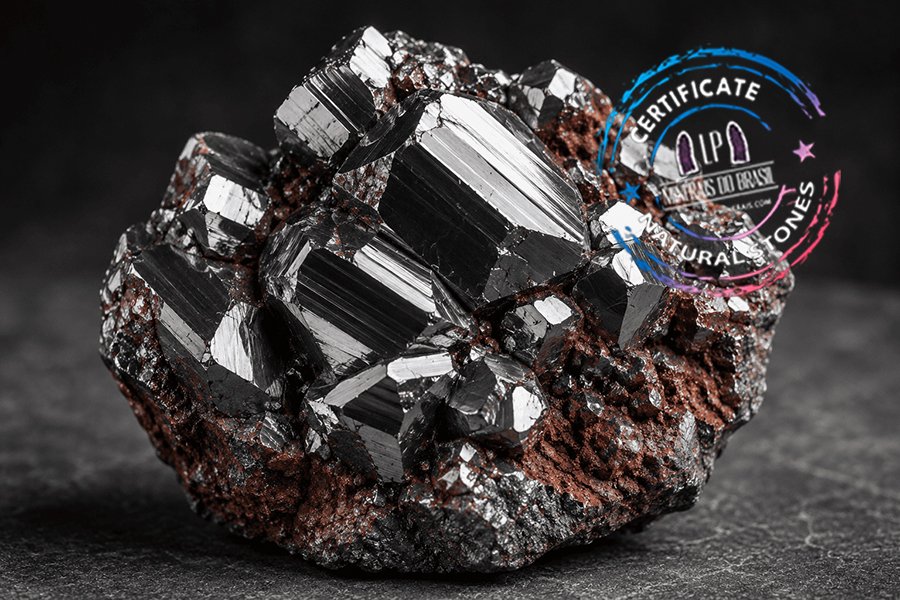
Hematite has an appearance that seems to contradict its very name. At first glance, many specimens exhibit a dark gray, silvery, or nearly black metallic luster, a surface reminiscent of polished steel, and a visual presence quite different from that of the better-known colored gemstones. But one need only observe its streak—the powder left by the mineral on a suitable surface—to reveal its true signature: red to reddish-brown. It is precisely this characteristic that gives it its name, derived from the Greek word haima, meaning “blood.”
This connection to the color red is not merely a mineralogical curiosity. Hematite is one of the most important iron minerals on Earth and has been part of human history for thousands of years. Long before it appeared in bracelets, tumbled stones, sculptures, or mineral collections, its reddish pigments were already being used by ancient peoples. Throughout different periods of history, the mineral played a role in art and ornamentation and later became essential for the production of iron on an industrial scale.
In the world of crystals, its identity has taken another equally remarkable path. Hematite is traditionally associated with grounding, stability, strength, protection, and the ability to remain present in the face of the demands of everyday life. It is not a stone whose symbolism invites one to escape reality; on the contrary, its energetic language is deeply connected to returning to one’s center, recognizing limits, and transforming distraction into presence.
It is precisely this combination that makes hematite so interesting: a stone whose material history is linked to iron and whose energetic tradition speaks of steadfastness.
Hematite: The Iron Oxide That May Look Like Metal
Mineralogically, hematite is an iron oxide with the chemical formula Fe₂O₃. Despite the metallic appearance of many specimens, it is not a metal. It belongs to the trigonal crystal system and has a hardness of approximately 5 to 6.5 on the Mohs scale, depending on the aggregate and the characteristics of the sample.
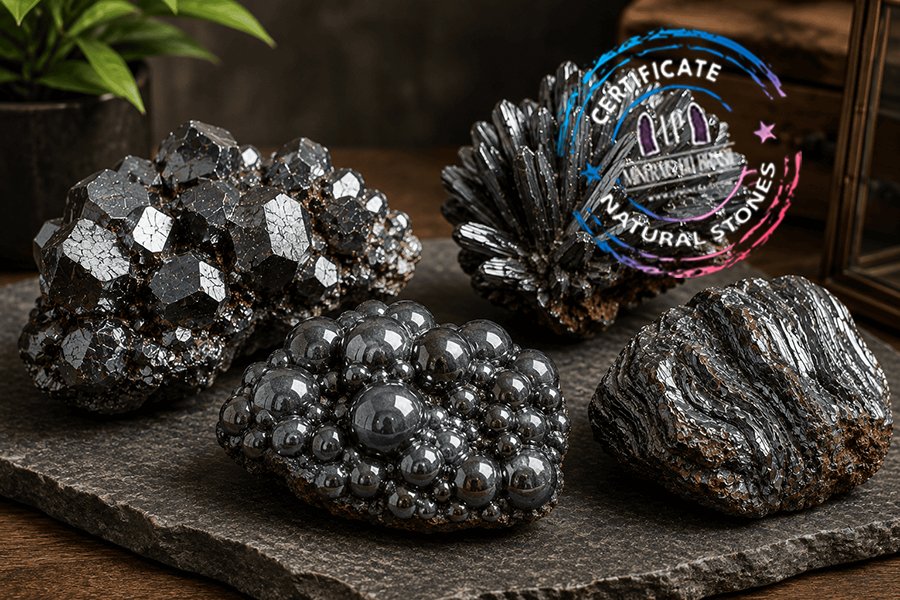
Its appearance can vary much more widely than the general public typically imagines. There are compact, metallic hematites; reddish earthy masses; tabular crystals; laminated aggregates; and botryoidal formations—those rounded surfaces that resemble clusters of small bubbles or bunches.
One of the most visually fascinating varieties is known as “iron rose,” formed by tabular crystals arranged in a way that resembles petals. In other specimens, highly lustrous, metallic-gray surfaces create an aesthetic completely different from that of the earthy, red hematite, even though both belong to the same mineral species.
Its best-known diagnostic characteristic, however, remains its streak.
When a suitable specimen of hematite is scratched on an unglazed porcelain plate used in mineralogy, the resulting powder tends to exhibit a reddish or reddish-brown hue. This helps distinguish it from various minerals with a similar appearance.
This characteristic reveals something very interesting: an apparently black or gray hematite retains within its own powder the color of oxidized iron, which defines its chemical identity.
How Hematite Forms
Hematite can form in different geological contexts, which explains its widespread distribution across the planet. It occurs in iron-rich sedimentary deposits, in hydrothermal environments, as a product of the alteration of other iron-bearing minerals, and in certain metamorphic and igneous contexts.
Among the most geologically significant occurrences are the ancient banded iron formations, known internationally by the acronym BIF. These rocks preserve extraordinary chapters in the planet’s history and contain large quantities of iron minerals.
Many of these formations began to develop in ancient oceans, when iron dissolved in water reacted with oxygen that gradually became available in the environment. The precipitation of iron compounds over enormous spans of time contributed to the formation of sequences of layers rich in iron and silica.
Millions and billions of years of subsequent geological processes altered many of these deposits, concentrating minerals and creating ore bodies of enormous economic importance.
In this sense, observing hematite is also observing a part of Earth’s chemical history.
Brazil occupies a particularly significant position in this context. Minas Gerais, whose very name reveals its long history with mining, possesses important iron ore deposits, especially in the Iron Quadrangle. The region is internationally recognized for the richness and diversity of its iron ores.
Hematite is also present in major Brazilian mineral provinces, contributing to the country’s importance in global iron ore production.
From Prehistoric Pigment to the Iron Industry
Few minerals bridge such distant periods of human history as hematite.
Earth-colored varieties rich in iron oxides have provided red pigments used since prehistoric times. Red ochre is associated with artistic expressions, objects, and symbolic practices of ancient societies in different regions of the world. Naturally, not all ochre is pure hematite, but iron oxides—especially hematite—are responsible for a large part of these characteristic shades.
This relationship between the mineral and the pigment has spanned millennia. The red obtained from iron-bearing materials was used in paintings, ceramics, and various forms of visual expression.
With the development of metallurgy and, later, modern industry, another aspect of hematite came to the fore: its high iron content.
Since it contains approximately 70% iron by mass when considered in its ideal composition, hematite is one of the primary ore minerals used to extract this metal. Of course, natural ores contain other minerals and impurities, and their industrial quality depends on the composition of the deposit and the processing methods used.
The iron extracted from ores is used in the manufacture of steel, which underpins much of today’s infrastructure—buildings, vehicles, machinery, tools, bridges, and countless pieces of equipment.
It is hard to find a more fascinating contrast: the same mineral species that helped ancient humans produce pigments is now part of industrial chains capable of building entire cities.
Natural Hematite, Hematine, and “Magnetic Hematite”: An Important Difference
In the gemstone trade, few issues warrant as much clarity as the use of the name “Hematite.”
Natural hematite has relatively weak magnetic properties under normal conditions and should not be confused with those intensely magnetic materials commonly found in bracelets, necklaces, and other items marketed as “magnetic hematite.”
When a piece exhibits strong magnetism—capable of easily adhering to magnets or other similar objects—this alone is reason enough to investigate its composition. Products sold under names such as “hematine,” “magnetic hematite,” or simply “hematite” may be manufactured materials or compounds rich in iron oxides other than natural hematite.
This does not mean that every object of this type is necessarily bad. It simply means that it should not be presented as if it were natural hematite without any clarification.
There are also imitations made of glass, ceramic, or other materials with a metallic finish. Therefore, responsible identification should consider a set of characteristics, not just color and luster.
Some useful clues include:
- a red to reddish-brown streak in hematite;
- a metallic or submetallic luster in many varieties;
- relatively high density;
- usually weak magnetism in natural hematite;
- a wide variety of natural forms and appearances.
Improperly conducted tests can damage polished specimens or jewelry. For important specimens, professional identification remains the safest approach.
In the responsible trade of minerals, the rule is simple: beauty catches the eye; provenance and information build trust.
Value, Collectibility, and Mineral Significance
Hematite is abundant on a geological scale and is of enormous importance as an iron ore; therefore, it should not be treated generically as a rare mineral. This, however, does not mean that all specimens have the same value.
A mass of hematite intended for industrial processing belongs to a completely different commercial reality than a well-crystallized iron rose, an aesthetically exceptional botryoidal aggregate, or a mineralogical specimen from a classic locality.
In collecting, factors such as crystalline structure, aesthetics, size, integrity, association with other minerals, and provenance come into play. Well-developed specimens can occupy a prominent position in collections even when the mineral species itself is relatively common.
Tumbled stones and polished pieces, on the other hand, primarily showcase their metallic luster. When well-crafted, hematite can acquire a very distinctive mirror-like surface, which accounts for much of its popularity in accessories and decorative objects.
In jewelry and costume jewelry, it appears mainly in beads, cabochons, pendants, and bracelets. Its dark hue allows for elegant combinations with silver, steel, and other metals, creating understated and contemporary pieces.
Hematite thus demonstrates that mineralogical rarity and commercial value are not synonymous. A mineral can be abundant and still produce exceptional, collectible, and aesthetically valuable specimens.
From Matter to Energy: Why Did Hematite Become a Symbol of Grounding?
There is an almost immediate symbolic connection between hematite’s physical appearance and the way it has come to be interpreted in crystal healing traditions.
It is heavy for its size, dark, rich in iron, and deeply connected to the earth. Its energy is traditionally described as grounding, stabilizing, and strengthening—especially useful when thoughts, emotions, or worries seem to pull a person away from what is happening in the present moment.
The idea of grounding is sometimes presented in an overly abstract way. In energy practice, however, it can be understood in a very concrete way: being present in one’s own body, perceiving the environment, recognizing priorities, organizing thoughts, and refocusing attention on what really needs to be done.
It is an energy that symbolically says:
“Come back down to earth. Come back to yourself. Now look at what’s right in front of you.”
This characteristic makes Hematite a stone very different from crystals traditionally associated with spiritual expansion, imagination, or contemplative states. Its strength lies precisely in the opposite direction: bringing awareness back to everyday reality.
Hematite, Protection, and Energetic Boundaries
The protection attributed to hematite has a unique quality. Rather than being interpreted solely as a barrier against external influences, it can be understood as a strengthening of one’s own energy field and boundaries.
This distinction is important.
There are times when a person feels energetically vulnerable not because something external is necessarily extraordinary, but because they are tired, scattered, emotionally overwhelmed, or overly open to the demands of others.
The tradition of crystal therapy associates hematite with the ability to regain a sense of grounding in these situations. Its energy is often used to strengthen one’s sense of presence and help a person distinguish between what belongs to them and what they are absorbing from their surroundings.
For this reason, it is a stone frequently chosen by people who work in busy places, interact with the public, deal with many demands, or spend long periods in emotionally intense environments.
Protection, in this sense, begins from within.
When there is greater internal stability, it becomes easier to establish external boundaries.
The Root Chakra and the Body’s Intelligence
Hematite’s most evident energetic correspondence is with the Root Chakra, traditionally associated with security, survival, stability, structure, and connection to physical reality.
Although its external appearance may be metallic gray, its reddish hue creates a particularly interesting symbolic association with this energy center. Iron, red, Earth, and bodily presence come together in a single narrative.
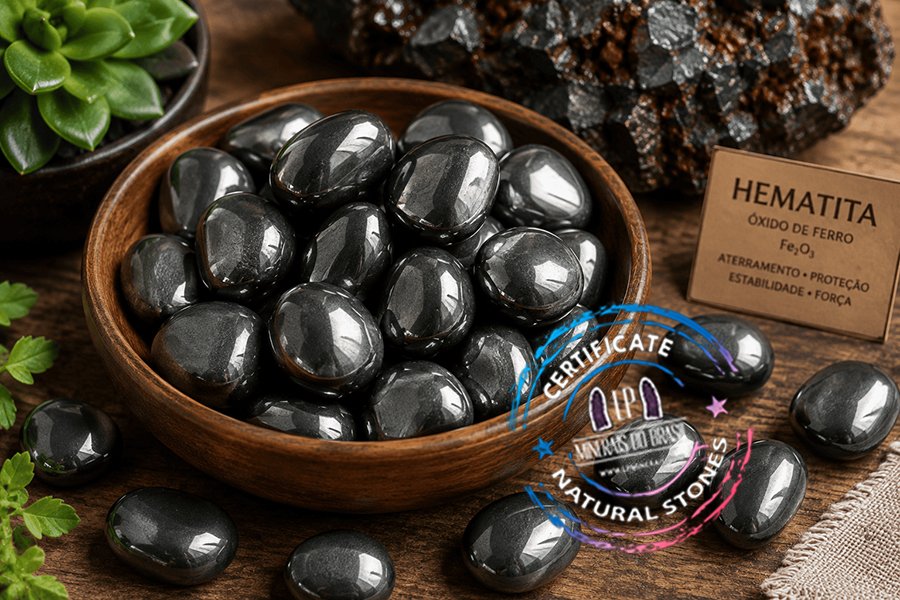
Hematite is often used in practices focused on body awareness. During meditation, it can be held in the hands or placed near the feet while attention is directed toward the breath, body weight, and contact with the ground.
The goal does not need to be achieving some extraordinary state.
In fact, with hematite, the exact opposite often happens.
The practice may simply consist of being fully present where you are.
This quality makes the stone particularly well-suited after very expansive spiritual or meditative activities. For some holistic practices, it symbolically serves as a return: after looking inward, imagining, visualizing, or contemplating, it is time to return to the body and continue living.
Strength, Courage, and Emotional Stability
Hematite is not usually described as a stone of expansive enthusiasm. Its strength is of a different nature.
It is the strength to persevere.
The strength to stick with a decision when the initial enthusiasm has waned. To see a task through. To keep your feet on the ground in the face of pressure. To regain your bearings when many things seem to demand your attention at once.
For this reason, its energetic tradition is closely associated with determination, courage, self-control, and stability.
In emotionally intense moments, it can be used as a symbol of restraint and grounding. This does not mean repressing emotions. The idea is different: to allow them to exist without completely losing your center.
There is a very fitting image to help understand this archetype: an anchor.
The anchor does not prevent the water from moving. It provides a point of reference while everything around it is in motion.
Hematite represents something similar on an energetic level.
Hematite at Work and in Daily Life
Few stones have a symbolism so consistent with professional environments that demand concentration, pragmatism, and decision-making.
A hematite on your desk can serve as a focal point to help you refocus when your mind begins to wander. Holding a tumbled stone for a few moments, feeling its weight, and directing your attention to a specific task is a simple practice that aligns closely with the mineral’s traditional symbolism.
In meetings or demanding professional situations, accessories featuring hematite are often used by those who wish to cultivate confidence, steadfastness, and presence.
In everyday life, some traditional uses include:
- work or study desk;
- entrances to rooms;
- professional spaces with heavy foot traffic;
- grounding practices;
- meditation;
- altars dedicated to stability and protection;
- personal use in bracelets, necklaces, or pocket stones.
More important than scattering hematite throughout every room is establishing a consistent intention for its use.
A crystal used consciously tends to take on much greater personal significance than a collection of stones placed at random.
Meditation with Hematite: Less Daydreaming, More Presence
A meditation with hematite can be surprisingly simple.
Instead of seeking complex images or elaborate visualizations, the practice can begin with the breath. Sitting comfortably, the practitioner holds a hematite in each hand—or just one stone—and observes its weight, temperature, and texture.
Attention is then directed to the feet and the body’s contact with the ground.
Breath after breath, the intention is to temporarily let go of worries about what has happened or what might still happen. The focus returns to the present moment.
This type of practice aligns particularly well with the symbolic nature of hematite because grounding is not about escaping to a different state of consciousness; it is about fully inhabiting the one we are already in.
On altars, the stone can be placed lower down or near the base of the arrangement, representing structure, support, and connection to the Earth. In professional settings, it can be placed near schedules, projects, or objects related to decisions that require consistency.
Energetic Combinations with Hematite
Hematite works very well as a foundation stone in energy combinations. Its stabilizing quality can complement crystals that are more expansive, intuitive, or emotionally intense.
When combined with Black Tourmaline, it forms a combination strongly associated with protection and grounding. Tourmaline traditionally works with energetic protection, while Hematite reinforces presence, stability, and boundaries.
When combined with Black Obsidian, the pairing takes on a deeper character. Obsidian is often associated with revelation and connecting with inner aspects that need to be acknowledged; hematite can symbolize the stability needed to remain present during this process.
With Clear Quartz, an interesting contrast is created between amplification and grounding. Quartz can direct and intensify an intention, while Hematite provides a firmer symbolic foundation.
With Red Jasper, the connection to the Root Chakra becomes even stronger, bringing together stability, vitality, and a connection to the Earth.
With Citrine, the combination can be especially beneficial for the professional environment: Citrine represents expansion, creativity, and fulfillment, while Hematite adds structure and focus.
The logic behind the combination is simple: to grow without losing touch with reality.
The Hematite Archetype: Remaining Whole
While Citrine, which we’ve just explored, symbolically embodies solar expansion, Hematite belongs to a different realm.
Its archetype is that of presence.
Not the kind of presence that needs to draw attention, but the kind that remains steadfast when external pressures arise. It is a silent force, related to the ability to maintain boundaries, recognize one’s own space, and not allow every event to pull us off-center.
Its very mineralogy offers an extraordinary metaphor.
On the outside, many specimens appear almost black or metallic.
Inside, its signature remains red.
There is something deeply symbolic about this: what we see on the surface does not necessarily reveal everything that exists within the material.
The red of hematite speaks of Earth, iron, the body, life, and permanence. Its metallic luster speaks of resilience. Its weight evokes a sense of solidity.
Perhaps that is why its energy has long been associated with the need to return to the essential.
When the mind races too much, return to the body.
When external demands pile up, return to your priorities.
When energy is scattered, return to the center.
When there is fear, find your footing before deciding on the next step.
Hematite doesn’t promise to eliminate everything that destabilizes us.
Its message is stronger than that: it symbolizes the ability to remain standing even when the world around us is in flux.
Hematite in Decor, Jewelry, and Collectibles
Hematite possesses a very distinctive aesthetic within the mineral world. While some stones captivate with their transparency or intense color, hematite draws attention with its metallic luster, its shades of graphite, steel, and silvery black, and its visual sense of weight and solidity. When polished, it can take on an almost mirror-like surface; when rough, it reveals textures ranging from compact and earthy to botryoidal aggregates and crystals of great mineralogical interest.
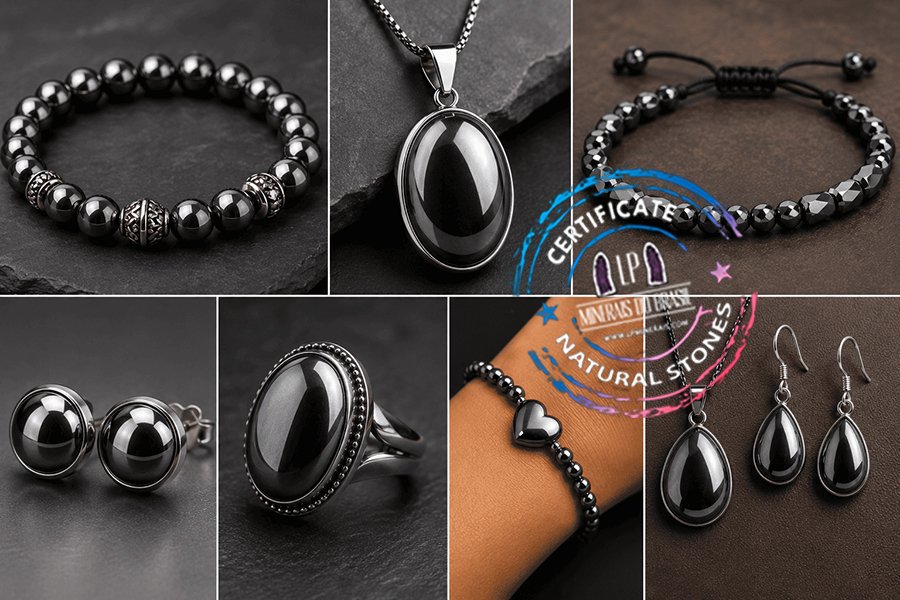
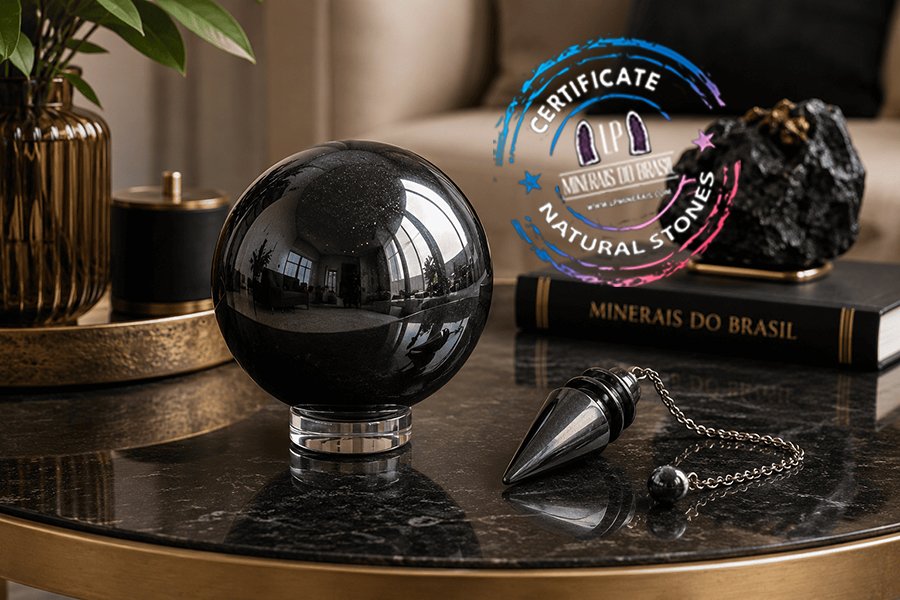
In interior design, this characteristic allows hematite to be used without necessarily creating an esoteric-looking space. A rough-hewn piece set on wood, natural stone, or a metal base works very well in contemporary, industrial, and minimalist interiors. Polished spheres and shapes offer a more sophisticated presence, while preserved mineralogical specimens enhance spaces where geology itself is part of the decor.
In jewelry and costume jewelry, its metallic appearance allows for highly versatile pieces. Polished beads are common in bracelets and necklaces; cabochons and faceted shapes can be found in pendants, earrings, and rings. The contrast with silver and steel creates an elegant monochromatic aesthetic, while combinations with more intensely colored stones produce visually striking compositions.
For collectors, however, the appeal may lie precisely in the opposite of polish. Iron roses, botryoidal aggregates, tabular crystals, and well-preserved mineral associations reveal a hematite that consumers accustomed only to small tumbled stones might not even recognize.
This diversity underscores an important characteristic of the mineral sector: a single species can serve completely different markets, ranging from industrial ore to collector’s specimens, from decorative applications to jewelry, and from energy use to design.
Hematite and the Brazilian Mineral Market
In Brazil, discussing hematite means addressing a topic of enormous economic significance. The country possesses some of the most significant reserves and operations related to iron ore, and Minas Gerais holds a historic position in this industry. The Iron Quadrangle, in particular, has become one of the most iconic geological regions in Brazil.
But there is a fundamental difference between viewing hematite as an industrial mineral resource and viewing it as a mineralogical specimen or a stone intended for the crystal market. In the first case, characteristics such as iron content, volume, processing, and feasibility of extraction are decisive factors. In the second, aesthetics, formation, size, integrity, finish, and origin come into play.
This distinction also helps explain why two pieces of hematite can have completely different prices without any contradiction. A mass-produced tumbled stone serves one market; an exceptional crystallized specimen serves another. A large decorative piece is evaluated by different criteria than those used for jewelry or a scientific specimen.
For professional buyers, retailers, collectors, and importers, understanding these differences is essential. LP MINERAIS ⛏💎📦🗺—with stones sourced from Brazil 🇧🇷, a showroom, services for the professional market, and export operations—relies precisely on this knowledge as one of the pillars for adding value to the stone beyond its appearance.
In a mineral supply chain committed to Fair Trade principles, provenance also takes on greater importance. The economic value of the mineral must go hand in hand with responsible commercial relationships, adequate information, and greater awareness of the origin of materials as they move through mining, processing, trade, and to the end consumer.
How to Recognize Natural Hematite
Recognizing hematite isn’t just about looking for a shiny gray stone. As we’ve seen, the mineral’s appearance varies widely, and some commercial imitations precisely replicate what the public has come to regard as its main characteristic: the metallic surface.
The red to reddish-brown streak remains one of the most useful mineralogical properties. The relatively high density is also noticeable in many specimens: a compact hematite often feels surprisingly heavy for its size.
Magnetism deserves special attention. Natural hematite may exhibit a weak magnetic response depending on the specimen and the associated minerals present, but those intensely magnetic beads that attract one another should not be automatically identified as natural hematite. Many pieces marketed as such belong to another category of material.
It is also important to note that home tests can scratch or damage polished surfaces. With a ready-made commercial piece, piece of jewelry, or collectible specimen, it makes no sense to compromise the product just to perform a makeshift test.
The best approach remains a combination of knowledge, provenance, and a reliable supplier. When the piece’s value or the need for identification warrants it, proper gemological and mineralogical methods offer far greater certainty than quick fixes found online.
Caring for Hematite
Although it appears robust, hematite requires care. Its moderate hardness does not make it immune to scratches and impacts, and polished pieces may lose some of their finish when stored alongside harder materials.
Water requires more careful attention than in the case of quartz. A quick rinse of a solid, well-preserved piece does not necessarily mean immediate damage, but it is not recommended to soak hematite or repeatedly expose the mineral to moisture. The presence of fractures, porosity, other associated minerals, metallic components in jewelry, and the piece’s specific characteristics can increase the risk of surface alteration.
For daily care, a soft, dry cloth is usually sufficient. When more thorough cleaning is needed, the procedure should take into account the specific characteristics of the specimen.
In terms of energy use, this also means there is no reason to submerge hematite in saltwater or subject it to aggressive methods simply because a particular crystal-cleaning practice recommends this procedure in general.
Different stones require different care.
Cleansing and Energetic Harmonization of Hematite
In the holistic tradition, the energetic cleansing of hematite can be performed using methods that do not rely on water. Sound, herbal smoke, or incense used in personal practice, conscious intention, and pairing with certain crystals are common alternatives.
Selenite is widely used today to support the energetic cleansing of other stones. It is also possible to use the sound of a bell, singing bowl, or vibrational instrument, passing the hematite through the sound field while mentally setting the intention for renewal.
Rather than turning cleansing into a ritualistic obligation, it’s worth observing how the stone is being used. A hematite kept on a work desk does not necessarily receive the same symbolic use as a stone employed daily in sessions, meditations, or energy practices.
The cleansing itself can become a small grounding exercise: hold the stone, feel its weight, breathe slowly, and bring your attention back to the present moment.
In this case, the ritual does not take place solely with the hematite.
It expresses exactly what the stone represents.
LP MINERAIS Technical-Energetic Module ⛏💎📦🗺
🗺 » ORIGIN: A mineral widely distributed throughout the world, found in major iron deposits. In Brazil, it is particularly prominent in the mining provinces of Minas Gerais and other major iron-bearing regions.
⚛️ » CHEMICAL COMPOSITION: Iron oxide — Fe₂O₃.
🔩 » MOHS HARDNESS: Approximately 5 to 6.5.
🔢 » NUMEROLOGY: Numerological correspondences vary depending on the tradition used and do not constitute a mineralogical property of hematite.
🔅 » MEANING: Grounding, strength, stability, protection, focus, presence, and strengthening of personal boundaries.
🅰️ » SUMMARY: An important iron oxide of great geological and economic significance. In energy traditions, it is one of the stones most closely associated with grounding and the ability to remain centered and present.
✅ » SPECIFICATION: A mineral in the oxide group, with a trigonal crystal system, high density, and a characteristic red to reddish-brown streak.
🧩 » STATE: It can occur in compact masses, earthy forms, botryoidal aggregates, tabular crystals, and formations known as iron roses. Commercially, it also appears in its raw state, tumbled, polished, carved, and incorporated into accessories.
⚒ » FORMATION: It occurs in various geological environments, including iron-bearing sedimentary deposits, hydrothermal systems, and metamorphic processes, and can also result from the alteration of other iron-bearing minerals.
⚠️ » CARE: Avoid impacts, harsh chemicals, abrasives, prolonged moisture, and improper storage alongside minerals that could scratch its surface.
🛁 » CLEANING: Preferably use a soft cloth for physical cleaning. For energy work, sound, intention, smudging, or dry methods compatible with your practice may be used.
🎨 » COLOR: Steel gray, dark gray, metallic black, red, and reddish-brown. The streak exhibits a red to reddish-brown hue even in many specimens that appear metallic on the outside.
☯️ » ZODIAC: Correspondences vary among crystal therapy schools; traditionally, it is associated with energies of firmness, action, and stability.
🪐 » SOLAR SYSTEM: Mars is one of the most consistent traditional correspondences, especially due to the ancient symbolic association between iron, strength, blood, and the Red Planet.
➰ » CHAKRAS: Primarily the Root Chakra.
♻ » ELEMENT: Earth.
💎 » RARITY: Hematite is a relatively abundant mineral, although well-formed crystals, iron roses, and exceptional specimens can be of great interest and have high collectible value.
🗳 » CHARACTERISTIC: An iron mineral of great industrial and historical importance, recognized for its weight, the metallic luster of many varieties, and its characteristic reddish streak.
Frequently Asked Questions About Hematite
What is the energetic purpose of Hematite?
Hematite is traditionally used for grounding, stability, protection, focus, and personal empowerment. In holistic practices, it is especially sought after when one feels scattered, overwhelmed by stimuli, or in need of regaining presence and steadiness.
Its symbolism is closely tied to the concrete world. For this reason, it is often used in practices focused on organization, personal boundaries, concentration, and the ability to face everyday situations with greater stability.
Is hematite a protective stone?
Yes. The tradition of crystal therapy often describes it as a protective stone, but its protection has a strong grounding component. Rather than thinking of it merely as a kind of “shield,” it is helpful to understand its symbolic function as a means of strengthening one’s center and personal boundaries.
This characteristic explains why hematite and black tourmaline are often combined, even though they do not have exactly the same energetic identity.
Is natural hematite magnetic?
Natural hematite does not typically exhibit the intense magnetism seen in many products sold as “magnetic hematite.” There may be weak magnetic responses and variations due to the material’s composition, but a very strong attraction warrants further investigation.
Commercially available pieces that are strongly magnetic may be manufactured materials or contain other iron oxides. Therefore, intense magnetism should not be used as proof of Hematite’s authenticity—in fact, it may indicate the need to examine the product more closely.
How can you tell if a piece of hematite is genuine?
The red or reddish-brown streak is one of the mineral’s classic diagnostic characteristics. Density, luster, habit, and other properties also aid in identification.
However, we do not recommend damaging jewelry or finished pieces to conduct tests. When authenticity and value are important, a reliable source and professional identification are safer options.
What is the difference between hematite and magnetic hematite?
“Magnetic hematite” is a commercial term that may be applied to products that do not correspond mineralogically to natural hematite. Some strongly magnetic pieces are manufactured materials containing iron oxides.
Therefore, consumers should carefully review the supplier’s description and not assume that any metallic, magnetic bracelet is made of natural hematite.
Can hematite get wet?
For preservation, it is best to avoid prolonged immersion and frequent exposure to moisture, especially in pieces with fractures, metal components, or other associated minerals.
Gentle, predominantly dry cleaning reduces unnecessary risks. For energetic cleansing, there are several methods that do not require water at all.
Does hematite rust?
The answer requires some nuance. Hematite is already an iron oxide, but that does not mean every piece remains visually unchanged under all conditions. Associated materials, inclusions, metal components, and humidity levels can cause surface changes.
Therefore, keeping the stone dry and avoiding damp storage remains a good conservation practice.
Where should you place hematite in your home?
Energetically, it can be used in places where you wish to promote stability and grounding. The entrance to the home, an office, a study area, or a space set aside for meditation are common options.
In interior design, both rough and polished specimens also work very well on sideboards, tables, bookshelves, and arrangements featuring wood and other natural materials.
Is hematite suitable for work?
It is one of the applications most consistent with its energetic tradition. The stone is associated with focus, presence, discipline, and stability—qualities that are especially valuable in activities requiring concentration or decision-making.
A tumbled stone or small piece placed on the desk can serve as a symbolic anchor to bring your attention back to what really needs to be done.
Which chakra corresponds to hematite?
The primary association is with the Root Chakra, which relates to stability, security, survival, structure, and connection to the body and the Earth.
This correspondence is symbolically reinforced by the mineral’s high iron content and its characteristic red streak.
Does hematite go well with black tourmaline?
Yes. It is one of the most interesting traditional combinations for grounding and protection. Black Tourmaline has a strong tradition linked to energetic protection, while Hematite adds presence, stability, and strengthens boundaries.
Does hematite pair well with citrine?
Yes, especially when the intention relates to work and achievement. Citrine carries expansive symbolism linked to creativity, prosperity, and manifestation; hematite works with a more concrete energy of focus and stability.
Together, they create a very balanced energetic dynamic: envisioning possibilities without losing the ability to bring them to fruition.
Hematite: A Stone That Brings Us Back Down to Earth
Hematite may not have the transparency of a quartz crystal, the intense colors of fluorite, or the optical phenomena of labradorite. Its beauty speaks a different language.
It comes from iron.
It comes from the rocks that record ancient chapters in the planet’s evolution, from the iron-bearing formations that help chronicle fundamental changes in the chemistry of the oceans and the atmosphere, from the red pigments used by human societies for thousands of years, and from the deposits that today form part of one of the world’s most important mineral chains.
And, curiously, all this materiality finds an almost perfect parallel in its energetic tradition.
Hematite is not a stone of escape.
It is a stone of presence.
Its symbolism reminds us that spirituality and material life do not have to be at odds with one another. We can meditate and still need to pay bills. We can cultivate our intuition and still need to make decisions. We can seek expansion and, at the same time, need boundaries. We can look up without forgetting that our feet remain planted on the ground.
Perhaps this is precisely the great symbolic power of hematite.
Grounding does not mean remaining motionless.
It means having a foundation firm enough to consciously choose where we want to go.
In the Brazilian mineral world, its importance takes on yet another dimension. Iron is part of the country’s geological, economic, and industrial history, while specimens of hematite also find their way to collectors, interior designers, therapists, retailers, and international buyers. Working with this mineral while considering its information and provenance means acknowledging all these dimensions without reducing the stone to mere raw material or mere symbolism.
At LP MINERAIS ⛏💎📦🗺, our emphasis on Brazilian 🇧🇷 provenance, fair-trade relationships, mineral knowledge, and a more conscious supply chain reinforces precisely this vision: every stone has a story that predates its arrival in the display case.
In the case of hematite, that story began long before our time.
And perhaps that is why its message seems so simple and, at the same time, so powerful: when everything is moving too fast, find your grounding again.
By: Doris S. Rosa.
Howlite: what lies behind the Stone of Calm and Inner Silence?
Moonstone: the Stone of Intuition, Feminine Energy, and the Mysteries of the Moon.
Jade: The Stone of Wisdom, Prosperity, and Harmony That Spans Millennia
Angelite: The Stone of Serenity, Intuition, and Spiritual Connection
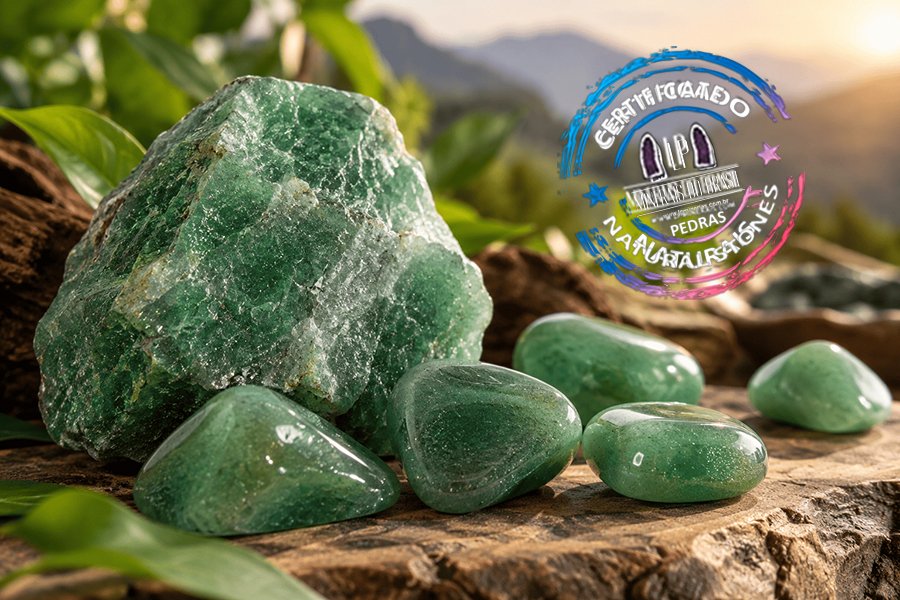
Green Aventurine: the Stone of Prosperity, Opportunity, and New Paths
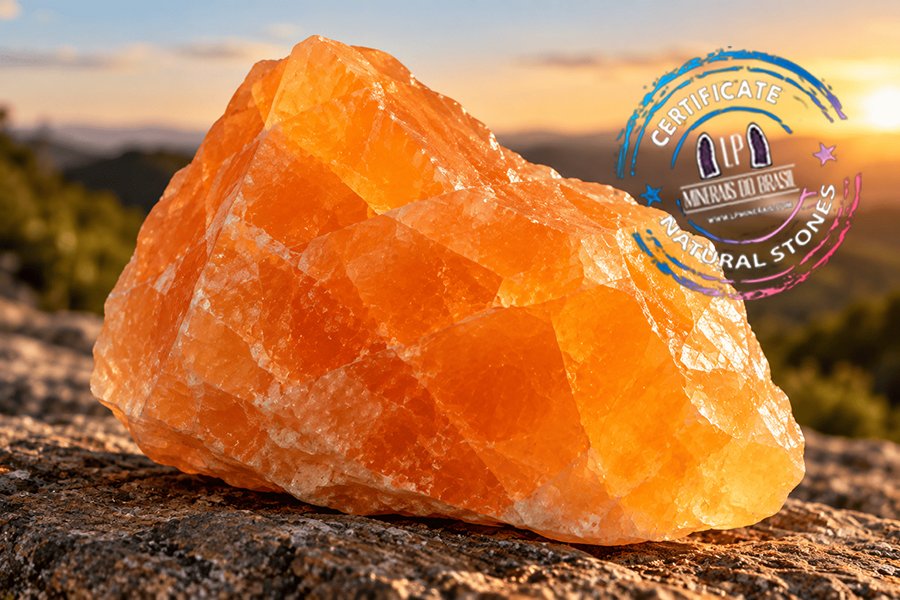
Orange Calcite: The Solar Energy That Awakens Creativity and Movement
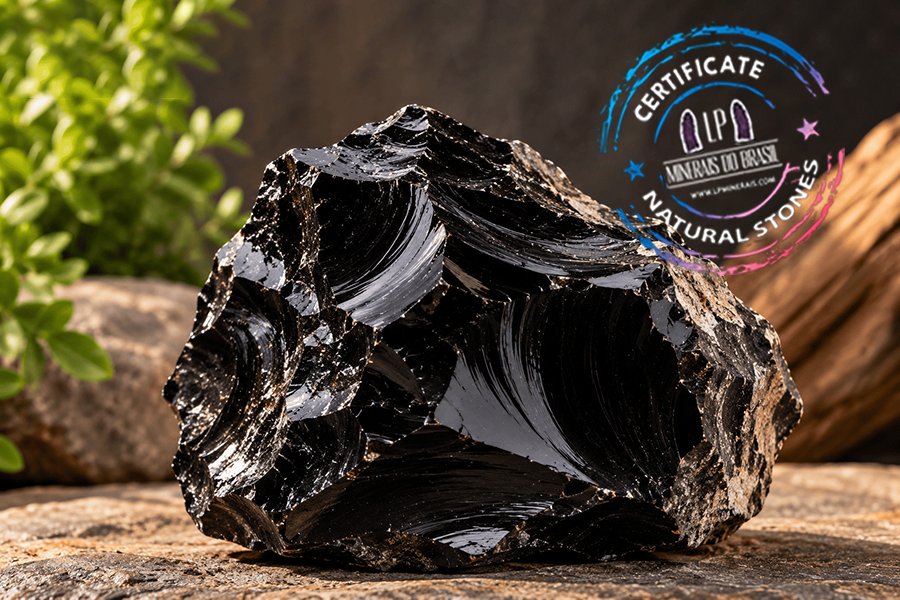
Black Obsidian: origin, formation, properties, and meaning of one of the best-known protective stones.
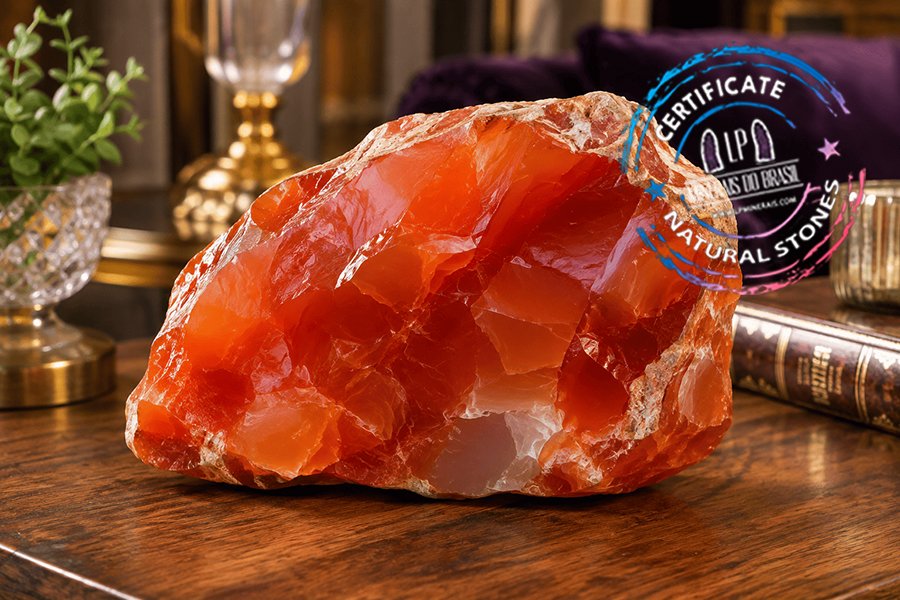
Carnelian: origin, formation, mineralogy, and the vibrant energy of a stone linked to action.
Fluorite: Mineralogy, Formation, Colors, and Meaning of a Mineral that Organizes Light and Color
Red Jasper: Mineralogy, Vitality, and the Ancestral Strength of an Earth-Connected Stone