



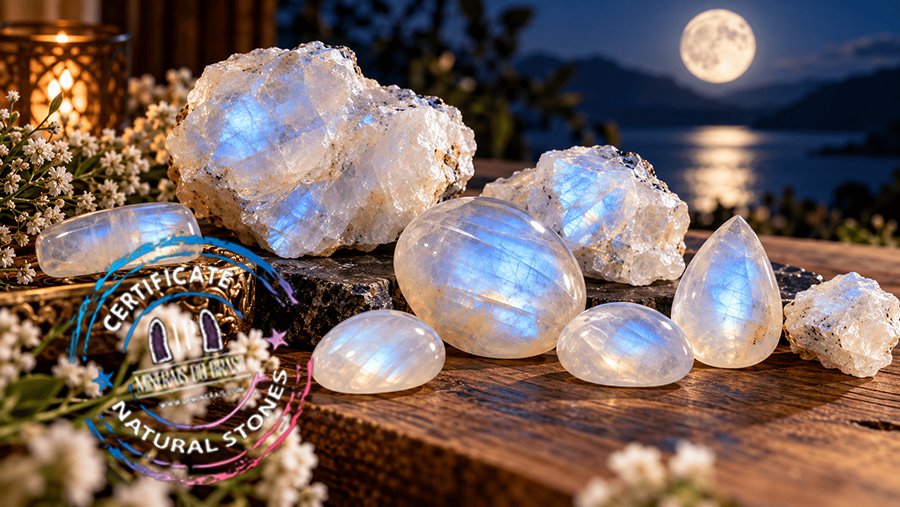
There is something about the Moonstone that seems to change right before our eyes. At first glance, it may appear delicately white, cream-colored, or nearly transparent. But simply move it under the light, and a soft glow seems to glide through its interior—sometimes bluish, sometimes silvery-white—as if a small light were hidden inside the stone.
It’s not hard to see why a mineral with this appearance has become steeped in stories, symbolism, and associations with the Moon. Over time, its ethereal beauty has been linked to intuition, cycles, sensitivity, and the feminine principle, and Moonstone has become one of the best-known gemstones within spiritual and crystal healing traditions.
But there is also a fascinating mineralogical history behind this glow. And understanding it is particularly important because not every stone sold as “Moonstone” corresponds to the gemological material traditionally recognized by that name.
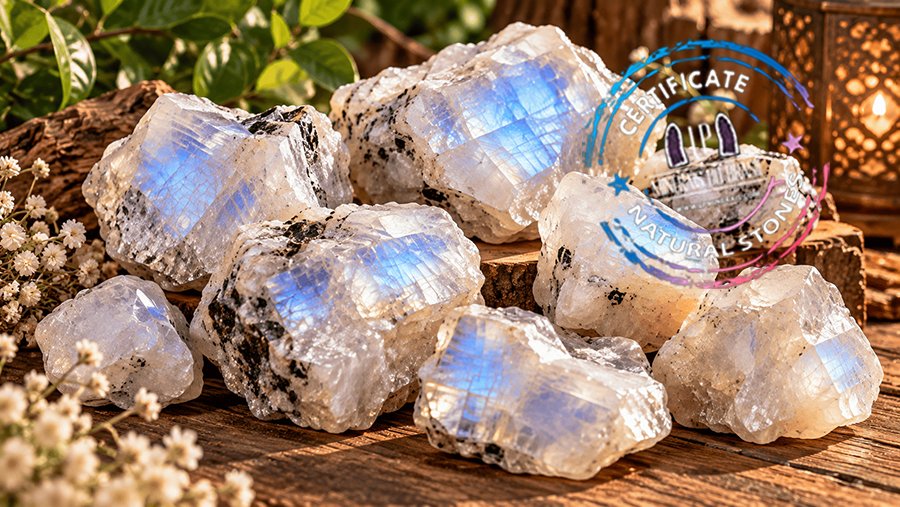
Between the science of feldspars and the imagery built around the Moon, we find a stone that truly deserves close attention.
The shimmer that seems to move within the stone
The Moonstone’s most famous visual characteristic is an optical phenomenon called adularescence.
When a high-quality specimen is moved under a light source, a diffuse luminosity appears to float beneath its surface. Unlike a metallic sheen or small sparkling specks, adularescence has a soft, almost hazy appearance.
This effect is related to the material’s internal structure and the interaction of light with fine interlayers formed during the feldspar’s development. Light is scattered by these microscopic structures, creating the characteristic sheen that has made the gem famous.
The intensity varies greatly. Some specimens exhibit subtle adularescence, while others display an intense bluish sheen across much of their surface.
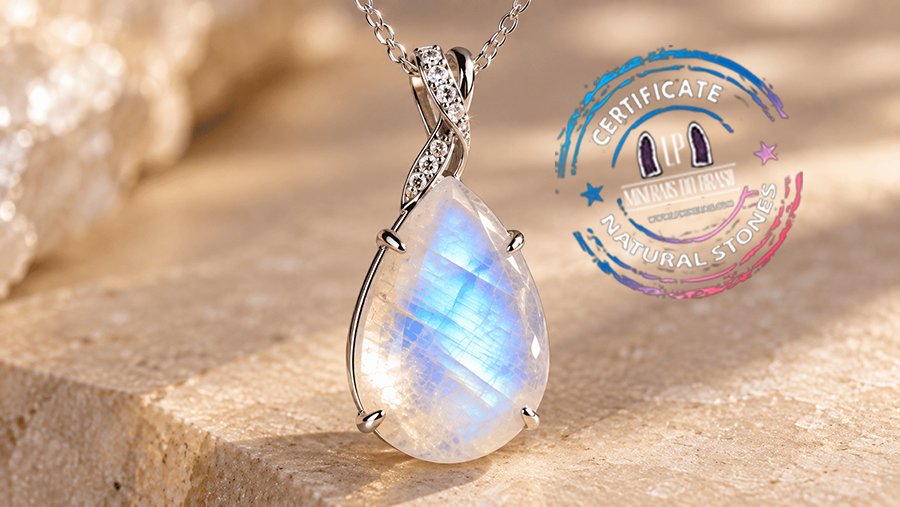
In jewelry, the cabochon cut—with its rounded, polished surface—is particularly favored because it highlights this phenomenon.
It is precisely this seemingly shifting luminosity that has helped shape the Moonstone’s identity—and likely also the imaginative association between the gem and the moon’s glow.
What Is a Real Moonstone?
Moonstone belongs to the important mineral group of feldspars, which make up a significant portion of the rocks that constitute the Earth’s crust.
Gemologically, the name is associated with feldspars that exhibit the characteristic of adularescence.
Historically, many classic specimens are related to the orthoclase–albite system, although feldspar materials of different compositions also appear on the market and require careful identification.
Its hardness ranges from approximately 6 to 6.5 on the Mohs scale. It is sufficiently durable for various ornamental applications but requires more care than quartz, especially since feldspars have cleavage planes that can make them more susceptible to damage from impacts.
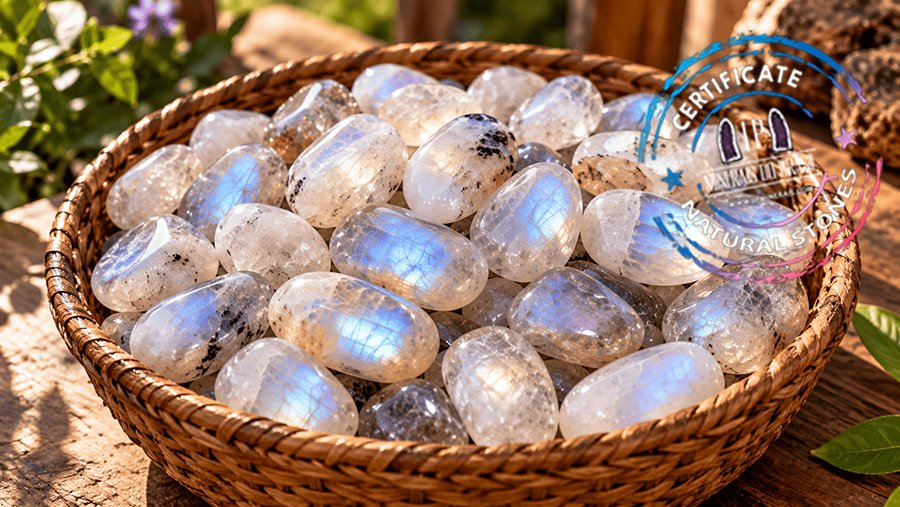
Natural colors are not limited to white. There are colorless, cream, grayish, peach, and other shades, as well as materials that exhibit different intensities and colors of adularescence.
Factors that increase a piece’s appeal include the quality of the optical effect, transparency, body color, size, cut, and the absence of inclusions or fractures that significantly detract from its appearance.
Moonstone, Rainbow Moonstone, and Labradorite: Where Does the Confusion Come From?
This is one of the most interesting—and important—points for gemstone buyers.
It is common in the market to find a white or transparent gemstone with strong blue and multicolored reflections being sold as Rainbow Moonstone.
Despite its well-established commercial name, this material is typically a variety of white labradorite, belonging to the plagioclase feldspar series. Therefore, it should not be confused, from a mineralogical standpoint, with the classic Moonstone associated with alkali feldspar.
This does not mean that Rainbow Moonstone is “fake.” It is a natural and beautiful material. The issue lies in correct and transparent nomenclature.
There is yet another very common source of confusion: opalite.
The opalite found in much of the crystal trade is a manufactured glass-like material, known for its milky translucent appearance and bluish or orange-colored reflections. Visually, it may resemble Moonstone, but it is not natural Moonstone.
This distinction is especially important for LP MINERAIS ⛏💎📦🗺, because working with natural stones requires that beauty be accompanied by information. A material can be beautiful regardless of its category; what matters is that it is sold for what it truly is.
A gemstone steeped in the imagery of the Moon
Long before contemporary crystal therapy, the appearance of Moonstone already inspired symbolic interpretations.
Its shifting luster was associated with the moon’s radiance, and in various traditions, the stone came to be linked to the mysteries of the night, sensitivity, and the cycles of nature. The Moon itself, since ancient times, has held a special place in mythologies and symbolic systems linked to time, fertility, water, and transformation.
In India, the Moonstone acquired great cultural and spiritual significance. In the West, it also gained immense prominence as an ornamental gemstone, especially during the Art Nouveau period, when jewelers explored its luminosity in pieces inspired by nature and organic forms.
This combination of history, jewelry, and symbolism has made it much more than just a white stone.
The stone of intuition and feminine energy
In the tradition of crystal healing, Moonstone is often associated with intuition, sensitivity, receptivity, and feminine energy.
It is important to understand “feminine energy” here as a symbolic and archetypal concept, rather than something limited exclusively to women. Within these traditions, it represents qualities such as nurturing, perception, creation, introspection, and the ability to understand one’s own internal rhythms.
Moonstone is also strongly associated with cycles.
The Moon waxes, reaches its fullness, wanes, and begins anew. By analogy, the stone has become a symbol of the phases we go through in life itself: beginnings, endings, changes, maturation, and renewal.
For this reason, it is often chosen during times of transition. When a project begins, a phase ends, or a change requires trust in the unknown, its symbolism invites us less toward absolute control and more toward being present in the moment.
These associations are part of spiritual and crystal therapy traditions. They do not represent scientifically proven medical effects and are not a substitute for professional healthcare.
Intuition, Dreams, and the Inner World
Another traditional association with Moonstone relates to dreams and intuitive perception.
In meditative practices, it is often used when the intention is to reduce external stimuli and direct attention toward more subtle feelings, thoughts, and perceptions. It is not about predicting events, but about using the stone symbolically as a focal point for observing one’s own inner world.
For this reason, some people keep a Moonstone in meditation spaces, on personal altars, or in environments dedicated to rest and contemplation.
Its energetic association varies among different schools of thought. It is often linked to the crown chakra and, in certain traditions, to the sacral chakra and the centers associated with intuitive perception.
Its symbolic element is usually Water, precisely because of its connection to fluidity, emotions, receptivity, and cycles.
Moonstone in Relationships and Emotions
There is also a strong emotional dimension within the stone’s tradition.
Because it represents sensitivity and receptivity, Moonstone is often associated with the ability to perceive emotions before simply reacting to them. In holistic practices, it is used as a symbol of emotional acceptance and understanding.
This also explains its inclusion in combinations with other stones.
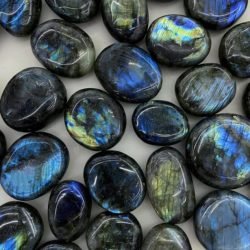
When paired with Rose Quartz, it often forms a combination symbolically focused on affection, acceptance, and relationships. With Amethyst, it takes on a more contemplative and spiritual meaning. With Labradorite, it creates a visually interesting combination traditionally associated with intuition and perception.
None of these combinations should be understood as a promise of automatic transformation. In the energetic realm, stones function primarily as symbolic tools within personal practices of intention, contemplation, and spirituality.
How to Wear Moonstone in Everyday Life
In jewelry, Moonstone is particularly elegant. Pendants, earrings, rings, and bracelets allow its adularescence to be seen as the piece moves.
Rings require extra care because they are more exposed to impacts. Since the gem has a cleavage plane, a strong blow can cause damage even if its hardness seems adequate for everyday use.
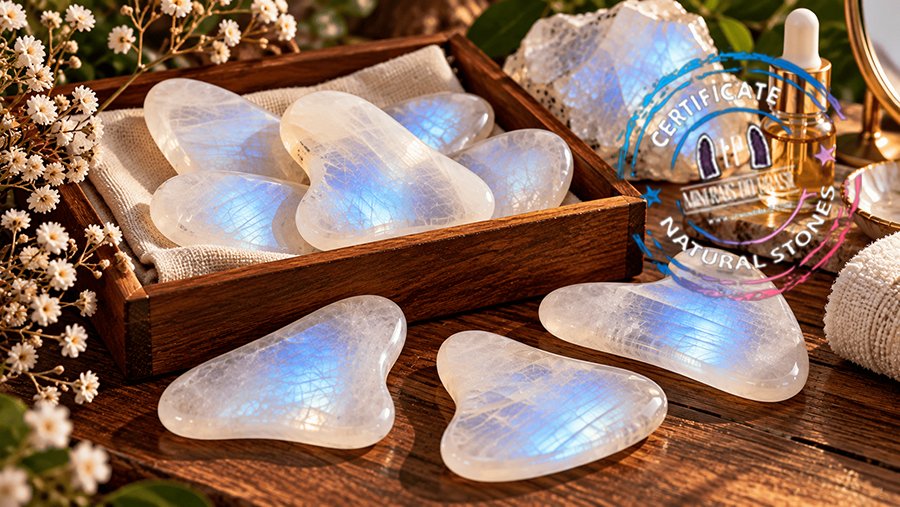
Tumbled stones and free-form pieces can be used for meditation, collections, or decoration. In interior design, its light hue pairs especially well with wood, natural fabrics, neutral tones, and spaces designed to inspire tranquility.
For those who work with its symbolism, bedrooms, meditation spaces, and environments designed for introspection are traditional choices.
How to Care for Moonstone?
Handle it with care.
Avoid impacts, drops, and sudden temperature changes. For jewelry, warm water, gentle cleaning, and a soft cloth are usually suitable options when the setting allows. Harsh methods should be avoided.
It is also prudent not to leave the stone in contact with much harder minerals during storage, especially when it comes to cut pieces.
For energetic cleansing, gentle methods such as sound, smudging according to personal tradition, or indirect exposure to moonlight are popular choices. Moonlight, of course, holds primarily symbolic value within these practices.
LP MINERALS Table ⛏💎📦🗺
🗺 » ORIGIN: Significant deposits are found in countries such as Sri Lanka, India, Madagascar, Tanzania, and other locations
⚛️ » CHEMICAL COMPOSITION: feldspar; the specific composition varies depending on the gemological material
🔩 » MOHS SCALE: approximately 6 to 6.5
🔢 » NUMEROLOGY: traditionally associated with the number 4
🔅 » MEANING: intuition, cycles, sensitivity, feminine energy, and new beginnings
🅰️ » SUMMARY: a stone with strong lunar symbolism, linked to inner perception and life’s transformations
✅ » SPECIFICATION: gemological feldspar characterized especially by its adularescence
🧩 » CONDITION: natural; found in rough, tumbled, polished, and cut forms
⚒ » FORMATION: related to the geological processes of feldspar formation and the development of internal structures responsible for the optical effect
⚠️ » CARE: Avoid impacts, excessive heat, and sudden temperature changes
🛁 » CLEANING: gentle physical cleaning; energetically, use gentle methods and indirect moonlight according to personal practice
🎨 » COLOR: colorless, white, cream, grayish, peach, and other shades
☯️ » ZODIAC: traditionally associated especially with Cancer
🪐 » SOLAR SYSTEM: Moon
➰ » CHAKRAS: crown, sacral, and intuitive centers, depending on different traditions
♻ » ELEMENT: Water
💎 » RARITY: variable; specimens with excellent transparency and strong adularescence may be more highly valued
🗳 » CHARACTERISTIC: adularescence — a seemingly floating luminosity within the stone
Frequently Asked Questions About Moonstone
How can you tell if Moonstone is genuine?
Pay close attention to the optical effect, structure, and overall appearance, but don’t rely solely on visual inspection. For high-value pieces, gemological identification is the most reliable way to confirm the material.
Is Opalite Moonstone?
No. Commercial opalite is generally a manufactured glass. It may have a very beautiful milky, bluish appearance, but it should not be sold as natural Moonstone.
Is Rainbow Moonstone the same as Moonstone?
“Rainbow Moonstone” is a trade name traditionally used for a specific type of white labradorite, a plagioclase feldspar. It is a natural material, but mineralogically distinct from classic alkali feldspar Moonstone.
Why does Moonstone shimmer blue?
The sheen results from the interaction of light with microscopic structures inside the feldspar. This phenomenon is known as adularescence and can appear white, silvery, or bluish.
What is Moonstone used for energetically?
Traditionally, it is associated with intuition, sensitivity, feminine energy, dreams, emotional balance, and cycles of transformation. These associations are part of crystal therapy and spiritual practices.
Can Moonstone be used in jewelry?
Yes. It is a highly prized gemstone in jewelry, especially when cut as a cabochon. However, its cleavage means it requires care to protect it from impacts.
Is moonstone rare?
Availability varies depending on quality. Commercial-grade specimens can be found relatively easily, while transparent, clear specimens with intense blue adularescence may command greater interest and value.
Between the Science of Light and the Mysteries of the Moon
Perhaps few stones represent the intersection of mineralogy and the human imagination quite so well.
Science explains why that luminosity seems to glide beneath its surface: microscopic structures interfere with the passage of light and produce adularescence. But it was precisely these reflections that, for generations, have awakened another dimension of the human experience—one that seeks meaning in the beauty of nature.
Thus was born a stone associated with cycles, intuition, and mystery.
The Moonstone symbolically reminds us that life, too, unfolds in phases. There are moments of expansion and withdrawal, clarity and doubt, closure and new beginnings. And perhaps that is precisely why its glow continues to fascinate: it never seems completely still.
At LP MINERAIS ⛏💎📦🗺, valuing a stone also means knowing its true identity. Distinguishing between feldspars, recognizing trade names, disclosing treatments when applicable, and operating with transparency and traceability are all part of a responsible mineral supply chain—from selection to the showroom, from jewelry to home decor and the export market.
Because when we know what we have before our eyes, beauty ceases to be merely appearance and comes to embody history, knowledge, and meaning as well.
Doris S. Rosa
Howlite: what lies behind the Stone of Calm and Inner Silence?
Jade: The Stone of Wisdom, Prosperity, and Harmony That Spans Millennia
Angelite: The Stone of Serenity, Intuition, and Spiritual Connection
Green Aventurine: the Stone of Prosperity, Opportunity, and New Paths
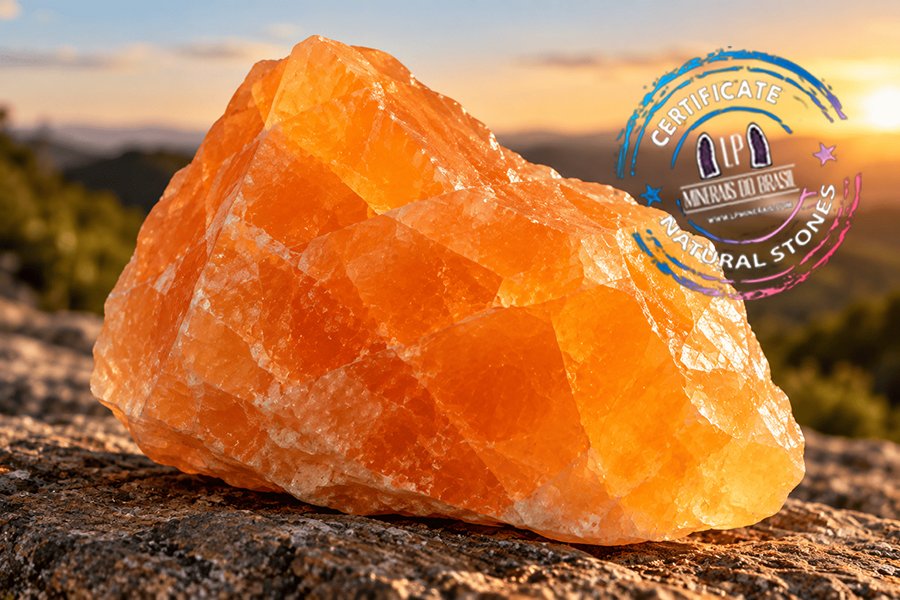
Orange Calcite: The Solar Energy That Awakens Creativity and Movement
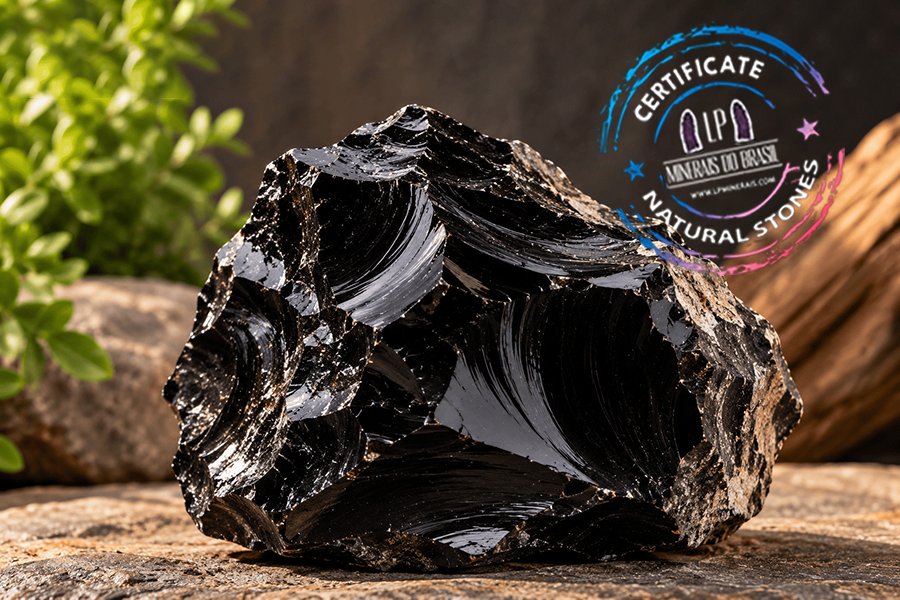
Black Obsidian: origin, formation, properties, and meaning of one of the best-known protective stones.
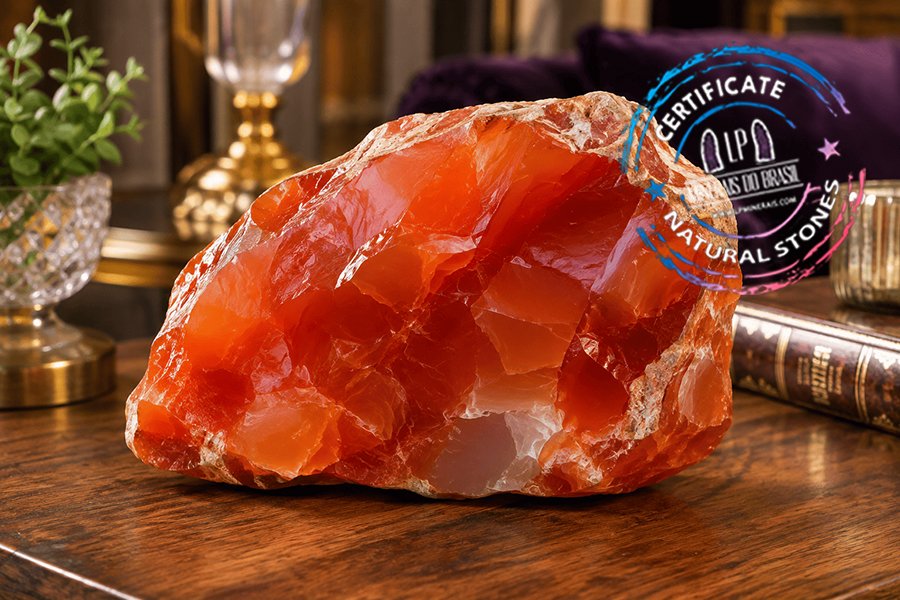
Carnelian: origin, formation, mineralogy, and the vibrant energy of a stone linked to action.
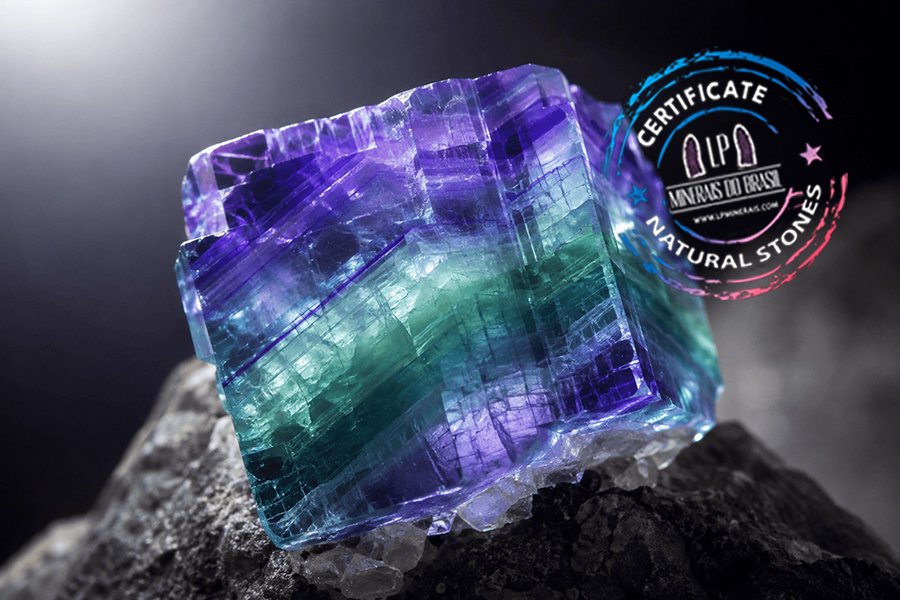
Fluorite: Mineralogy, Formation, Colors, and Meaning of a Mineral that Organizes Light and Color
Red Jasper: Mineralogy, Vitality, and the Ancestral Strength of an Earth-Connected Stone
Hematite: The Strength of Iron, Grounding, and the Presence That Comes from the Earth