



White, delicately veined with gray and reminiscent of a small landscape etched onto the stone, howlite has a serene appearance that curiously contrasts with the symbolism associated with it. In the world of crystals, it has become known as a stone associated with tranquility, patience, and self-knowledge. In mineralogy, however, its history is even more interesting: it is a true mineral species, with its own composition and formation, very different from the stones with which it is often confused.
This distinction deserves attention because howlite is also at the center of one of the most well-known commercial practices in the ornamental stone market: its artificial coloring. Because it is naturally light in color and takes dye well, howlite specimens can be dyed intense colors—especially blue—and end up being presented as if they were turquoise. Understanding the stone in its natural state is, therefore, a matter of mineralogy, authenticity, and commercial transparency.
For LP MINERAIS ⛏💎📦🗺, this is exactly the type of mineral that demonstrates how technical knowledge and provenance go hand in hand.
What is Howlite?
Howlite is a mineral containing calcium, boron, silicon, oxygen, and hydroxyl, with the ideal formula Ca₂B₅SiO₉(OH)₅. It is recognized as a valid mineral species and belongs to the monoclinic crystal system. Its density is close to 2.6 g/cm³, and it is not typically found in the form of those perfect geometric crystals that many people imagine when they think of minerals. In nature, it appears mainly in compact masses and nodules, while well-defined crystals are very rare.
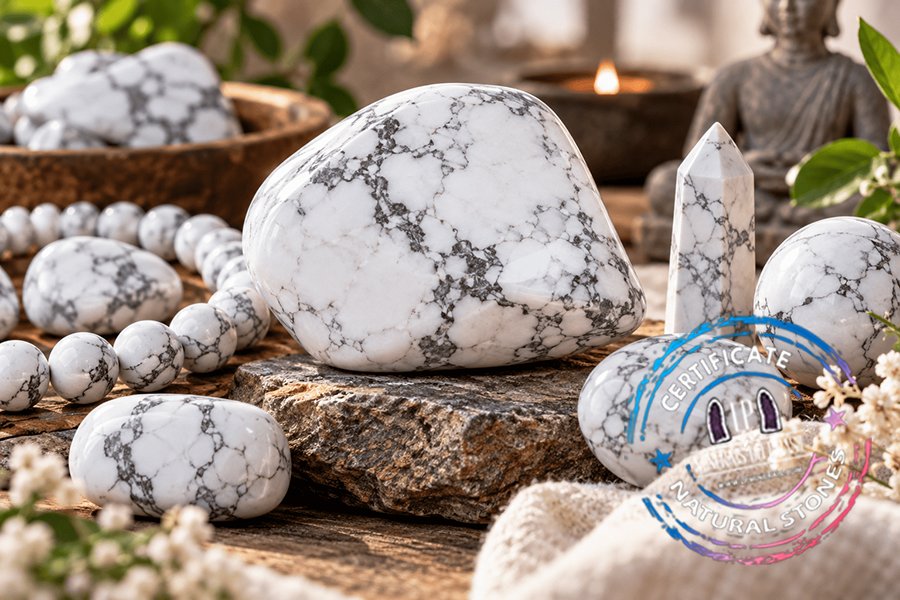
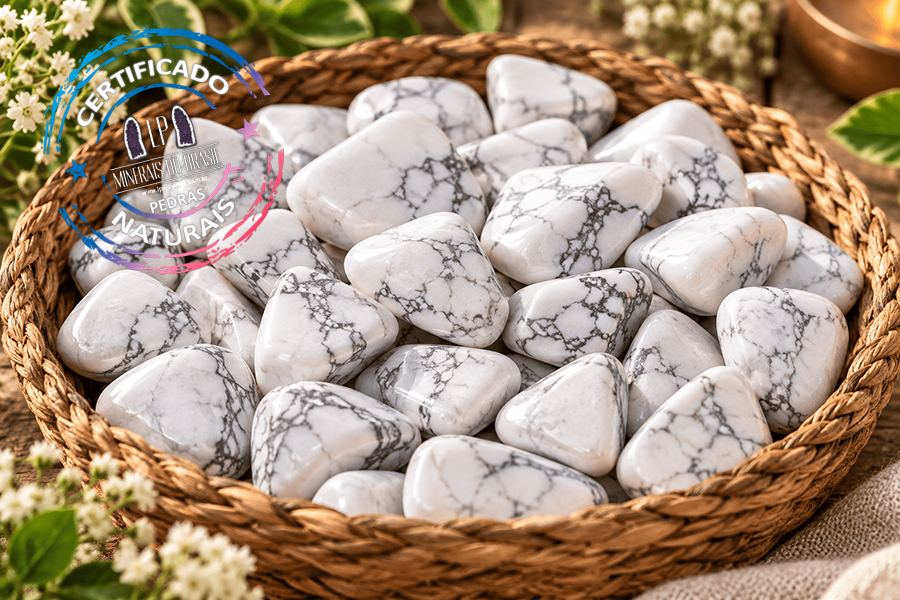
Its most common commercial appearance is white or cream-white, often accompanied by grayish or dark lines and veins. It is precisely this contrast that makes each piece visually unique. When polished, howlite can take on a very pleasing surface, highlighting its natural patterns and making it suitable for use in beads, cabochons, decorative pieces, and carved objects.
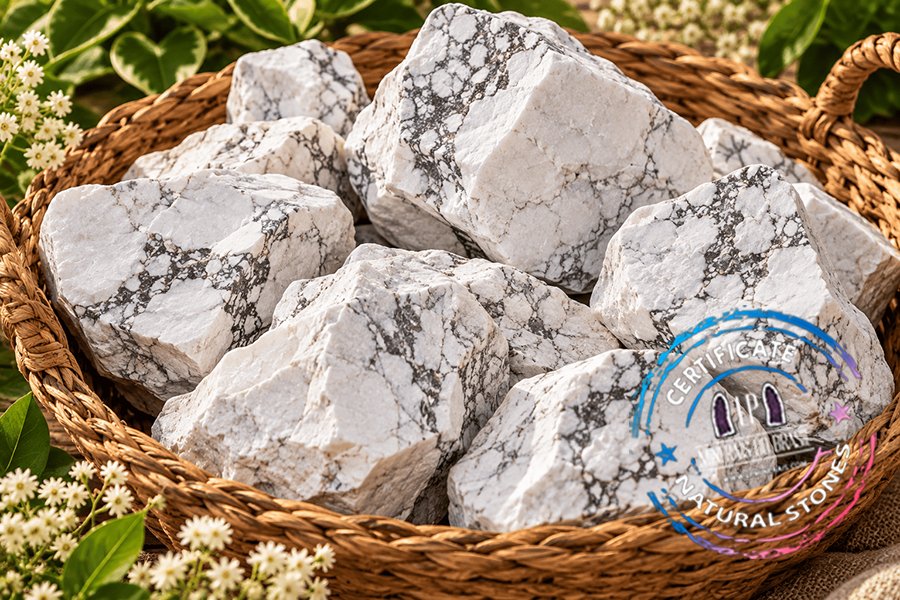
There is also an interesting peculiarity regarding hardness. Howlite crystals have a hardness of approximately 6.5 on the Mohs scale, while the massive, earthy material may exhibit much lower apparent hardness—close to 3.5—due to the way its grains aggregate. Therefore, simply stating “Howlite has a hardness of 3.5” without explaining the context leaves out an important aspect of the material’s mineralogy.
From Nova Scotia to the World: The Discovery of Howlite
The scientific history of howlite begins in Canada. The mineral was described in 1868 by chemist, geologist, and mineralogist Henry How, based on material from the Windsor region of Nova Scotia. It was initially named silicoborocalcite and shortly thereafter renamed howlite, in honor of Henry How. The recognized type locality is Black’s Quarry in Windsor.
The environment in which it occurs also helps explain its formation. Howlite is associated with borate-rich contexts and evaporite deposits; it has even been found at its type locality alongside minerals such as gypsum and anhydrite. Other occurrences are known in various regions, with Canadian and North American localities being particularly important to the mineralogical history of the species.
Its nodular form is particularly characteristic. Instead of large, transparent crystals suited for traditional gem cutting, nature often produces rounded, compact masses. This explains why the market makes such good use of howlite in polished pieces, beads, and small sculptures.
And it is precisely this versatility that has led the stone to occupy a unique place in the mineral trade.
White Howlite, Blue Howlite, and Turquoise: A Fundamental Difference
Natural Howlite is not, by nature, that intense turquoise blue so common in some gemstone and accessory stores. The natural coloration documented for the species is predominantly white, colorless, or, in some specimens, with brownish tones.
Since the light-colored stone can be dyed, it has become common to dye it blue to produce an appearance visually similar to turquoise. The result can be beautiful and perfectly valid as an ornamental product—as long as it is correctly identified as dyed howlite.
The problem arises when the treatment is not disclosed and the piece is offered as natural turquoise.
In the trade, the term “Turquenite” is also used, often to refer to dyed materials that imitate turquoise. The commercial term, in and of itself, does not transform howlite into turquoise nor does it imply a mineralogical equivalence between the two materials.
In practical terms:
- Natural howlite: predominantly white, often with gray or dark veins;
- Dyed howlite: may exhibit blue, green, and other artificial hues;
- Turquoise: is a different mineral species with a completely different chemical composition;
- Treatment does not imply counterfeiting, provided it is correctly disclosed;
- Selling dyed howlite as natural turquoise constitutes misleading commercial labeling.
This transparency is especially important for suppliers, jewelers, designers, and professional buyers. Ethical sourcing also means disclosing what the mineral actually is and what treatments it has undergone.
How can you recognize authentic howlite?
Identification begins with observation, but should not end there. A polished natural howlite typically features a white to cream-colored background with irregular gray or dark patterns. These veins may resemble a small network or branches, but there is no single, identical pattern found in all stones.
Pieces that are excessively uniform warrant careful scrutiny, as do blue materials sold simply as “natural blue Howlite.” It is also possible to find imitations made from other materials, which means that color and appearance alone do not constitute a definitive gemological test.
For higher-value purchases or professional-grade lots, provenance, a reliable supplier, and proper identification are safer bets than “home tests.” Damaging a piece to find out if it’s genuine is rarely a good strategy.
Howlite in Jewelry, Home Decor, and Collectibles
The combination of white and gray gives howlite an extremely versatile aesthetic. It works particularly well in minimalist designs, neutral settings, and contemporary jewelry. Spherical beads are very common, but the stone can also be found in cabochons, pendants, bracelets, carved objects, towers, spheres, and various ornamental shapes.
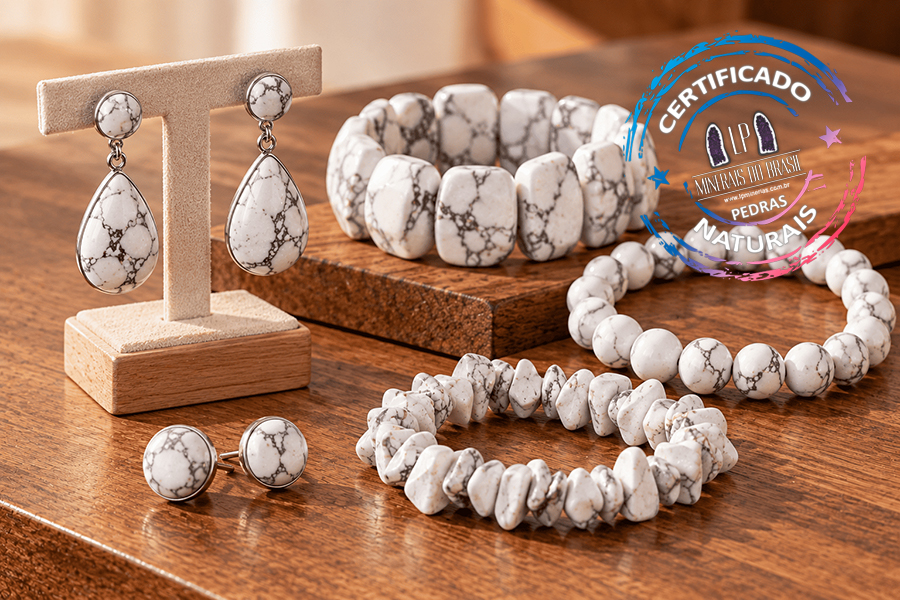
In jewelry, its natural contrast complements silver and gold metals, wood, leather, and other stones. Since it is not among the transparent gemstones traditionally valued for their brilliance and fire, its appeal lies primarily in its natural pattern, visual texture, and aesthetic appeal.
For mineralogical collectors, however, the perspective may differ. Well-formed howlite crystals are rare compared to the nodular masses typically sold on the market. Specimens associated with classic localities may also hold specific interest for systematic collections.
Thus, value does not depend solely on size. Factors such as naturalness, formation, aesthetic quality, provenance, degree of polish, and—in specialized collecting—the specimen’s own mineralogical significance all factor into the evaluation.
The Energy of Howlite: When Silence Is Also a Source of Strength
In the tradition of crystal therapy, Howlite is often presented as a stone of serenity, patience, and inner awareness. Its symbolism is not associated with explosive force or immediate conquest. On the contrary: its energetic language is that of the conscious pause, of observation, and of the ability to respond to situations with less impulsiveness.
For this reason, it has become particularly associated with moments of racing thoughts, irritation, and difficulty slowing down. This interpretation belongs to the spiritual and symbolic realm of crystals—it does not constitute a scientifically proven medical or psychological effect—but it helps explain why Howlite has gained a place in meditation and harmonization practices.
There is also an interesting dimension of self-awareness. Traditionally, it is used not only to seek tranquility but to recognize emotional patterns before reacting automatically to them. In this sense, its serenity does not represent passivity: it represents awareness.
Its archetype could be described as the silent observer —one who first understands, then decides.
Howlite, Meditation, and Daily Life
In contemplative practices, Howlite can be used as an object of focus during meditation. Its very appearance lends itself to this symbolism: the white color suggests space and clarity, while the dark veins serve as a reminder that tranquility does not mean an absence of complexity.
Traditionally associated with the higher energy centers, especially the crown chakra, it also features in practices focused on inner perception and awareness. Some contemporary traditions make additional associations, but these correspondences vary among authors and schools.
In everyday life, it can be placed in areas set aside for rest, reading, or meditation. On a desk, its meaning can serve as a symbolic reminder to slow down before responding under pressure. Placed near the bed, it is traditionally chosen by people seeking to create an atmosphere of contemplation before resting—without attributing to the stone a therapeutic function for treating sleep disorders.
Among its most common symbolic uses are:
- meditation and contemplation;
- the pursuit of patience and self-control;
- spaces intended for rest;
- moments of study and reflection;
- jewelry worn for personal reasons;
- practices of self-awareness;
- altars and spaces for spirituality.
The symbolic power of Howlite lies precisely in its simplicity: not every transformation needs to begin with movement; some begin when we manage to be still enough to perceive what is happening within us.
Energetic Combinations with Other Stones
Howlite allows for interesting combinations because its traditionally serene energy can take on different roles depending on the stone it is paired with. With Amethyst, for example, it creates a combination widely used in meditation and introspection practices. With Rose Quartz, the symbolic language revolves around emotional acceptance, gentleness, and loving relationships.
With sodalite, the combination can be directed toward reflection, thoughtful communication, and mental organization. With black tourmaline, on the other hand, an interesting symbolic contrast is created between serenity and grounding/protection.
These combinations are part of holistic traditions and do not represent physical reactions between the minerals. Their value lies in the intention, the ritual, and the meaning attributed to the experience.
Care, Cleaning, and Maintenance
Although Howlite may appear quite solid when polished, it requires care similar to that of other ornamental stones. Chemicals, acids, and harsh cleaning methods should be avoided. This is particularly important because Howlite is readily attacked by diluted acids.
With dyed pieces, even greater care is required, as certain products or prolonged exposure can alter the appearance of the treatment. For daily cleaning, the safest approach is to use a soft cloth, avoiding abrasive products and unnecessary prolonged soaking.
When it comes to energetic cleansing, those who practice crystal therapy may opt for gentle, dry methods, such as meditative intention, sound, or indirect contact with other crystals traditionally used for harmonization. Thus, physical conservation and symbolic ritual remain clearly separate.
🔬 LP MINERALS Technical-Energetic Profile
🗺 » ORIGIN: originally described in Windsor, Nova Scotia, Canada; known occurrences in various borate deposits.
⚛️ » CHEMICAL COMPOSITION: Ca₂B₅SiO₉(OH)₅ — a mineral containing calcium, boron, and silicon.
🔩 » MOHS HARDNESS: approximately 6.5 in crystals; massive aggregates may exhibit lower apparent hardness. Mindat
🔢 » NUMEROLOGY: Correspondences vary depending on the school of numerology; there is no official mineralogical attribution.
🔅 » MEANING: serenity, patience, awareness, and self-knowledge, according to crystal therapy traditions.
🅰️ » SUMMARY: a striking white mineral, known both for its ornamental use and for its symbolism associated with tranquility.
✅ » SPECIFICATION: a valid mineral species; dyed howlite must be commercially labeled as a treated material.
🧩 » OCCURRENCE: natural in compact masses and nodules; well-developed crystals are rare.
⚒ » FORMATION: associated with borate-rich environments and evaporitic settings.
⚠️ » CARE: Avoid acids, harsh chemicals, abrasives, and impacts.
🛁 » CLEANING: soft cloth; energetically, prefer gentle, non-aggressive methods.
🎨 » COLOR: white, colorless, or occasionally brownish; intense colors found in commercial specimens may result from treatment. Mindat
☯️ » ZODIAC: associations vary across traditions; often linked to signs associated with patience, perception, and balance.
🪐 » SOLAR SYSTEM: planetary correspondences vary by esoteric tradition; lunar associations are common in contemporary interpretations.
➰ » CHAKRAS: primarily the crown chakra in crystal therapy traditions.
♻ » ELEMENT: often symbolically associated with Air, though correspondences may vary.
💎 » RARITY: Commercially available in massive form; well-formed crystals are significantly rarer.
🗳 » CHARACTERISTICS: white, usually marked by gray veins; polishes to a high luster and can be dyed.
FAQ — Frequently Asked Questions About Howlite
Does blue howlite occur naturally?
Commercially available blue howlite is typically dyed. The natural variety is known primarily for its white, colorless, and occasionally brownish hues. A dyed piece can still be genuine howlite—the treatment must simply be disclosed.
Are Howlite and Turquoise the same stone?
No. They are different minerals, with distinct compositions and properties. Blue-dyed howlite can be used as a visual imitation of turquoise, but it does not become turquoise from a mineralogical standpoint.
How can you tell if a Howlite is genuine?
Color, veins, texture, and finish provide clues, but a photograph or visual inspection alone does not guarantee authenticity. For higher-value materials, provenance and, when necessary, gemological analysis are more reliable.
What is howlite used for?
Materially, it is used in costume jewelry, fine jewelry, beads, cabochons, sculptures, and decorative objects. In energy traditions, it is associated with serenity, patience, meditation, and self-knowledge.
Is Howlite a rare stone?
There is an important distinction: solid howlite, used in the jewelry trade, can be found relatively easily, while well-formed natural crystals are much rarer.
Can howlite get wet?
Occasional contact with water during careful cleaning is not the same as soaking the stone. For home care, especially for dyed or jewelry-set pieces, it is wiser to avoid prolonged immersion and use a soft cloth instead.
What is the spiritual meaning of howlite?
Traditionally, it is associated with calmness, patience, mindfulness, and a symbolic reduction of impulsivity. It is widely used in contemplative practices and self-discovery. These interpretations belong to the spiritual realm and do not constitute scientifically proven therapeutic effects.
Can Howlite be used at work?
Yes. In addition to its decorative function, people who follow holistic practices can use it as a symbol of thoughtfulness, patience, and less reactive communication in professional settings.
Which stones pair well with howlite?
In energy practices, common combinations include Amethyst for introspection, Rose Quartz for acceptance, Sodalite for reflection, and Black Tourmaline when one wishes to add the symbolism of grounding and protection.
Does Howlite have value in the mineral market?
Yes, although the value varies widely. Ornamental pieces are valued based on size, finish, aesthetics, and origin; mineralogical specimens may gain additional value based on their locality and, especially, the presence of well-formed crystals, which are rare.
Howlite: Serenity with Its Own Identity
Perhaps the greatest commercial injustice done to Howlite was making it famous precisely when people tried to make it look like another stone. It doesn’t need to be Turquoise to be interesting.
In its natural color, howlite presents an elegant and contemporary aesthetic. Mineralogically, it has its own composition, a documented scientific history, and unique forms of occurrence. In the symbolic realm, it has built an equally coherent identity: the stone that represents patience, silence, awareness, and the ability to observe before reacting.
For a mineral market committed to provenance and transparency, recognizing treatments and respecting the identity of each material is also part of a responsible supply chain. At LP MINERAIS ⛏💎📦🗺, technical expertise, careful selection, and transparency help transform a stone into something more than just a product: a geological story that can be understood, valued, and preserved.
Doris S. Rosa
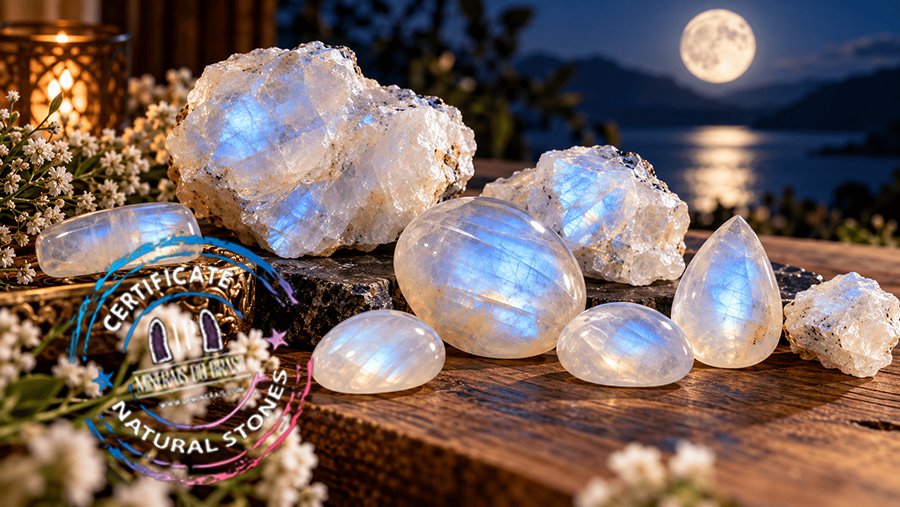
Moonstone: the Stone of Intuition, Feminine Energy, and the Mysteries of the Moon.
Jade: The Stone of Wisdom, Prosperity, and Harmony That Spans Millennia
Angelite: The Stone of Serenity, Intuition, and Spiritual Connection
Green Aventurine: the Stone of Prosperity, Opportunity, and New Paths
Orange Calcite: The Solar Energy That Awakens Creativity and Movement
Black Obsidian: origin, formation, properties, and meaning of one of the best-known protective stones.
Carnelian: origin, formation, mineralogy, and the vibrant energy of a stone linked to action.
Fluorite: Mineralogy, Formation, Colors, and Meaning of a Mineral that Organizes Light and Color
Red Jasper: Mineralogy, Vitality, and the Ancestral Strength of an Earth-Connected Stone
Hematite: The Strength of Iron, Grounding, and the Presence That Comes from the Earth