




Carnelian is one of the best-known varieties of chalcedony, which belongs to the large quartz family.
Known for its hues ranging from golden orange to deep red, this gemstone has been part of human history for thousands of years, having been used as an ornament, amulet, seal, and status symbol by various civilizations.
Its beauty is characterized primarily by the intensity of its warm colors and the soft luster it acquires after polishing. Depending on the quality of the material and the number of natural inclusions, carnelian can appear translucent or nearly opaque—a common characteristic among chalcedony varieties. This combination lends the stone visual depth and makes each specimen unique.
In addition to its aesthetic value, carnelian arouses interest due to its geological formation and impressive durability. Many objects produced thousands of years ago remain preserved to this day, highlighting the resilience of this mineral and its importance throughout history.
Long before it was imbued with symbolic and energetic interpretations, carnelian was already admired for its natural beauty and its excellent properties for gem cutting. Today, it remains one of the most prized gemstones in jewelry, among collectors, and among mineralogists.
Geological Origin and Formation of Carnelian
Carnelian forms from silica-rich solutions that circulate slowly through cavities and fractures in rocks, primarily in environments of volcanic origin. Over the course of thousands or millions of years, this silica is deposited in microscopic layers until it forms an extremely compact mass known as chalcedony.
During this process, small amounts of iron are incorporated into the mineral structure. It is precisely this element that gives rise to the orange and reddish hues that characterize carnelian. In some deposits, natural heating processes that have occurred over geological time promote the oxidation of these compounds, making the colors even more intense.
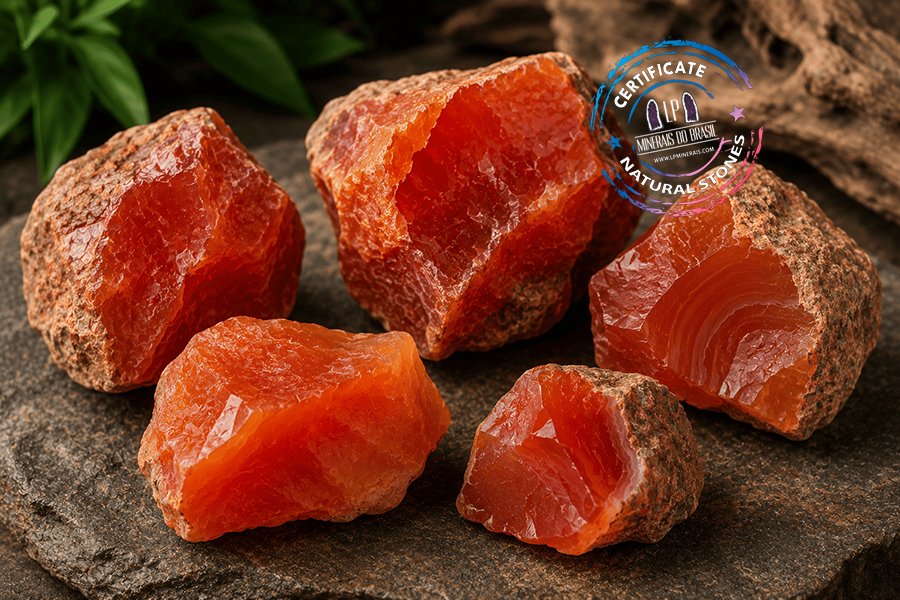
As part of the chalcedony family, carnelian does not form large, visible crystals as do amethyst or hyaline quartz. Its structure consists of microscopic crystals so compact that the surface appears uniform and highly resistant.
The main geological environments where carnelian is found include:
- basaltic flows;
- cavities in volcanic rocks;
- silica-rich hydrothermal deposits;
- alluvial gravel formed by the erosion of older rocks.
Among the world’s leading producers are India, Brazil, Madagascar, Uruguay, Botswana, Germany, and some deposits found in the United States.
Chemical Composition and Mineralogical Characteristics
Chemically, carnelian has the same composition as quartz: silicon dioxide (SiO₂). The difference between carnelian and other varieties of chalcedony lies mainly in the presence of iron oxides and hydroxides distributed throughout its formation, which are responsible for the warm hues that have made this stone so well known.
Its extremely compact structure provides excellent mechanical strength and allows for a high-quality polish, producing a smooth surface that is pleasant to the touch.
Among its main mineralogical characteristics are:
- Chemical composition: silicon dioxide (SiO₂);
- Mineral group: Quartz – chalcedony variety;
- Crystal system: trigonal (microcrystalline);
- Luster: waxy to vitreous after polishing;
- Transparency: translucent to opaque;
- Streak: white;
- Density: between 2.58 and 2.64 g/cm³.
Although many people confuse Carnelian and Agate due to their similar composition, the two have significant visual differences. While Agate typically features well-defined bands of different colors, Carnelian is characterized by a much more uniform coloration.
Crystal System and Physical Properties
Although it does not form well-defined external crystals, Carnelian inherits its trigonal crystal system from quartz. Since its crystals are microscopic and grow in an interlocking manner, the stone has an extremely compact structure, a factor that explains its high resistance.
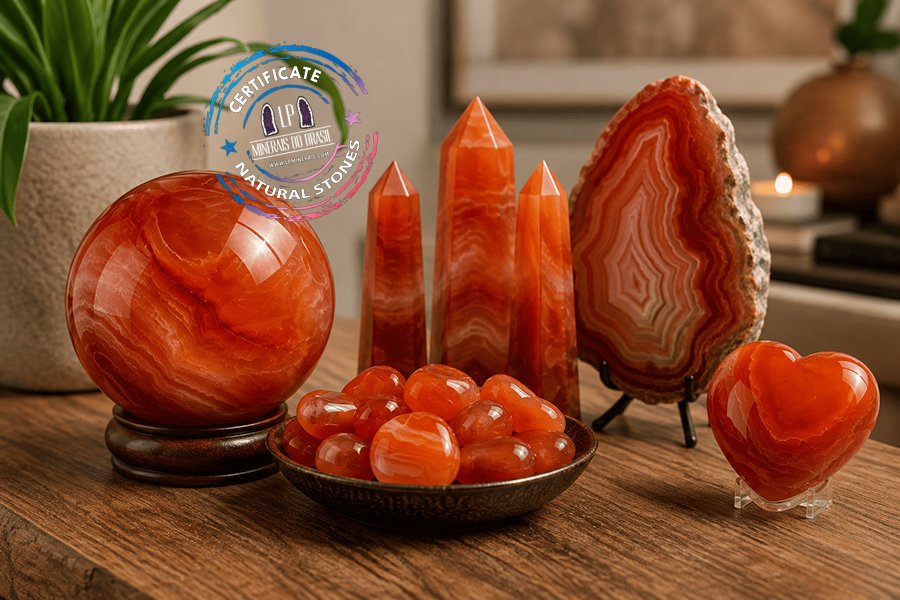
On the Mohs scale, its hardness ranges from 6.5 to 7, allowing it to be used in rings, pendants, earrings, sculptures, and decorative objects without showing significant wear when properly cared for.
Another important characteristic is the absence of cleavage. Instead of breaking along defined planes, as occurs in some minerals, carnelian tends to exhibit a subconchoidal fracture, a behavior typical of quartz varieties.
Among its main physical properties are:
- a hardness between 6.5 and 7 on the Mohs scale;
- absence of cleavage;
- subconchoidal fracture;
- excellent resistance to wear;
- waxy luster when polished;
- high chemical stability.
These characteristics explain why so many archaeological artifacts made of carnelian have survived to the present day in excellent condition.
The Origin of Its Colors
The color of carnelian results primarily from the presence of iron compounds distributed throughout its structure during its geological formation. The higher the concentration and oxidation state of these minerals, the more intense the observed hues tend to be.
Nature produces a wide variety of colors, ranging from a delicate honey-orange to a deep red with brownish undertones. This diversity gives each stone its own unique identity, making it difficult to find two specimens that are exactly alike.
The most common shades include:
- light orange;
- deep orange;
- orange-red;
- brownish red;
- reddish brown.
Some carnelian stones available on the market undergo controlled heating to intensify their color. This treatment has been known for centuries and is widely accepted in gemology, provided that consumers are informed of its use.
History, Etymology, and Trivia
Carnelian has been part of human history since the earliest civilizations. Archaeological excavations have uncovered beads, amulets, and ornamental objects made from this stone dating back more than five thousand years.
In Ancient Egypt, it was used in jewelry and funerary objects, symbolizing protection and vital energy. Among the Greeks and Romans, it became one of the preferred materials for producing signets and engraved seals, as its hardness allowed for extremely detailed engravings and its surface did not easily adhere to the wax used to seal documents.
During the Middle Ages, it continued to be used in jewelry and religious objects, maintaining its reputation as an elegant and durable gemstone.
An interesting fact is the origin of its name. It is believed that “Carnelian” derives from the Latin *cornum*, the fruit of the corneliancherry tree (*Cornus mas*), whose reddish-orange color resembles the stone’s characteristic hue.
This long historical trajectory demonstrates that carnelian has always been much more than a simple ornament. Its durability, beauty, and cultural richness have made it one of the most important gemstones in human history, remaining to this day a benchmark among chalcedony varieties.
Applications, Market, and the Symbolism of Carnelian
Over thousands of years, carnelian has gained prominence in various cultures not only for its beauty but also for its durability and ease of cutting. Today, it remains one of the most highly valued chalcedony varieties for jewelry, decorative objects, and collecting, maintaining steady demand among both mineral enthusiasts and gemology professionals.
Its wide availability makes it accessible in various forms, ranging from small tumbled stones to sculptures, spheres, obelisks, and high-quality cut specimens. At the same time, pieces with intense color, excellent transparency, and a known origin continue to attract great interest among collectors.
Carnelian in Jewelry
The combination of hardness, chemical stability, and warm colors makes carnelian an excellent gemstone for everyday jewelry. Unlike more delicate minerals, it withstands daily wear and tear well when properly cared for, retaining its luster for many years.
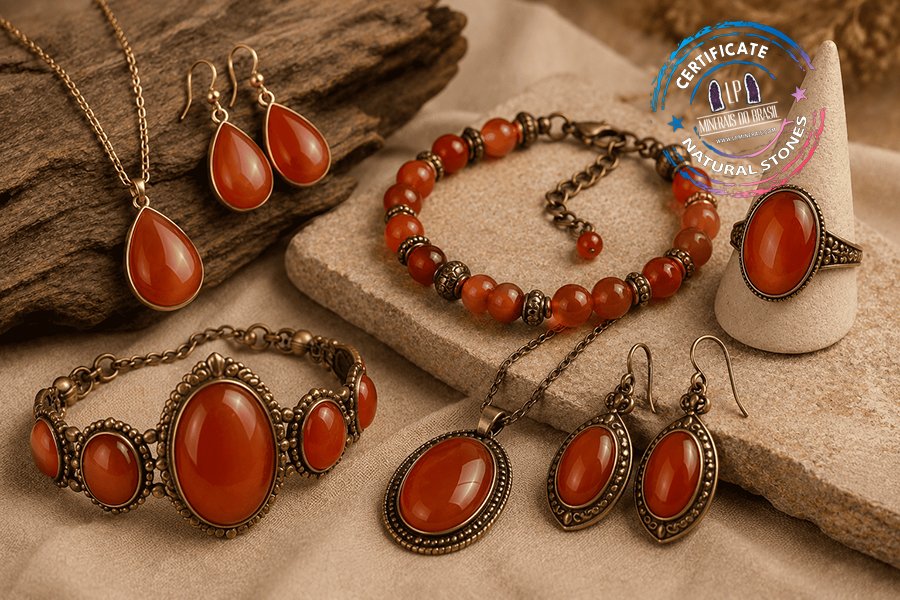
Its naturally warm tone harmonizes with different metals, and it is frequently used in yellow gold, rose gold, and silver. Cabochon cuts remain the most traditional, but faceted cuts are also found in specimens with greater transparency.
The most common uses include:
- rings;
- pendants;
- earrings;
- bracelets;
- necklaces;
- beads for handmade jewelry.
Because of its naturally striking color, carnelian often becomes the focal point of a piece of jewelry, eliminating the need for large quantities of other gemstones.
Decor and Collectibles
In interior design, carnelian is prized for the sense of warmth conveyed by its warm tones. Larger pieces are often used in offices, living rooms, libraries, and meditation spaces, where their presence adds a natural touch without sacrificing elegance.
Among collectors, interest focuses mainly on specimens with uniform coloration, a good polish, or well-preserved natural shapes. Sculptures made from carnelian also attract attention due to the ease with which this material can be worked without losing its strength.
Among the most sought-after forms are:
- rough stones;
- tumbled stones;
- spheres;
- obelisks;
- sculptures;
- geodes filled with chalcedony and carnelian.
How to Identify Natural Carnelian
Because it is a very popular stone, it is common to find dyed materials or stones incorrectly marketed as carnelian on the market. In many cases, light-colored agates are artificially dyed to achieve a similar hue.
Natural carnelian typically exhibits a harmoniously distributed coloration, although there may be slight internal variations. Unlike dyed stones, its color tends to be integrated into the mineral rather than concentrated solely in fractures or on the surface.
Certain characteristics aid in identification:
- natural hue, without excessively vibrant colors;
- a waxy luster after polishing;
- absence of dye concentrated in fissures;
- hardness comparable to that of quartz;
- reliable provenance.
Whenever possible, it is advisable to prioritize specialized suppliers who disclose the stone’s origin and any treatments it has undergone.
Market Value
Carnelian offers an excellent balance between beauty and cost, and is considered one of the most affordable natural gemstones within the quartz family. Its value varies depending on factors such as color intensity, uniformity, size, polish quality, and the material’s origin.
Specimens with intense red color, good translucency, and few inclusions typically command higher prices than those with lighter or brownish hues. Artistic carvings and antique pieces also have their own market among collectors.
More than just an ornamental stone, carnelian remains a gem prized for its combination of durability, beauty, and historical tradition.
The Meaning of Carnelian in the Tradition of Crystal Therapy
Long before modern crystal therapy gained popularity, various cultures already attributed to carnelian a meaning linked to courage, vitality, and the willingness to face challenges. Its color, reminiscent of fire and sunset, has always evoked images of movement, strength, and renewal.
According to the tradition of crystal therapy, carnelian is often described as a stone that awakens motivation, strengthens self-confidence, and encourages conscious action. Rather than promoting impulsivity, it is traditionally associated with the ability to turn ideas into action, fostering initiative, determination, and creativity.
It is also commonly used by people who wish to regain their enthusiasm during periods of discouragement or stagnation. Its symbolism is linked to the drive to move forward, facing changes with greater emotional security and confidence in one’s own abilities.
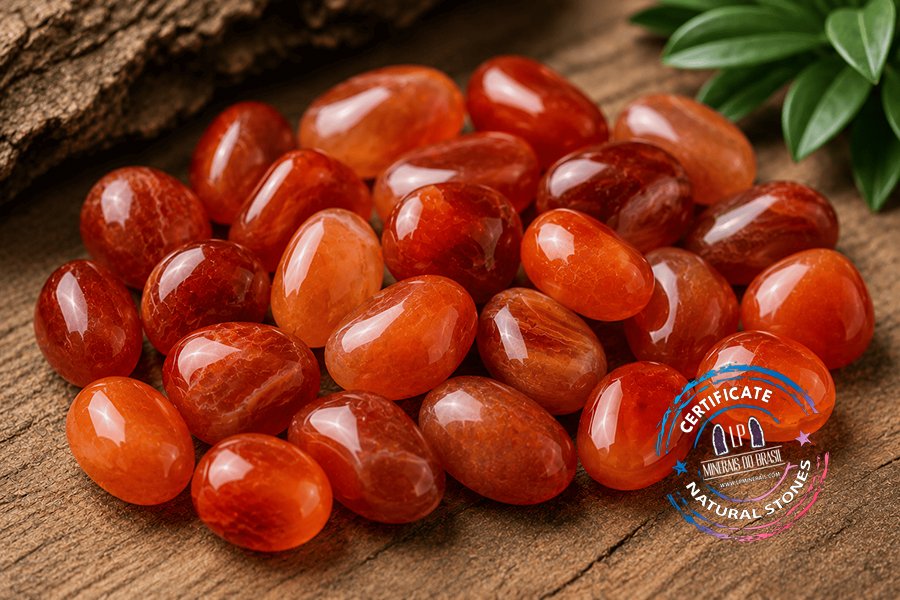
In meditative practices, it is often chosen to aid in connecting with the present moment, fostering a more active approach to life. In work environments, many use it as a symbol of creativity, productivity, and perseverance.
Traditionally, Carnelian is associated with:
- courage;
- vitality;
- creativity;
- motivation;
- self-confidence;
- determination;
- enthusiasm;
- emotional stability.
It is also frequently associated with the Sacral Chakra, an energy center linked to creativity, emotions, relationships, and the expression of vital energy. In some traditions, its use also extends to the Root Chakra, symbolizing stability, security, and connection to reality.
Carnelian usually harmonizes well with other complementary energy stones. When used with Citrine, it is traditionally associated with creativity and prosperity. When paired with Garnet, it symbolically reinforces courage and determination. Combined with Clear Quartz, it seeks to enhance clarity and balance, while the combination with Tiger’s Eye is often chosen by those seeking focus and confidence to make decisions.
Its presence on altars, in meditation spaces, and in artistic environments represents, above all, an invitation to act with enthusiasm, cultivate confidence, and transform potential into achievement. In many traditions, Carnelian serves as a reminder that true strength does not stem from impulsiveness, but from the courage to move forward with balance and purpose.
Care, Cleaning, and Maintenance of Carnelian
Carnelian is a durable gemstone suitable for daily use, but taking a few precautions will help preserve its luster and beauty for many years. As a member of the quartz family, it has good physical and chemical stability, although it may lose its polish if it comes into constant contact with harder materials or abrasive products.
For routine cleaning, simply use water, mild soap, and a soft cloth. After washing, it is recommended to dry the stone completely before storing it. When worn as jewelry, it is best to store it separately to prevent friction with other gemstones.
According to crystal therapy tradition, many people also perform periodic energy cleansing as a symbolic way to renew the qualities associated with the crystal.
The most common methods are:
- smudging with natural herbs;
- exposure to moonlight, especially during a full moon;
- placing it on a selenite slab or rod;
- using a quartz druse for energization.
Although carnelian can withstand contact with water, you should avoid harsh chemicals, sudden temperature changes, and prolonged exposure to intense heat.
LP MINERAIS Technical Notes ⛏💎📦🗺
🗺 Origin: Brazil, India, Madagascar, Uruguay, Botswana, Germany, and the United States.
⚛️ Chemical Composition: Silicon Dioxide (SiO₂).
🔩 Mohs Scale: 6.5 to 7.
🔢 Numerology: Traditionally associated with the number 5.
🔅 Meaning: Vitality, courage, creativity, and inner strength.
🅰️ Summary: A variety of chalcedony belonging to the quartz family, recognized for its orange and reddish hues.
✅ Specifications: Microcrystalline quartz with a waxy to vitreous luster, translucent to opaque.
🧩 State: Natural, found in compact masses, tumbled stones, cut pieces, and sculptures.
⚒ Formation: Deposition of silica in cavities within volcanic rocks, with coloring produced by iron compounds.
⚠️ Care: Avoid severe impacts, abrasive products, and excessive heat.
🛁 Cleaning: Use mild soap and water for physical cleaning. Use smudging, moonlight, or selenite for energetic cleansing.
🎨 Colors: Light orange, deep orange, orange-red, and brownish-red.
☯️ Zodiac: Aries, Leo, and Virgo.
🪐 Solar System: Traditionally associated with the planet Mars.
➰ Chakras: Sacral and Root.
♻ Element: Fire.
💎 Rarity: Relatively abundant, with intensely colored specimens being more highly valued.
🗳 Characteristics: Excellent durability, easy to cut, elegant luster, and a long historical tradition.
Frequently Asked Questions (FAQ)
Is Carnelian a natural stone?
Yes. Carnelian is a natural variety of chalcedony, belonging to the quartz family, formed over millions of years by the deposition of silica in rock cavities.
Can carnelian be worn every day?
Yes. Its hardness of 6.5 to 7 on the Mohs scale provides good resistance to everyday wear, as long as you avoid strong impacts and scratches caused by harder materials.
How can you tell if a carnelian is genuine?
A natural carnelian typically has harmonious coloring, a soft luster, and slight internal variations. Stones that are excessively uniform or have a very intense color may have been treated or dyed, so it’s important to know the origin of the material.
What is the difference between carnelian and agate?
Both belong to the chalcedony family, but agate usually features well-defined colored bands, while carnelian has a predominantly uniform color.
Does carnelian fade over time?
Under normal conditions of use, no. However, prolonged exposure to intense heat or sunlight over long periods can alter the appearance of some stones, especially those that have undergone heat treatment.
What is Carnelian traditionally used for in crystal therapy?
According to crystal therapy tradition, it is often associated with vitality, creativity, courage, self-confidence, and motivation, and is used as a symbol of action, enthusiasm, and inner strength.
Conclusion
Few gemstones can boast a history as rich as that of carnelian. From the earliest civilizations to contemporary jewelry, its beauty and durability have endured through the centuries, keeping it among the world’s most prized stones.
Its geological formation reveals millions of years of natural transformations, while its presence in different cultures demonstrates the fascination it has always held for humanity. Whether as a gemstone for jewelry, a collector’s item, or a decorative element, carnelian continues to spark interest with its striking colors and the understated elegance that accompanies it.
In the tradition of crystal therapy, it remains a symbol of vitality, courage, and creativity—qualities that reinforce its place among the crystals most sought after by those seeking inspiration, balance, and determination in their daily lives.
By: Doris S. Rosa.
Hematite: The Strength of Iron, Grounding, and the Presence That Comes from the Earth
Black Obsidian: The Stone of Protection, Grounding, and Inner Truth

Selenite: The Stone of Purity, Light, and Serenity

Orange Calcite: The Stone of Joy, Creativity, and Renewal

Fluorite: The Stone of Mental Clarity, Natural Geometry, and Mineralogical Diversity
Labradorite: The Stone That Reveals the Magic of Light
Aquamarine: the gemstone that symbolizes serenity, elegance, and the power of the oceans
Amazonite: the stone of hope, communication, and natural harmony
Abalone: The jewel of the ocean that combines natural beauty, tradition, and sophistication
Sputnik Aragonite: Why does this crystal look like it came from another planet?